


Demographic Characteristics, Survival and Prognostic Factors for Mortality in Cats with Primary Immune-Mediated Hemolytic Anemia
- PMID: 26645865
- PMCID: PMC4913623
- DOI: 10.1111/jvim.13658
Demographic Characteristics, Survival and Prognostic Factors for Mortality in Cats with Primary Immune-Mediated Hemolytic Anemia
Abstract
Background: Immune-mediated hemolytic anemia (IMHA) is uncommon in cats, but may result in severe disease. Demographic predispositions for development of the disease and prognostic factors for mortality have not been investigated previously.
Hypothesis/objectives: To explore possible demographic predispositions for development of primary IMHA in cats and to investigate possible prognostic factors for mortality.
Animals: 107 client-owned cats with IMHA, of which 72 had primary IMHA and 35 had secondary IMHA, and 9,194 control cats.
Methods: Data were collected retrospectively from records of cats with IMHA, defined by the presence of anemia and concurrent autoagglutination, ghost cells without oxidative damage on fresh blood smear, positive titer in a direct antiglobulin test, or evidence of phagocytosis of erythroid precursors in bone marrow. Odds ratios were calculated to assess the risk of development of primary IMHA in different demographic groups and Cox proportional hazards analysis was conducted to evaluate prognostic factors.
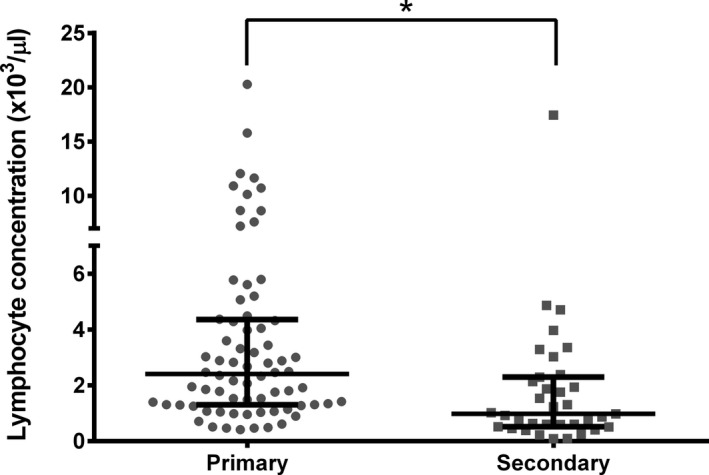
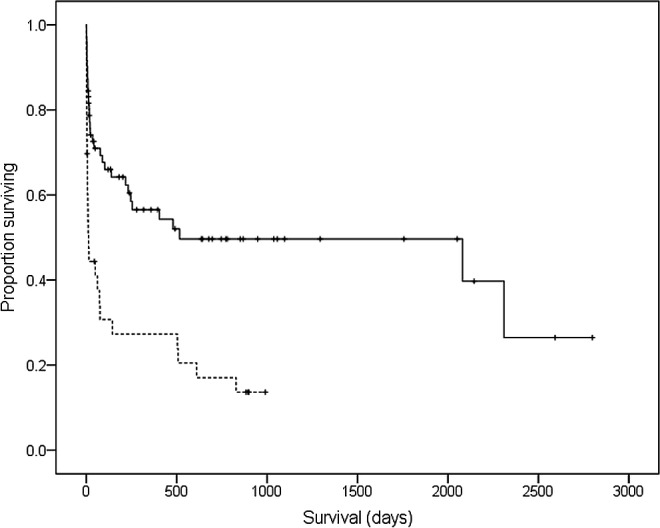
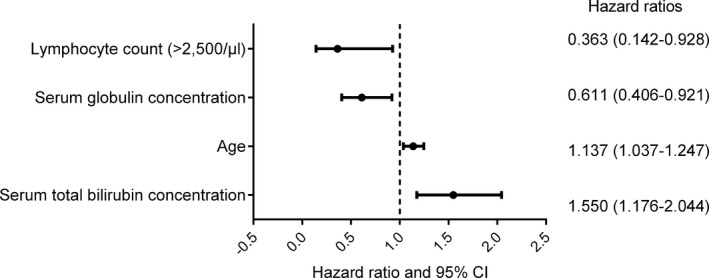
Results: No sex or breed predisposition was identified for the development of primary IMHA in comparison to the control cats, but cats in the age range 2.1-5.9 years were predisposed. Higher total bilirubin concentration and age were significant negative prognostic factors and higher lymphocyte numbers and serum globulin concentration were positive prognostic factors in a multivariable model.
Conclusions and clinical importance: Young adult cats were more likely to develop primary IMHA than other groups, but no apparent male predisposition was identified in this study, contrary to previous reports. Several prognostic factors were identified, which may be helpful in guiding clinical practice in the future.
Keywords: Autoimmunity; Bone marrow; Direct antiglobulin test; Hemolysis.
Copyright © 2015 The Authors. Journal of Veterinary Internal Medicine published by Wiley Periodicals, Inc. on behalf of the American College of Veterinary Internal Medicine.
Figures
Comment in
-
A retrospective review of cats with suspected false positive results in point-of-care feline leukemia virus tests and concurrent immune-mediated anemia.J Am Vet Med Assoc. 2023 May 30;261(10):1459-1465. doi: 10.2460/javma.23.02.0059. Print 2023 Oct 1. J Am Vet Med Assoc. 2023. PMID: 37257827
References
-
- Mitchell K, Kruth S. Immune‐mediated hemolytic anemia and other regenerative anemias In: Ettinger SJ, Feldman EC, eds. Textbook of Veterinary Internal Medicine, 7th ed St Louis: Saunders Elsevier; 2010:768–769.
-
- Lutz HU, Wipf G. Naturally occurring autoantibodies to skeletal proteins from human red blood cells. J Immunol 1982;128:1695–1699. - PubMed
-
- Barker RN, Elson CJ. Red cell‐reactive non‐specific immunoglobulins and autoantibodies in the sera of normal and anaemic dogs. Vet Immunol Immunopathol 1993;39:339–354. - PubMed
-
- Naik R. Warm autoimmune hemolytic anemia. Hematol Oncol Clin North Am 2015;29:445–453. - PubMed
-
- Scott DW, Schultz RD, Post JE, et al. Autoimmune hemolytic anemia in the cat. J Am Anim Hosp Assoc 1973;9:530–539.
MeSH terms
LinkOut - more resources
Full Text Sources
Other Literature Sources
Miscellaneous