


Survival among patients with advanced renal cell carcinoma in the pretargeted versus targeted therapy eras
- PMID: 26645975
- PMCID: PMC4735783
- DOI: 10.1002/cam4.574
Survival among patients with advanced renal cell carcinoma in the pretargeted versus targeted therapy eras
Abstract
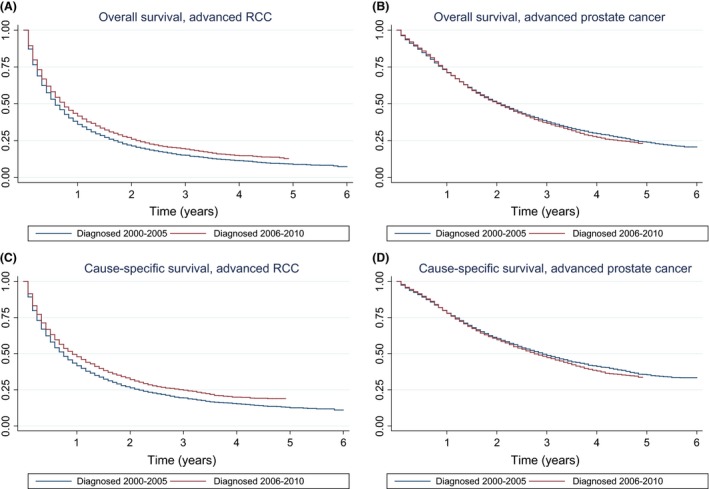
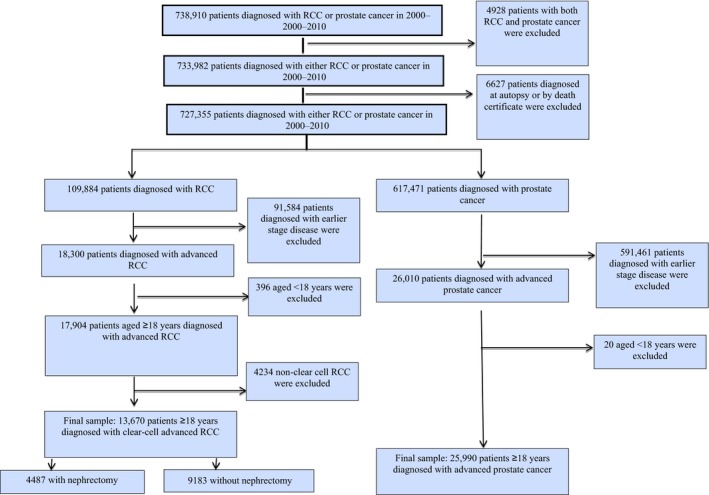
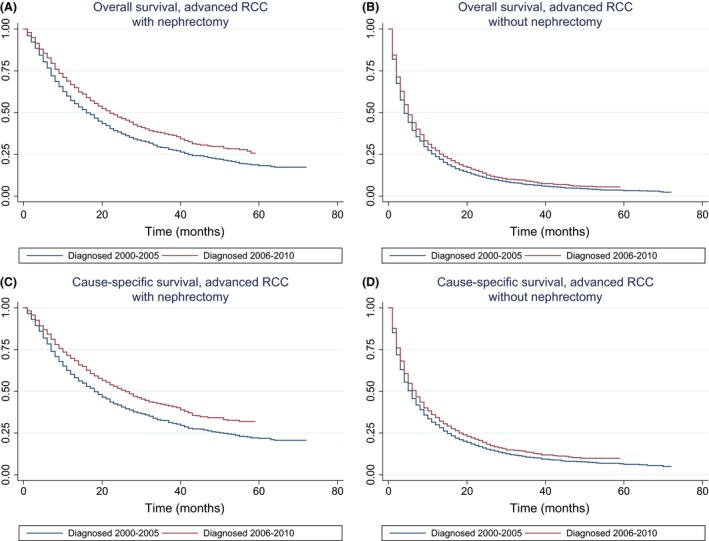
Between December 2005 and October 2009, FDA approved six targeted therapies shown to significantly extend survival for advanced renal cell carcinoma (RCC) patients in clinical trials. This study aimed to examine changes in survival between the pretargeted and targeted therapy periods in advanced RCC patients in a real-world setting. Utilizing the 2000-2010 SEER Research files, a pre-post study design with a contemporaneous comparison group was employed to examine differences in survival outcomes for patients diagnosed with advanced RCC (study group) or advanced prostate cancer (comparison group, for whom no significant treatment innovations happened during this period) across the pretargeted therapy era (2000-2005) and the targeted therapy era (2006-2010). RCC patients diagnosed in the targeted therapy era (N = 6439) showed improved survival compared to those diagnosed in the pretargeted therapy era (N = 7231, hazard ratio (HR) for all-cause death: 0.86, P < 0.01), while the change between the pre-post periods was not significant for advanced prostate cancer patients (HR: 0.97, P = 0.08). Advanced RCC patients had significantly larger improvements in overall survival compared to advanced prostate cancer patients (z = 4.31; P < 0.01). More detailed year-to-year analysis revealed greater survival improvements for RCC in the later years of the posttargeted period. Similar results were seen for cause-specific survival. Subgroup analyses by nephrectomy status, age, and gender showed consistent findings. Patients diagnosed with advanced RCC during the targeted therapy era had better survival outcomes than those diagnosed during the pretargeted therapy era. Future studies should examine the real-world survival improvements directly associated with targeted therapies.
Keywords: Advanced renal cell carcinoma; metastatic kidney cancer; population-based study; survival; targeted therapies.
© 2015 The Authors. Cancer Medicine published by John Wiley & Sons Ltd.
Figures
References
-
- American Cancer Society . Cancer facts and figures. Available at http://www.cancer.org/acs/groups/content/@research/documents/webcontent/... (accessed 28 July 2014).
-
- Jonasch, E. , Matin S. F., Pagliaro L. C., Wood C. G., Tannir N. M.. 2011. Renal cell carcinoma in Kantarjian H. M., Wolff R. A. and Koller C. A., eds. The MD Anderson Manual of Medical Oncology. McGraw‐Hill, New York, NY.
-
- Motzer, R. J. , Bander N. H., and Nanus D. M.. 1996. Renal‐cell carcinoma. N. Engl. J. Med. 335:865–875. - PubMed
-
- Garcia, J. A. , and Rini B. I.. 2007. Recent progress in the management of advanced renal cell carcinoma. CA Cancer J. Clin. 57:112–125. - PubMed
-
- Motzer, R. J. , Hutson T. E., Tomczak P., Michaelson M. D., Bukowski R. M., Rixe O., et al. 2007. Sunitinib versus interferon alfa in metastatic renal‐cell carcinoma. N. Engl. J. Med. 356:115–124. - PubMed
Publication types
MeSH terms
Grants and funding
LinkOut - more resources
Full Text Sources
Other Literature Sources
Medical
