. 2015 May 18:14:660-71.
doi: 10.17179/excli2015-240. eCollection 2015.

Protective role of taurine in developing offspring affected by maternal alcohol consumption

Affiliations

Protective role of taurine in developing offspring affected by maternal alcohol consumption

Pilant Ananchaipatana-Auitragoon et al. EXCLI J. .

Abstract

Maternal alcohol consumption is known to affect offspring growth and development, including growth deficits, physical anomalies, impaired brain functions and behavioral disturbances. Taurine, a sulfur-containing amino acid, is essential during development, and continually found to be protective against neurotoxicity and various tissue damages including those from alcohol exposure. However, it is still unknown whether taurine can exert its protection during development of central nervous system and whether it can reverse alcohol damages on developed brain later in life. This study aims to investigate protective roles of taurine against maternal alcohol consumption on growth and development of offspring. The experimental protocol was conducted using ICR-outbred pregnant mice given 10 % alcohol, with or without maternal taurine supplementation during gestation and lactation. Pregnancy outcomes, offspring mortality and successive bodyweight until adult were monitored. Adult offspring is supplemented taurine to verify its ability to reverse damages on learning and memory through a water maze task performance. Our results demonstrate that offspring of maternal alcohol exposure, together with maternal taurine supplementation show conserved learning and memory, while that of offspring treated taurine later in life are disturbed. Taurine provides neuroprotective effects and preserves learning and memory processes when given together with maternal alcohol consumption, but not shown such effects when given exclusively in offspring.

Keywords: development; learning; maternal alcohol; memory; taurine.


Figures
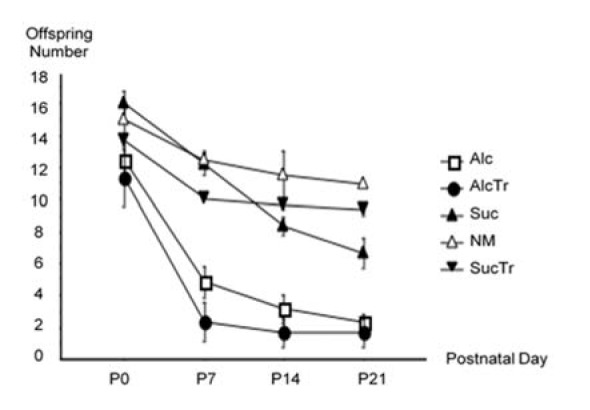
Figure 1
Figure 1. Offspring Survival Rates from Birth (P0) to Weaning (P21), comparison among NM, Suc, Alc, SucTr, and AlcTr groups (n = 3-6 mothers per study group).
Data demonstrated as mean ± SEM. ANOVA test revealed that survival rates of the groups examined were significantly different at p < 0.0001 when compared the groups: Alc and Suc, Alc and NM, AlcTr and Suc, AlcTr and NM, AlcTr and SucTr; and at p = 0.0001 when compared the groups of Alc and SucTr. NM = normal control group; Suc = Iso-caloric sucrose, pair-fed control group; Alc = maternal alcohol treated group; SucTr = Iso-caloric sucrose + maternal taurine supplementation, pair-fed control group; AlcTr = Maternal alcohol + maternal taurine supplementation group.
Figure 2
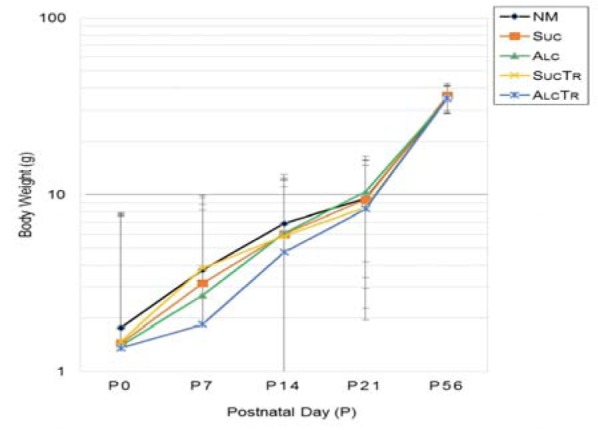
Figure 2. Offspring Successive Body Weight (in gram) from Birth (P0) to Adult (P56), comparison among NM, Suc, Alc, SucTr and AlcTr groups (n = 8-10).
Data demonstrated as mean ± SEM. NM = normal control group; Suc = Iso-caloric sucrose, pair-fed control group; Alc = maternal alcohol treated group; SucTr = Iso-caloric sucrose + maternal taurine supplementation, pair-fed control group; AlcTr = Maternal alcohol + maternal taurine supplementation group.
Figure 3
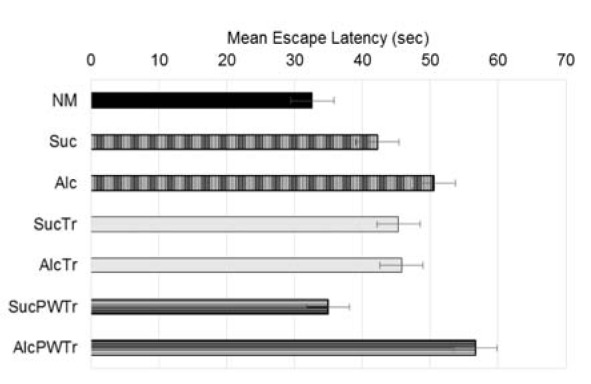
Figure 3. Mean Escape Latency (in second), comparison among NM, Suc, Alc, SucTr, AlcTr, SucPWTr and AlcPWTr groups (n = 6-8).
Data demonstrated as mean ± SEM. NM was able to escape within the shortest time (30.13 seconds). When compared among pair-fed groups, it was observed that offspring from AlcTr demonstrated similar time spent compared to pair-fed control (43.87 and 43.35 seconds, for AlcTr and SucTr, respectively). Offspring from Alc showed longer time spent to escape than Suc (48.84 and 40.17 seconds, for Alc and Suc, respectively). And AlcPWTr group also showed longer time spent to escape than pair-fed control (55.23 and 32.51 seconds, for AlcPWTr and SucPWTr, respectively). NM = normal control group; Alc = maternal alcohol treated group; Suc = Iso-caloric sucrose, pair-fed control group; AlcTr = Maternal alcohol + maternal taurine supplementation group; SucTr = Iso-caloric sucrose + maternal taurine supplementation, pair-fed control group; SucPWTr = Iso-caloric sucrose + post-wean offspring taurine supplementation, pair-fed control group; AlcPWTr = Maternal alcohol + post-wean offspring taurine supplementation group.
Figure 4
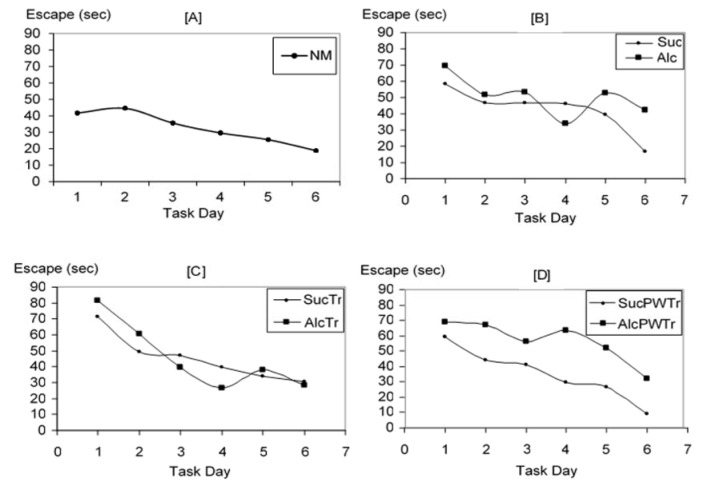
Figure 4. Learning Curves. [A] Illustrates normal learning curve. [B], [C], and [D] Illustrate pair-fed group comparison between Suc and Alc, SucTr and AlcTr, SucPWTr and AlcPWTr, respectively (n = 6-8).
Data demonstrated as means. NM = normal control group; Suc = Iso-caloric sucrose, pair-fed control group; Alc = maternal alcohol treated group; SucTr = Iso-caloric sucrose + maternal taurine supplementation, pair-fed control group; AlcTr = Maternal alcohol + maternal taurine supplementation group; SucPWTr = Iso-caloric sucrose + post-wean offspring taurine supplementation, pair-fed control group; AlcPWTr = Maternal alcohol + post-wean offspring taurine supplementation group.
Figure 5
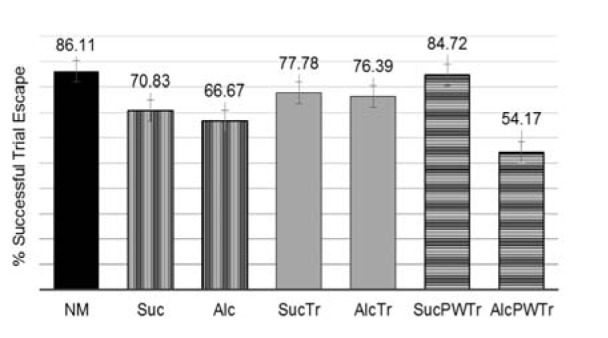
Figure 5. Mean Percentage of Overall Successful Trial Escape, comparison among NM, Suc, Alc, SucTr, AlcTr, SucPWTr and AlcPWTr, groups (n = 6-8).
Data demonstrated as mean ± SEM. When analyzed using ANOVA analysis per trials, there was a level of significant difference among trials at p = 0.0001. When analyzed the percentage of escapes among all groups investigated, it was found that they were significantly different at p = 0.0001. NM = normal control group; Suc = Iso-caloric sucrose, pair-fed control group; Alc = maternal alcohol treated group; SucTr = Iso-caloric sucrose + maternal taurine supplementation, pair-fed control group; AlcTr = Maternal alcohol + maternal taurine supplementation group; SucPWTr = Iso-caloric sucrose + post-wean offspring taurine supplementation, pair-fed control group; AlcPWTr = Maternal alcohol + post-wean offspring taurine supplementation group.

References

    1. Aragon C, Trudeau L, Amit Z. Effect of taurine on ethanol-induced changes in open-field locomotor activity. Psychopharmacology. 1992;107:337–340. - PubMed
    1. Chen JH. Maternal alcohol use during pregnancy, birth weight and early behavioral outcomes. Alcohol Alcohol. 2012;47:649–656. - PubMed
    1. Clement KM, Girard TA, Ellard CG, Wainwright PE. Short-term memory impairment and reduced hippocampal c-Fos expression in an animal model of fetal alcohol syndrome. Alcoholism. 2005;29:1049–1059. - PubMed
    1. Devi SL, Viswanathan P, Anuradha CV. Taurine enhances the metabolism and detoxification of ethanol and prevents hepatic fibrosis in rats treated with iron and alcohol. Environ Toxicol Pharmacol. 2009;27:120–126. - PubMed
    1. El Idrissi A, Boukarrou L, Dokin C, Brown W. Taurine improves congestive functions in a mouse model of fragile x syndrome. Adv Exp Med Biol. 2009;643:191–198. - PubMed

LinkOut - more resources