Review
. 2016 Mar;73(5):949-60.
doi: 10.1007/s00018-015-2096-7. Epub 2015 Dec 9.

Controlling the response to DNA damage by the APC/C-Cdh1

Affiliations
Review

Controlling the response to DNA damage by the APC/C-Cdh1

H Rudolf de Boer et al. Cell Mol Life Sci. 2016 Mar.

Erratum in

Abstract

Proper cell cycle progression is safeguarded by the oscillating activities of cyclin/cyclin-dependent kinase complexes. An important player in the regulation of mitotic cyclins is the anaphase-promoting complex/cyclosome (APC/C), a multi-subunit E3 ubiquitin ligase. Prior to entry into mitosis, the APC/C remains inactive, which allows the accumulation of mitotic regulators. APC/C activation requires binding to either the Cdc20 or Cdh1 adaptor protein, which sequentially bind the APC/C and facilitate targeting of multiple mitotic regulators for proteasomal destruction, including Securin and Cyclin B, to ensure proper chromosome segregation and mitotic exit. Emerging data have indicated that the APC/C, particularly in association with Cdh1, also functions prior to mitotic entry. Specifically, the APC/C-Cdh1 is activated in response to DNA damage in G2 phase cells. These observations are in line with in vitro and in vivo genetic studies, in which cells lacking Cdh1 expression display various defects, including impaired DNA repair and aberrant cell cycle checkpoints. In this review, we summarize the current literature on APC/C regulation in response to DNA damage, the functions of APC/C-Cdh1 activation upon DNA damage, and speculate how APC/C-Cdh1 can control cell fate in the context of persistent DNA damage.

Keywords: Cell cycle; Checkpoint; Cyclosome; DNA damage; E3 ligase.


Figures
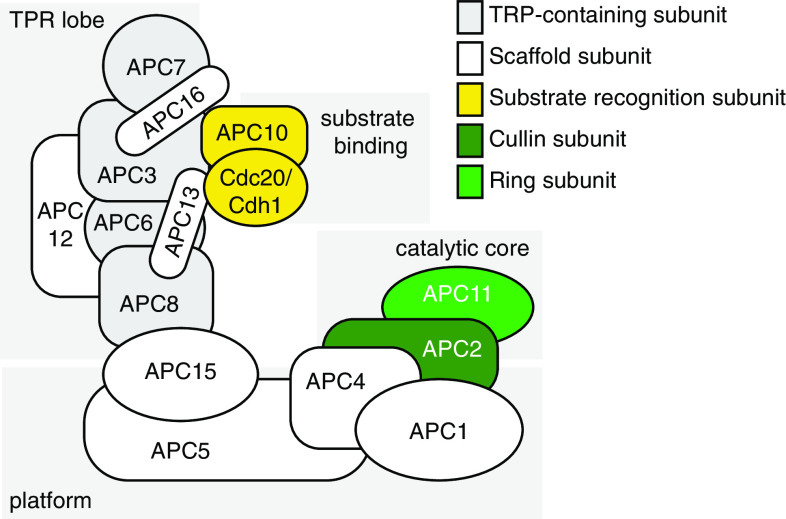
Fig. 1
Fig. 1
The molecular composition of the APC/C. The subunits of the mammalian APC/C are indicated. APC3, APC6, APC7, and APC8 contain tetracopeptide-repeat (TPR) domains, and together with APC12 for the TPR lobe. APC1, APC4, and APC5 form the ‘platform’ domain of the APC/C. The catalytic core is composed of APC11 (Ring) and APC2 (Cullin). APC10 together with one the co-activators Cdc20/Cdh1 forms the degron-recognition domain
Fig. 2
Fig. 2
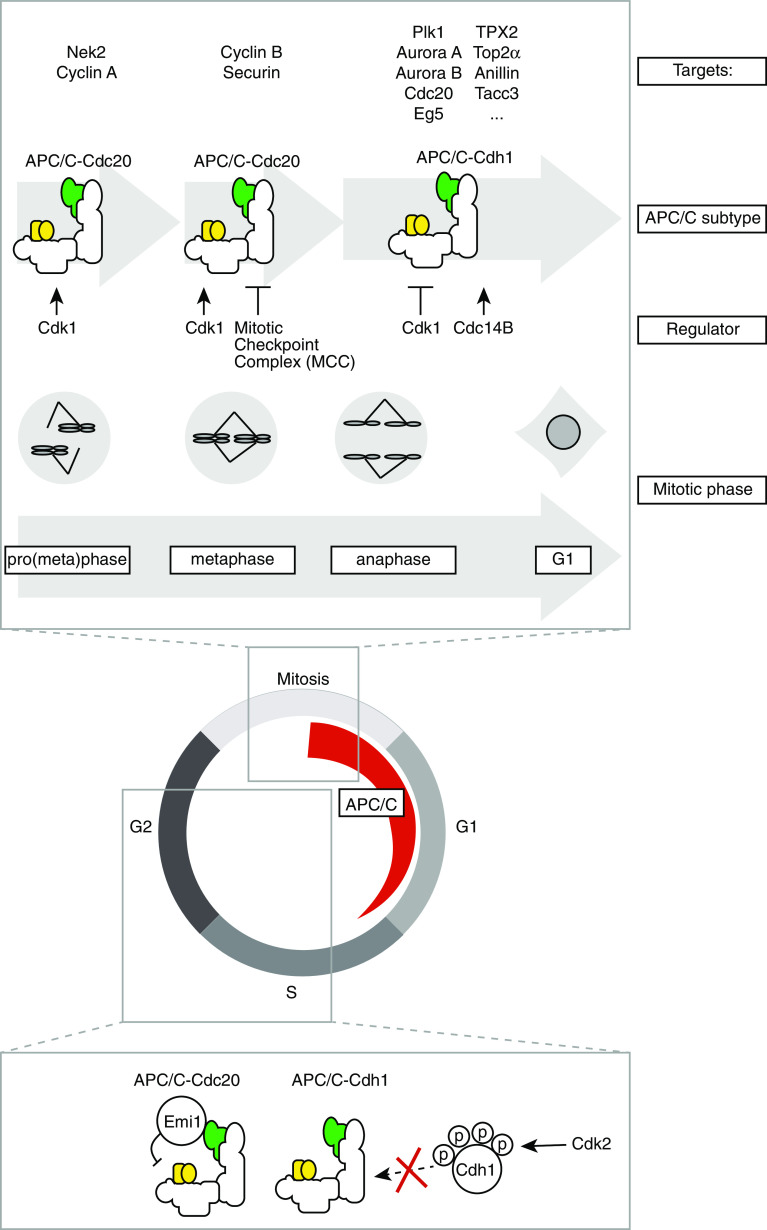
Three waves of APC/C activation during mitosis. The APC/C is activated during mitosis and remains active up until G1 phase. Three independent waves of APC/C activity can be distinguished. 1 APC/C-Cdc20 activity during prometaphase, which is unaffected by the spindle checkpoint, 2 APC/C-Cdc20 activity in metaphase, which is under control of the spindle checkpoint, 3 APC/C-Cdh1 activity, which commences during anaphase onset. Identified substrates of each of the APC/C entities are indicated. Interphase activation of the APC/C is precluded by Emi1 and Cdk2-mediated phosphorylation of Cdh1
Fig. 3
Fig. 3
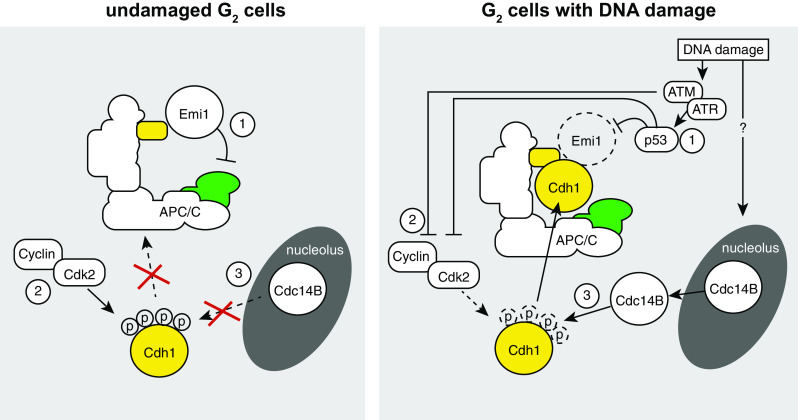
Roles of the APC/C-Cdh1 in response to DNA damage. During an unperturbed interphase, the APC/C is not active due to 1 binding of Emi1, 2 phosphorylation of Cdh1 by Cdk2, and 3 the inability of Cdc14B to dephosphorylate Cdh1. In response to DNA damage in G2 cells, 1 the DDR kinases ATM and ATR mediate activation of p53, which leads to Emi1 down-regulation. 2 ATM/ATR and p53 inactivate Cdk2 activity, and 3 Cdc14B is released from the nucleolus through unknown mechanisms. Combined, these mechanisms lead to activation of the APC/C-Cdh1
Fig. 4
Fig. 4
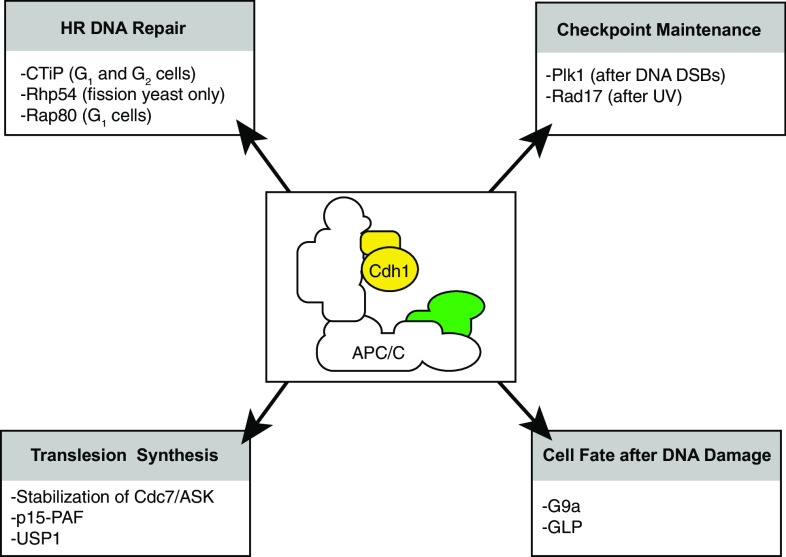
Functions of the APC/C-Cdh1 in situations of DNA damage. Different functions of the APC/C-Cdh1 and its targets are illustrated

References

    1. Mailand N, Falck J, Lukas C, et al. Rapid destruction of human Cdc25A in response to DNA damage. Science (New York, NY) 2000;288:1425–1429. doi: 10.1126/science.288.5470.1425. - DOI - PubMed
    1. Sørensen CS, Syljuåsen RG, Falck J, et al. Chk1 regulates the S phase checkpoint by coupling the physiological turnover and ionizing radiation-induced accelerated proteolysis of Cdc25A. Cancer Cell. 2003;3:247–258. doi: 10.1016/S1535-6108(03)00048-5. - DOI - PubMed
    1. Guo Z, Kumagai A, Wang SX, Dunphy WG. Requirement for Atr in phosphorylation of Chk1 and cell cycle regulation in response to DNA replication blocks and UV-damaged DNA in Xenopus egg extracts. Genes Dev. 2000;14:2745–2756. doi: 10.1101/gad.842500. - DOI - PMC - PubMed
    1. Liu Q, Guntuku S, Cui XS, et al. Chk1 is an essential kinase that is regulated by Atr and required for the G(2)/M DNA damage checkpoint. Genes Dev. 2000;14:1448–1459. doi: 10.1101/gad.840500. - DOI - PMC - PubMed
    1. Lukas C, Falck J, Bartkova J, et al. Distinct spatiotemporal dynamics of mammalian checkpoint regulators induced by DNA damage. Nat Cell Biol. 2003;5:255–260. doi: 10.1038/ncb945. - DOI - PubMed

Publication types

Substances

LinkOut - more resources