


Screen detection of ductal carcinoma in situ and subsequent incidence of invasive interval breast cancers: a retrospective population-based study
- PMID: 26655422
- PMCID: PMC4691349
- DOI: 10.1016/S1470-2045(15)00446-5
Screen detection of ductal carcinoma in situ and subsequent incidence of invasive interval breast cancers: a retrospective population-based study
Erratum in
-
Correction to Lancet Oncol 2016; 17: 109. Screen detection of ductal carcinoma in situ and subsequent incidence of invasive interval breast cancers: a retrospective population-based study.Lancet Oncol. 2016 Feb;17(2):e46. doi: 10.1016/S1470-2045(16)00021-8. Lancet Oncol. 2016. PMID: 26868353 Free PMC article. No abstract available.
Abstract
Background: The value of screen detection and treatment of ductal carcinoma in situ (DCIS) is a matter of controversy. At present, the extent to which the diagnosis and treatment of DCIS could prevent the occurrence of invasive breast cancer in the future is not clear. We sought to estimate the association between detection of DCIS at screening and invasive interval cancers subsequent to the relevant screen.
Methods: We obtained aggregate data for screen-detected cancers from 84 local screening units within 11 regional Quality Assurance Reference Centres in England, Wales, and Northern Ireland from the National Health Service Breast Screening Programme. Data for DCIS diagnoses were obtained for women aged 50-64 years who were invited to and attended mammographic breast screening from April 1, 2003, to March 31, 2007 (4 screening years). Patient-level data for interval cancer arising in the 36 months after each of these were analysed by Poisson regression with invasive interval cancer screen detection rate as the outcome variable; DCIS detection frequencies were fitted first as a continuous and then as a categorical variable. We repeated this analysis after adjustment with both small size and high-grade invasive screen-detected cancers.
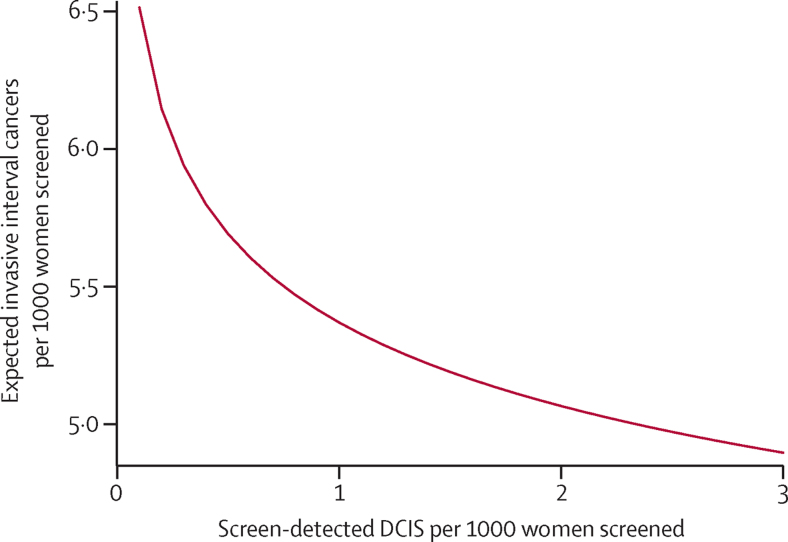
Findings: We analysed data for 5,243,658 women and on interval cancers occurring in the 36 months after the relevant screen. The average frequency of DCIS detected at screening was 1·60 per 1000 women screened (median 1·50 [unit range 0·54-3·56] [corrected to] per 1000 women). There was a significant negative association of screen-detected DCIS cases with the rate of invasive interval cancers (Poisson regression coefficient -0·084 [95% CI -0·13 to -0·03]; p=0·002). 90% of units had a DCIS detection frequency within the range of 1·00 to 2·22 per 1000 women; in these units, for every three screen-detected cases of DCIS, there was one fewer invasive interval cancer in the next 3 years. This association remained after adjustment for numbers of small screen-detected invasive cancers and for numbers of grade 3 invasive screen-detected cancers.
Interpretation: The association between screen-detected DCIS and subsequent invasive interval cancers suggests that detection and treatment of DCIS is worthwhile in prevention of future invasive disease.
Funding: UK Department of Health Policy Research Programme and NHS Cancer Screening Programmes.
Copyright © 2016 Duffy et al. Open Access article distributed under the terms of CC BY. Published by Elsevier Ltd.. All rights reserved.
Figures
Comment in
-
Screening for early breast cancer reduces invasive cancer, study finds.BMJ. 2015 Dec 6;351:h6576. doi: 10.1136/bmj.h6576. BMJ. 2015. PMID: 26643040 No abstract available.
-
Detection of DCIS and reduced invasive interval cancers.Lancet Oncol. 2016 Jan;17(1):14-5. doi: 10.1016/S1470-2045(15)00481-7. Epub 2015 Dec 5. Lancet Oncol. 2016. PMID: 26655426 No abstract available.
-
Detection of ductal carcinoma in situ and subsequent interval cancers.BMJ. 2016 Feb 1;352:i551. doi: 10.1136/bmj.i551. BMJ. 2016. PMID: 26834245 No abstract available.
-
DCIS and invasive interval breast cancer.Lancet Oncol. 2016 Mar;17(3):e87-e88. doi: 10.1016/S1470-2045(16)00023-1. Epub 2016 Mar 2. Lancet Oncol. 2016. PMID: 26972859 No abstract available.
-
DCIS and invasive interval breast cancer.Lancet Oncol. 2016 Mar;17(3):e87. doi: 10.1016/S1470-2045(15)00624-5. Epub 2016 Mar 2. Lancet Oncol. 2016. PMID: 26972860 No abstract available.
-
DCIS and invasive interval breast cancer - Author's reply.Lancet Oncol. 2016 Mar;17(3):e88-e89. doi: 10.1016/S1470-2045(16)00104-2. Epub 2016 Mar 2. Lancet Oncol. 2016. PMID: 26972861 No abstract available.
References
-
- Ernster VL, Barclay J, Kerlikowske K, Grady D, Henderson C. Incidence of and treatment for ductal carcinoma in situ of the breast. JAMA. 1996;275:913–918. - PubMed
-
- Paci E, Warwick J, Falini P, Duffy SW. Overdiagnosis in screening: is the increase in breast cancer incidence rates a cause for concern? J Med Screen. 2004;11:23–27. - PubMed
-
- Yen MF, Tabar L, Vitak B, Smith RA, Chen HH, Duffy SW. Quantifying the potential problem of overdiagnosis of ductal carcinoma in situ in breast cancer screening. Eur J Cancer. 2003;39:1746–1754. - PubMed
-
- Allegra CJ, Aberle DR, Ganschow P. National Institutes of Health State-of-the-Science Conference statement: Diagnosis and Management of Ductal Carcinoma In Situ September 22–24, 2009. J Natl Cancer Inst. 2010;102:161–169. - PubMed
Publication types
MeSH terms
Grants and funding
LinkOut - more resources
Full Text Sources
Other Literature Sources
Medical
Miscellaneous
