. 2015 Dec 12;6(2):377-90.
doi: 10.1534/g3.115.023044.

Genetic Mapping of Resistance to Meloidogyne arenaria in Arachis stenosperma: A New Source of Nematode Resistance for Peanut

Affiliations

Genetic Mapping of Resistance to Meloidogyne arenaria in Arachis stenosperma: A New Source of Nematode Resistance for Peanut

Soraya C M Leal-Bertioli et al. G3 (Bethesda). .

Abstract

Root-knot nematodes (RKN; Meloidogyne sp.) are a major threat to crops in tropical and subtropical regions worldwide. The use of resistant crop varieties is the preferred method of control because nematicides are expensive, and hazardous to humans and the environment. Peanut (Arachis hypogaea) is infected by four species of RKN, the most damaging being M. arenaria, and commercial cultivars rely on a single source of resistance. In this study, we genetically characterize RKN resistance of the wild Arachis species A. stenosperma using a population of 93 recombinant inbred lines developed from a cross between A. duranensis and A. stenosperma. Four quantitative trait loci (QTL) located on linkage groups 02, 04, and 09 strongly influenced nematode root galling and egg production. Drought-related, domestication and agronomically relevant traits were also evaluated, revealing several QTL. Using the newly available Arachis genome sequence, easy-to-use KASP (kompetitive allele specific PCR) markers linked to the newly identified RKN resistance loci were developed and validated in a tetraploid context. Therefore, we consider that A. stenosperma has high potential as a new source of RKN resistance in peanut breeding programs.

Keywords: Arachis; QTL; drought; introgression; marker-assisted selection; peanut; root-knot nematode resistance; yield.


Figures

Figure 1
Figure 1
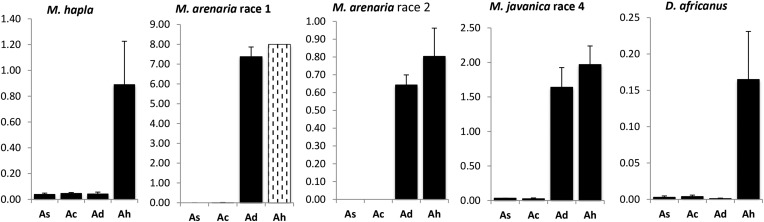
Reproductive factor of the nematodes Meloidogyne hapla, M. arenaria race 1, M. arenaria race 2, M. javanica race 4 and Ditylenchus africanus, observed in A. stenosperma (As), A. cardenasii (Ac), A. duranensis (Ad), and A. hypogaea cv. IAC Tatu (Ah). White bar with dashed vertical lines represents minimum expected RF of peanut plants that, due to heavy infestation, died before the end of the experiment.
Figure 2
Figure 2
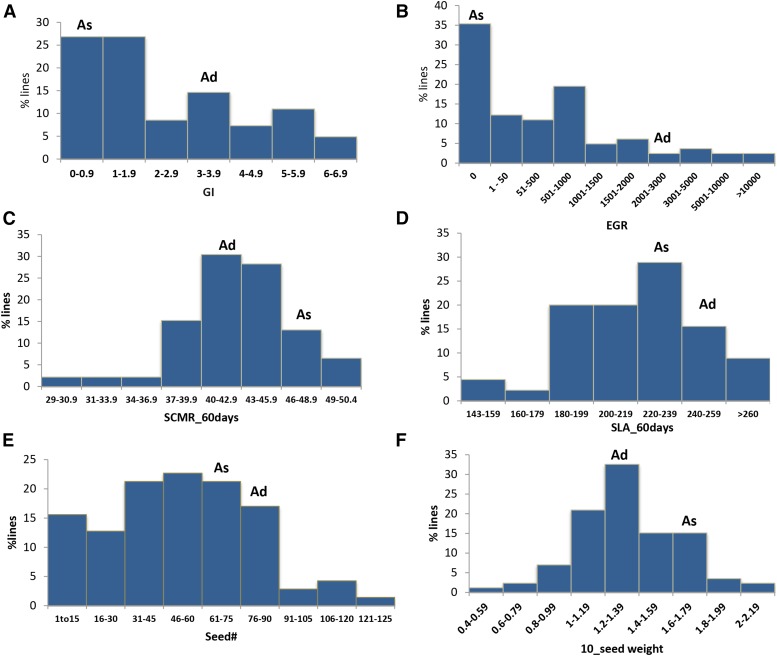
Frequency distribution of resistance to Meloidogyne arenaria race 1 (A–B), drought-related traits (C–D), and yield traits (E–F) in recombinant inbred lines (F6) derived from a cross of A. duranensis K7988 (Ad) with A. stenosperma V10309 (As). The means of the parents are significantly different (P < 0.05).
Figure 3
Figure 3
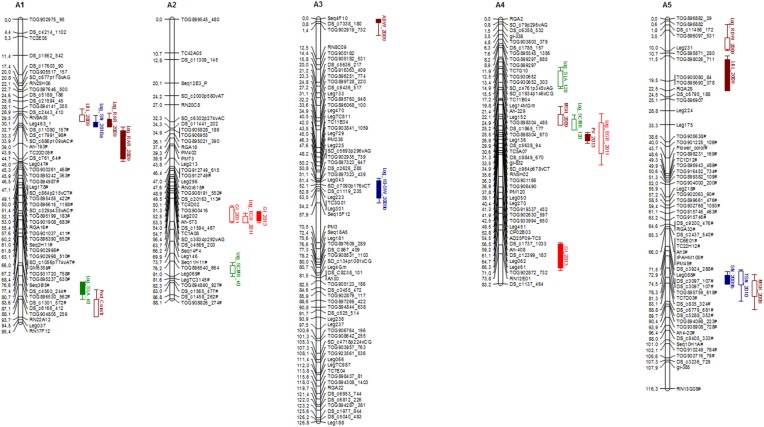
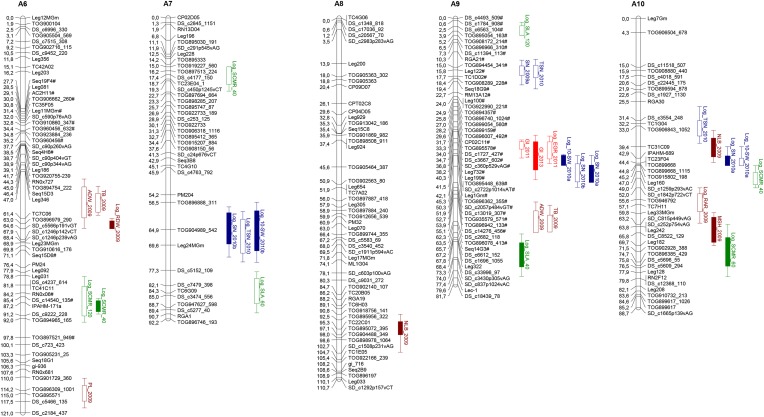
A genetic linkage map of the A-genome of Arachis obtained through the analysis of 90 F6 plants, generated from a cross between A. duranensis K7988 and A. stenosperma V10309. Numbers on the left of each group are Kosambi map distances (cM). QTL are indicated as colored bars running alongside linkage groups. Colors/textures are according to categories: red, nematode resistance; green, drought-related traits; blue, productivity; and brown, domestication and other agronomic traits. Distorted markers at P < 0.05 were identified by #.
Figure 3
Figure 3
A genetic linkage map of the A-genome of Arachis obtained through the analysis of 90 F6 plants, generated from a cross between A. duranensis K7988 and A. stenosperma V10309. Numbers on the left of each group are Kosambi map distances (cM). QTL are indicated as colored bars running alongside linkage groups. Colors/textures are according to categories: red, nematode resistance; green, drought-related traits; blue, productivity; and brown, domestication and other agronomic traits. Distorted markers at P < 0.05 were identified by #.
Figure 4
Figure 4
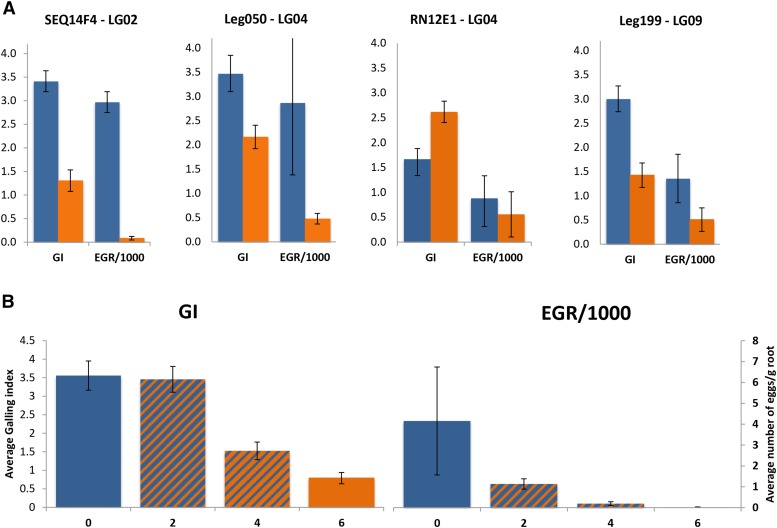
(A) Effect of QTL-linked markers for galling index (GI) and nematode egg production (EGR/1000) on mean phenotypic value (± SE). The markers are distributed on three different linkage groups: Seq14F4 - LG02, Leg050 and RN12E1 – LG04 and Leg199 - LG09. (B) Effect of combination of QTL based on genotypic classes carrying zero to six A. stenosperma favorable alleles Seq14F4, Leg050 and Leg199.
Figure 5
Figure 5
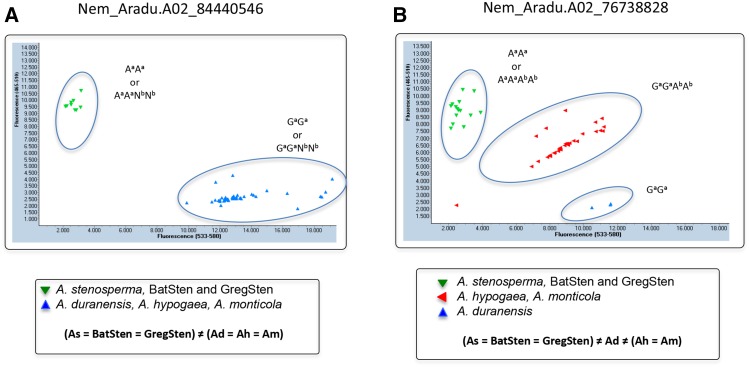
Screenshots of two examples of Arachis A-genome SNP genotyping using KASP assays. Both assays (Nem_Aradu.A02_84440546 and Nem_Aradu.A02_76738828) show differentiationcbetween A. duranensis V14167 and the A-genome of A. hypogaea from the wild species A. stenosperma V10309, and the induced allotetraploids BatSten and GregSten. In (A), two clusters are present: one with A. duranensis, A. monticola and all A. hypogaea cultivars, and another with A. stenosperma and induced allotetraploids [noted in Table 1 as (As = BatSten = GregSten) ≠ (Ad = Ah = Am)]. In (B), three clusters are present, with an intermediate cluster of A. hypogaea and A. monticola [noted in Table 1 as (As = BatSten = GregSten) ≠ Ad ≠ (Ah =Am)]. Diploid and tetraploid genotypes are indicated near each cluster. A and G refer to the DNA bases; the subscript letters refer to the A and B subcomponent genomes of peanut. N is used when B subgenome bases are not detected.

Similar articles

Cited by

References

    1. Bertioli D., Moretzsohn M., Madsen L., Sandal N., Leal-Bertioli S., et al. , 2009. An analysis of synteny of Arachis with Lotus and Medicago sheds new light on the structure, stability and evolution of legume genomes. BMC Genomics 10(1): 45. - PMC - PubMed
    1. Bertioli, D.J., P. Ozias-Akins, Y. Chu, K.M. Dantas, S.P. Santos et al., 2014 The use of SNP markers for linkage mapping in diploid and tetraploid peanuts. G3 (Bethesda) 4(1):89–96. - PMC - PubMed
    1. Bridge J., Page S. L. J., 1980. Estimation of root-knot nematode infestation levels on roots using a rating chart. Trop. Pest Manage. 26: 296–298.
    1. Burow M., Simpson C., Starr J., Paterson A., 2014. Transmission genetics of chromatin from a synthetic amphidiploid to cultivated peanut (Arachis hypogaea L.). broadening the gene pool of a monophyletic polyploid species. Genetics 159(2): 823–837. - PMC - PubMed
    1. Caillaud M. C., Dubreuil G., Quentin M., Perfus-Barbeoch L., Lecomte P., et al. , 2008. Root-knot nematodes manipulate plant cell functions during a compatible interaction. J. Plant Physiol. 165(1): 104–113. - PubMed

Publication types

Substances