


Interleaved Processors Improve Cochlear Implant Patients' Spectral Resolution
- PMID: 26656190
- PMCID: PMC4767634
- DOI: 10.1097/AUD.0000000000000249
Interleaved Processors Improve Cochlear Implant Patients' Spectral Resolution
Abstract
Objective: Cochlear implant patients have difficulty in noisy environments, in part, because of channel interaction. Interleaving the signal by sending every other channel to the opposite ear has the potential to reduce channel interaction by increasing the space between channels in each ear. Interleaving still potentially provides the same amount of spectral information when the two ears are combined. Although this method has been successful in other populations such as hearing aid users, interleaving with cochlear implant patients has not yielded consistent benefits. This may be because perceptual misalignment between the two ears, and the spacing between stimulation locations must be taken into account before interleaving.
Design: Eight bilateral cochlear implant users were tested. After perceptually aligning the two ears, 12-channel maps were made that spanned the entire aligned portions of the array. Interleaved maps were created by removing every other channel from each ear. Participants' spectral resolution and localization abilities were measured with perceptually aligned processing strategies both with and without interleaving.
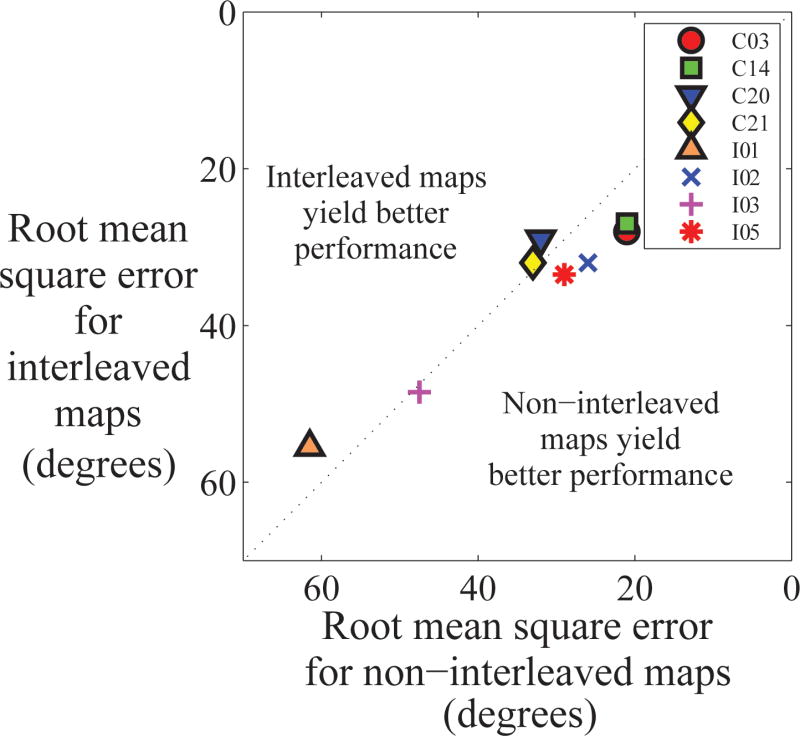
Results: There was a significant improvement in spectral resolution with interleaving. However, there was no significant effect of interleaving on localization abilities.
Conclusions: The results indicate that interleaving can improve cochlear implant users' spectral resolution. However, it may be necessary to perceptually align the two ears and/or use relatively large spacing between stimulation locations.
Figures

References
Publication types
MeSH terms
Grants and funding
- R03-DC013380/DC/NIDCD NIH HHS/United States
- R01-DC004993/DC/NIDCD NIH HHS/United States
- R01 DC001526/DC/NIDCD NIH HHS/United States
- R01-DC001526/DC/NIDCD NIH HHS/United States
- R03-DC010064/DC/NIDCD NIH HHS/United States
- R01-DC12152/DC/NIDCD NIH HHS/United States
- T32DC009975/DC/NIDCD NIH HHS/United States
- R01 DC004993/DC/NIDCD NIH HHS/United States
- T32 DC009975/DC/NIDCD NIH HHS/United States
- R01 DC012152/DC/NIDCD NIH HHS/United States
- R03 DC013380/DC/NIDCD NIH HHS/United States
- R03 DC010064/DC/NIDCD NIH HHS/United States
LinkOut - more resources
Full Text Sources
Other Literature Sources
Medical
