


Hlf is a genetic modifier of epilepsy caused by voltage-gated sodium channel mutations
- PMID: 26656780
- PMCID: PMC4698075
- DOI: 10.1016/j.eplepsyres.2015.11.016
Hlf is a genetic modifier of epilepsy caused by voltage-gated sodium channel mutations
Abstract
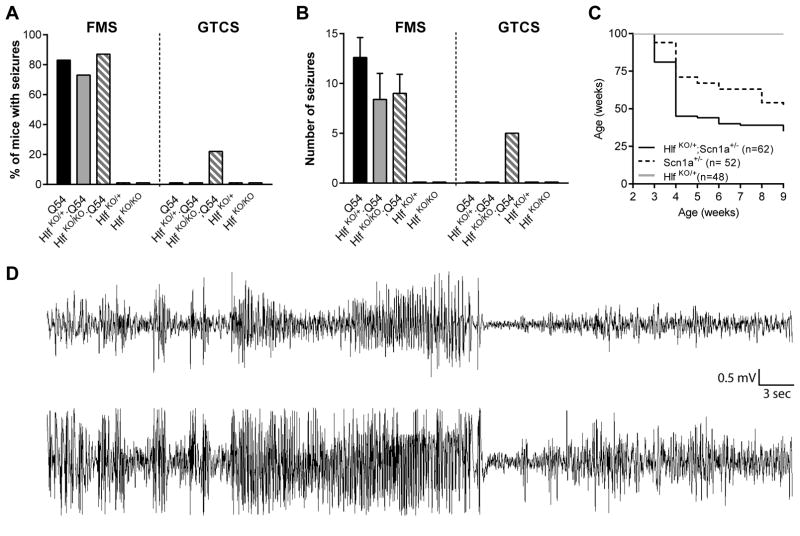
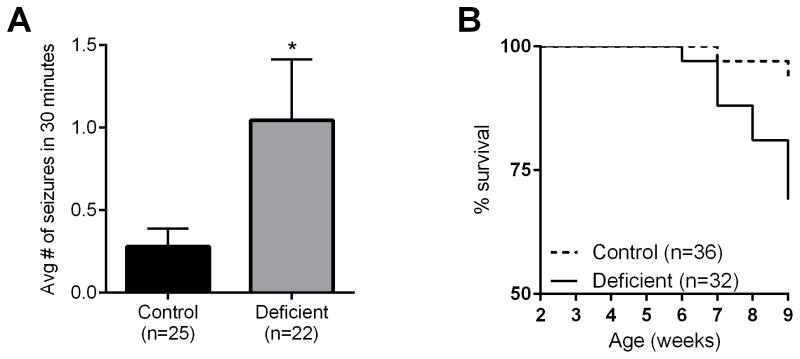
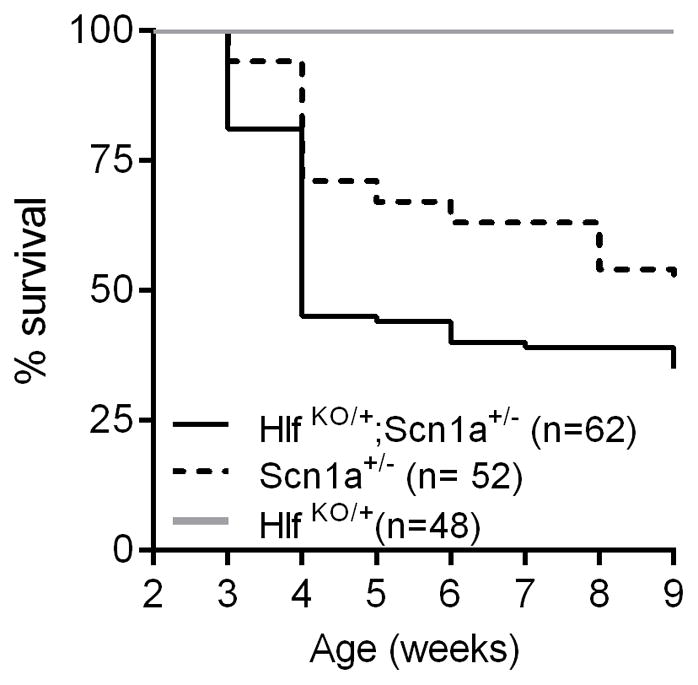
Mutations in voltage-gated sodium channel genes cause several types of human epilepsies. Often, individuals with the same sodium channel mutation exhibit diverse phenotypes. This suggests that factors beyond the primary mutation influence disease severity, including genetic modifiers. Mouse epilepsy models with voltage-gated sodium channel mutations exhibit strain-dependent phenotype variability, supporting a contribution of genetic modifiers in epilepsy. The Scn2a(Q54) (Q54) mouse model has a strain-dependent epilepsy phenotype. Q54 mice on the C57BL/6J (B6) strain exhibit delayed seizure onset and improved survival compared to [B6xSJL/J]F1.Q54 mice. We previously mapped two dominant modifier loci that influence Q54 seizure susceptibility and identified Hlf (hepatic leukemia factor) as a candidate modifier gene at one locus. Hlf and other PAR bZIP transcription factors had previously been associated with spontaneous seizures in mice thought to be caused by down-regulation of the pyridoxine pathway. An Hlf targeted knockout mouse model was used to evaluate the effect of Hlf deletion on Q54 phenotype severity. Hlf(KO/KO);Q54 double mutant mice exhibited elevated frequency and reduced survival compared to Q54 controls. To determine if direct modulation of the pyridoxine pathway could alter the Q54 phenotype, mice were maintained on a pyridoxine-deficient diet for 6 weeks. Dietary pyridoxine deficiency resulted in elevated seizure frequency and decreased survival in Q54 mice compared to control diet. To determine if Hlf could modify other epilepsies, Hlf(KO/+) mice were crossed with the Scn1a(KO/+) Dravet syndrome mouse model to examine the effect on premature lethality. Hlf(KO/+);Scn1a(KO/+) offspring exhibited decreased survival compared to Scn1a(KO/+) controls. Together these results demonstrate that Hlf is a genetic modifier of epilepsy caused by voltage-gated sodium channel mutations and that modulation of the pyridoxine pathway can also influence phenotype severity.
Keywords: Epilepsy; Genetics; Mouse model; Seizure; Voltage-gated sodium channel.
Copyright © 2015 Elsevier B.V. All rights reserved.
Figures
References
-
- Bergren SK, Chen S, Galecki A, Kearney JA. Genetic modifiers affecting severity of epilepsy caused by mutation of sodium channel Scn2a. Mamm Genome. 2005;16:683–690. - PubMed
Publication types
MeSH terms
Substances
Grants and funding
LinkOut - more resources
Full Text Sources
Other Literature Sources
Medical
Molecular Biology Databases
Research Materials
