. 2016 Jan 8;44(1):294-303.
doi: 10.1093/nar/gkv1379. Epub 2015 Dec 10.

Temperature dependent mistranslation in a hyperthermophile adapts proteins to lower temperatures

Affiliations

Temperature dependent mistranslation in a hyperthermophile adapts proteins to lower temperatures

Michael H Schwartz et al. Nucleic Acids Res. .

Abstract

All organisms universally encode, synthesize and utilize proteins that function optimally within a subset of growth conditions. While healthy cells are thought to maintain high translational fidelity within their natural habitats, natural environments can easily fluctuate outside the optimal functional range of genetically encoded proteins. The hyperthermophilic archaeon Aeropyrum pernix (A. pernix) can grow throughout temperature variations ranging from 70 to 100°C, although the specific factors facilitating such adaptability are unknown. Here, we show that A. pernix undergoes constitutive leucine to methionine mistranslation at low growth temperatures. Low-temperature mistranslation is facilitated by the misacylation of tRNA(Leu) with methionine by the methionyl-tRNA synthetase (MetRS). At low growth temperatures, the A. pernix MetRS undergoes a temperature dependent shift in tRNA charging fidelity, allowing the enzyme to conditionally charge tRNA(Leu) with methionine. We demonstrate enhanced low-temperature activity for A. pernix citrate synthase that is synthesized during leucine to methionine mistranslation at low-temperature growth compared to its high-fidelity counterpart synthesized at high-temperature. Our results show that conditional leucine to methionine mistranslation can make protein adjustments capable of improving the low-temperature activity of hyperthermophilic proteins, likely by facilitating the increasing flexibility required for greater protein function at lower physiological temperatures.


Figures

Figure 1.
Figure 1.
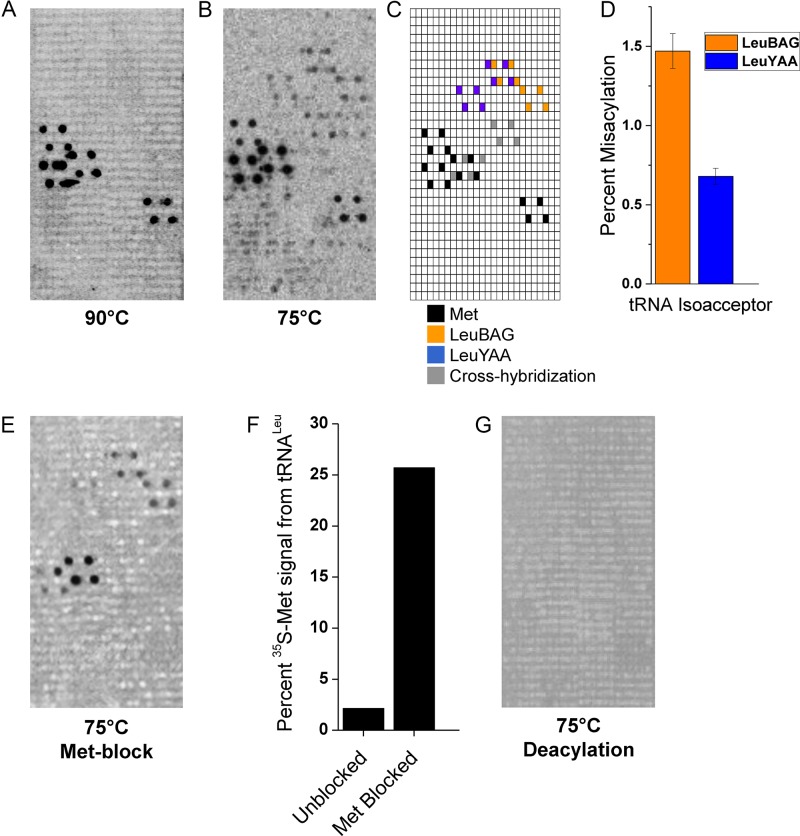
Mistranslation in A. pernix occurs during low-temperature growth. (A) tRNA microarray showing high-fidelity tRNA charging with Met during growth at 90°C. (B) tRNA microarray showing tRNALeu misacylation with Met during growth at 75°C. (C) Array map showing locations of relevant tRNA probes. (D) Quantification of tRNALeu misacylation from panel B as a percent of tRNAMet signal. (E) tRNA microarray excluding the possibility of Met-tRNA cross-hybridization to Leu probes through addition of free Met probes in hybridization mixture. (F) Quantification of Met blocked panel E and unblocked panel B showing the intensity of tRNALeu signal relative to tRNAMet signal. (G) tRNA microarray excluding the possibility of signal emanating from tRNA thiomodifications by chemical deacylation of charged tRNA prior to array hybridization.
Figure 2.
Figure 2.
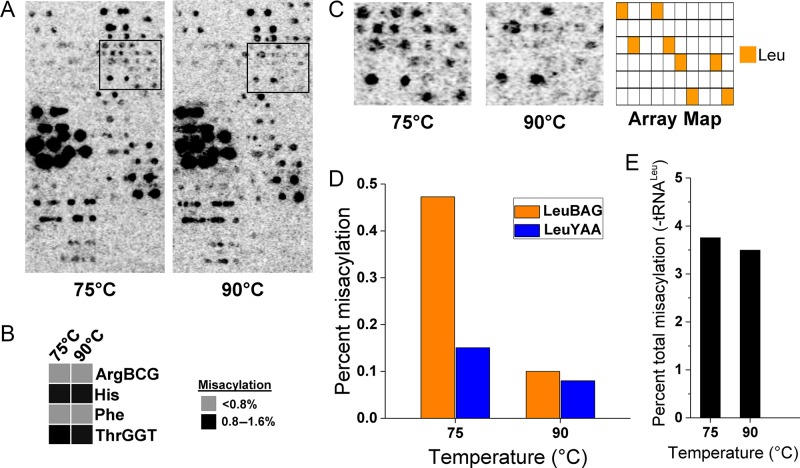
A. pernix methionine tRNA synthetase misacylates tRNALeu at lower temperatures. (A) tRNA microarrays showing tRNAs charged with Met by the recombinant A. pernix MetRS in vitro at 75°C and 90°C. (B) Quantification of in vitro misacylation to individual nonMet-tRNAs not observed in vivo as a percent of tRNAMet signal from panel A. (C) Zoomed array section from panel A showing probes for tRNALeu. (D) Quantification of in vitro tRNALeu misacylation as a percent of tRNAMet signal. All tRNALeu are misacylated approximately 4-fold more at 75°C than at 90°C in vitro. (E) Quantification of total in vitro non-Met tRNA misacylation—excluding tRNALeu—as a percent of tRNAMet signal at 75°C and 90°C.
Figure 3.
Figure 3.
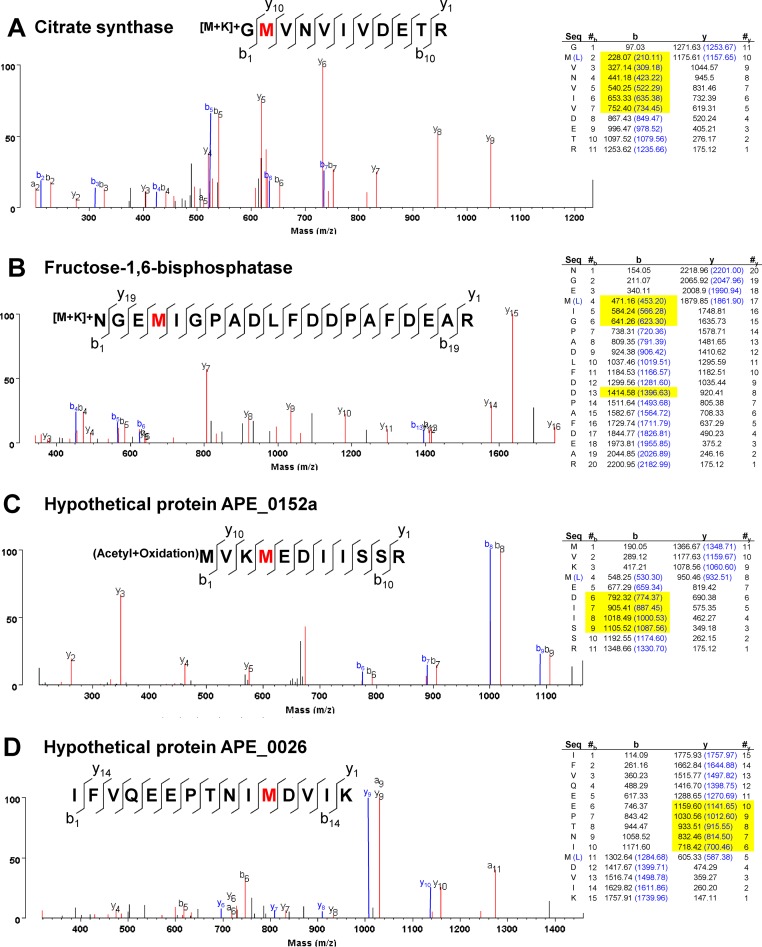
Mistranslated A. pernix proteins. Total protein mass spectrometry spectra with corresponding ion fragmentation tables from A. pernix grown at 75°C showing Leu-to-Met substitutions in red for citrate synthase (A), fructose-1,6-bisphosphate (B), hypothetical protein APE0152a (C) and hypothetical proteinAPE_0026 (D). Blue peaks in the spectra and blue masses in the ion fragmentation tables show the theoretical data for the genome-encoded, wild-type peptide sequence. The 18Da mass shift associated with Leu-to-Met substitution is illustrated in the differences between the corresponding experimental and theoretical peaks. The identifiable mass shifted peaks are highlighted in yellow.
Figure 4.
Figure 4.
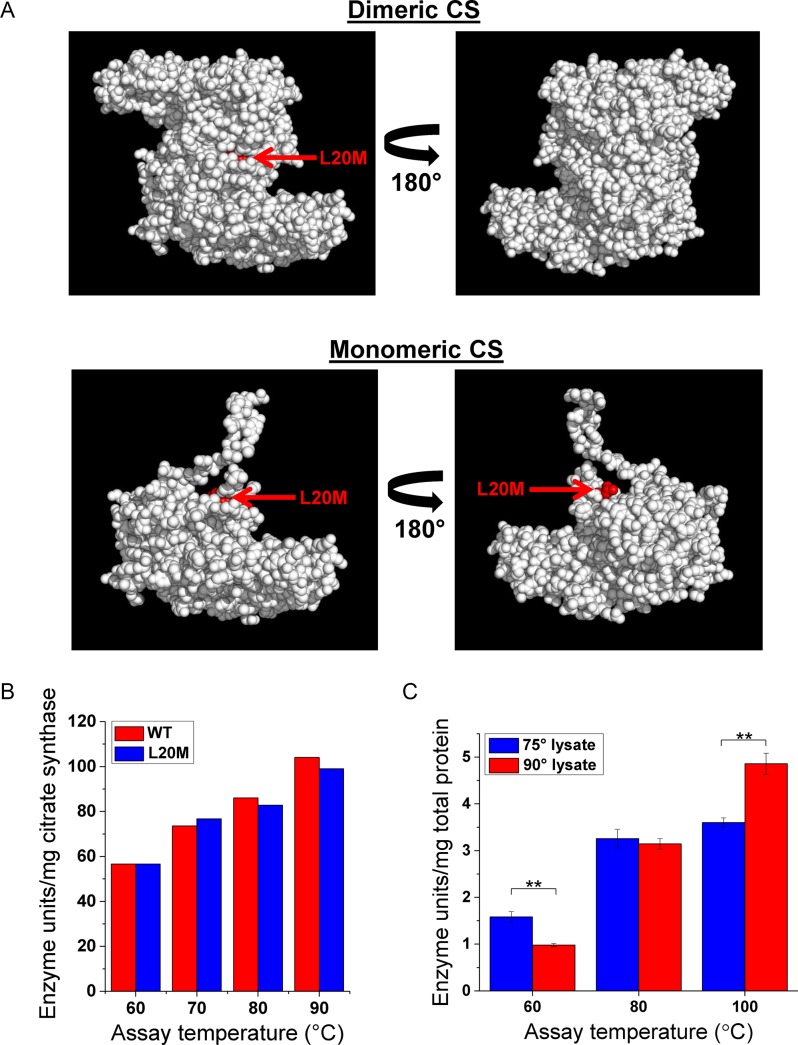
Met mistranslation of citrate synthase. (A) Structure of citrate synthase from the related organism Sulfolobus solfataricus showing the particular Leu-to-Met substitution identified by mass spectrometry in red in both the monomeric and dimeric forms. (B) Specific citrate synthase activity of the purified recombinant WT and single L20M mutant citrate synthase across relevant temperatures. (C) Total citrate synthase activity from A. pernix lysates obtained from growth at 75°C or 90°C and assayed at low, moderate and high temperatures (**P < 0.01, Student t-test).
Figure 5.
Figure 5.
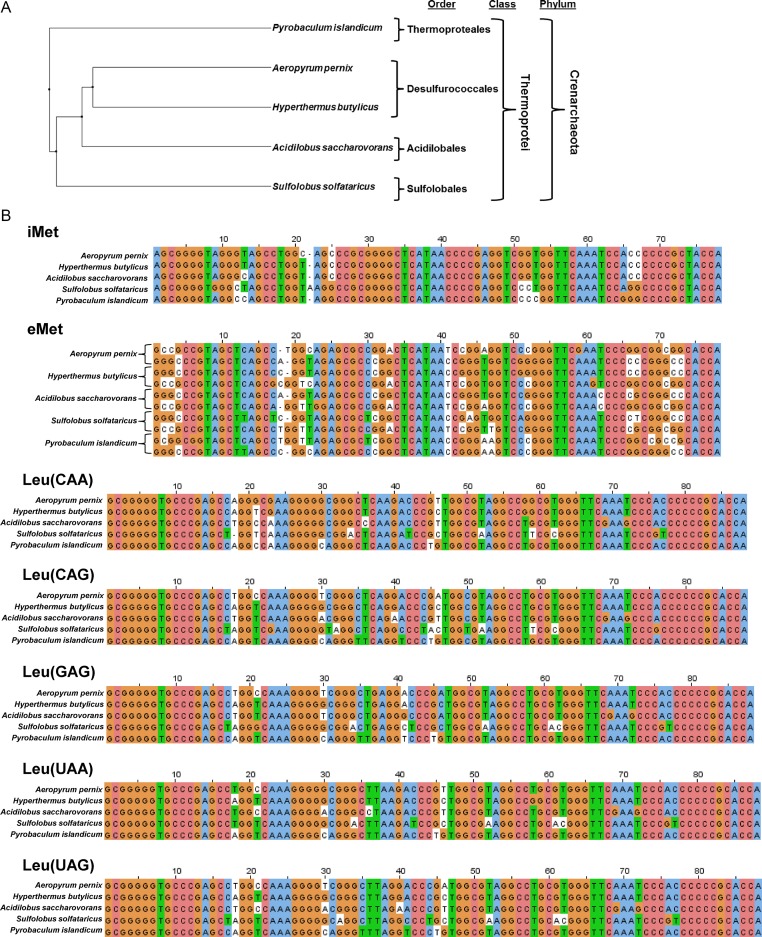
tRNAMet and tRNALeu conservation in Crenarchaeota. (A) Phylogenetic tree showing the relationship between Crenarchaeota species analyzed for tRNA sequence conservation. (B) tRNAMet and tRNALeu alignments for A. pernix and other Crenarchaeota from panel A.

References

    1. Reynolds N.M., Lazazzera B.A., Ibba M. Cellular mechanisms that control mistranslation. Nat. Rev. Microbiol. 2010;8:849–856. - PubMed
    1. Dale T., Uhlenbeck O.C. Amino acid specificity in translation. Trends Biochem. Sci. 2005;30:659–665. - PubMed
    1. Ibba M., Soll D. Aminoacyl-tRNA synthesis. Annu. Rev. Biochem. 2000;69:617–650. - PubMed
    1. Lee J.Y., Kim D.G., Kim B.G., Yang W.S., Hong J., Kang T., Oh Y.S., Kim K.R., Han B.W., Hwang B.J., et al. Promiscuous methionyl-tRNA synthetase mediates adaptive mistranslation to protect cells against oxidative stress. J. Cell Sci. 2014;127:4234–4245. - PMC - PubMed
    1. Netzer N., Goodenbour J.M., David A., Dittmar K.A., Jones R.B., Schneider J.R., Boone D., Eves E.M., Rosner M.R., Gibbs J.S., et al. Innate immune and chemically triggered oxidative stress modifies translational fidelity. Nature. 2009;462:522–526. - PMC - PubMed

Publication types