Review
. 2015 Dec 10;9(12):e0004176.
doi: 10.1371/journal.pntd.0004176. eCollection 2015 Dec.

The Interplay of Host Microbiota and Parasitic Protozoans at Mucosal Interfaces: Implications for the Outcomes of Infections and Diseases

Affiliations
Review

The Interplay of Host Microbiota and Parasitic Protozoans at Mucosal Interfaces: Implications for the Outcomes of Infections and Diseases

Ann-Katrein Bär et al. PLoS Negl Trop Dis. .

Abstract

Infections by parasitic protozoans are largely neglected, despite threatening millions of people, particularly in developing countries. With descriptions of the microbiota in humans, a new frontier of investigation is developing to decipher the complexity of host-parasite-microbiota relationships, instead of the classic reductionist approach, which considers host-parasite in isolation. Here, we review with specific examples the potential roles that the resident microbiota can play at mucosal interfaces in the transmission of parasitic protozoans and in the progress of infection and disease. Although the mechanisms underlying these relationships remain poorly understood, some examples provide compelling evidence that specific components of the microbiota can potentially alter the outcomes of parasitic infections and diseases in humans. Most findings suggest a protective role of the microbiota, which might lead to exploratory research comprising microbiota-based interventions to prevent and treat protozoal infections in the future. However, these infections are often accompanied by an unbalanced microbiota and, in some specific cases, apparently, these bacteria may contribute synergistically to disease progression. Taken together, these findings provide a different perspective on the ecological nature of protozoal infections. This review focuses attention on the importance of considering polymicrobial associations, i.e., parasitic protozoans and the host microbiota, for understanding these human infections in their natural microbial context.


Conflict of interest statement

The authors have declared that no competing interests exist.

Figures
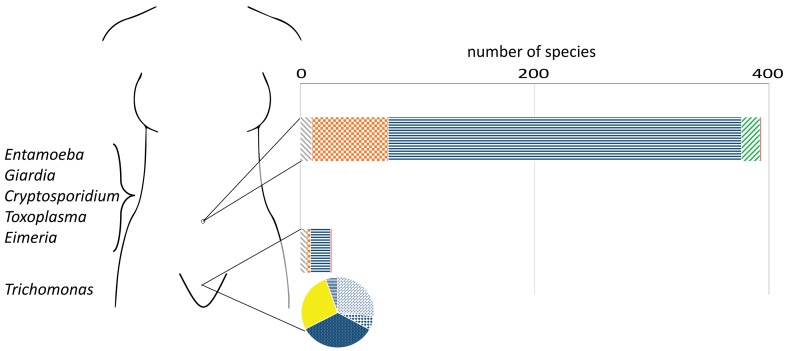
Fig 1
Fig 1. The microbiota of the human gut and vagina and the site-specific associated parasitic protozoans.
The bar chart illustrates bacterial diversity at species level, grouped by phylum, found in the gut (top bar) [4] and vagina (bottom bar) [9]. Bacterial phyla found in the gut are, from left to right: Actinobacteria, Bacteroidetes, Firmicutes, Proteobacteria, and the least diverse group of Fusobacteria. Bacterial phyla found in the vagina are, from left to right: Actinobacteria, Bacteroidetes, Firmicutes, and Fusobacteria. Despite showing higher species diversity in comparison to the vagina, the relative abundance of bacterial species in the gut varies greatly among individuals [5]. In the vagina, however, the microbiome can be categorized into five microbial communities as illustrated in the pie chart. Four of these are dominated by a single species of Lactobacillus (phylum Firmicutes). These species, coloured in blue, are shown on the pie chart from top to bottom in an anticlockwise direction: L. jensenii, L. crispatus, L. gasseri, and L. iners. A fifth community, coloured in yellow, is composed of a highly diverse polymicrobial community containing mostly anaerobic bacteria such as Prevotella bivia, Atopobium vaginae, Gardnerella vaginalis, Megasphaera sp., and Sneathia sp., [9]. Parasitic protozoans of human gut and vagina are listed on the left. The only vaginal protozoan of humans is the extracellular parasite Trichomonas vaginalis. Except for the extracellular parasite Entamoeba histolytica and the intracellular parasite Toxoplasma gondii, these protozoans are site-restricted and cause self-limiting infections. The interplay of these parasites with the human microbiota is discussed in this review.
Fig 2
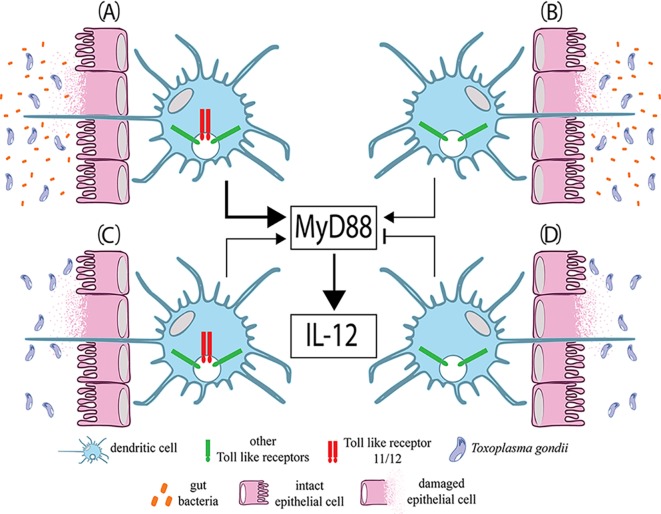
Fig 2. Initiation of mucosal innate immune response via dendritic cells against Toxoplasma gondii infection in mice.
The toll-like receptor (TLR)-adaptor protein MyD88 is a key element to the protective response based on production of IL-12. Secretion of IL-12 will trigger an effective cellular-based immune response with production of INF-γ and activation of a Th1 T lymphocyte profile. (A) This innate response is mainly dependent on TLR11, which forms endolysosomal dimers with TLR12 that recognize profilin from T. gondii. This recognition is central to mucosal immunity triggering production of IL-12. (B) In the absence of TLR11, however, this response is still minimally and sufficiently compensated by indirect stimulation provided by the gut microbial commensals via TLR2, TLR4, and TLR9 [44]. In this case, infection-induced cell destruction and intestinal dysbiosis apparently trigger loss of tolerance to gut commensals. When the gut microbiota is severely reduced by prolonged antibiotic treatment, the following observations can be made: (C) Wild-type mice expressing TLR11 exhibit a reduced but not abolished IL-12 response. These animals can still build up Th1 immunity. (D) TLR11-knockout mice are unable to mount IL-12 responses against this parasite, and Th1 immunity is severely impaired. In conclusion, gut commensals serve as natural molecular adjuvants during T. gondii infection.

References

    1. WHO. Bulletin of the World Health Organization 2013;91:501–508 10.2471/BLT.12.111732 - DOI - PMC - PubMed
    1. WHO. Global incidence and prevalence of selected curable sexually transmitted infections—2008. http://www.who.int/reproductivehealth/publications/rtis/stisestimates/en/ - PubMed
    1. O’Hara AM, Shanahan F. The gut flora as a forgotten organ. EMBO. 2006;7:688–93. - PMC - PubMed
    1. Eckburg PB, Bik EM, Bernstein CN, Purdom E, Dethlefsen L, Sargent M, et al. Diversity of the human intestinal microbial flora. Science. 2005;308(5728):1635–8. - PMC - PubMed
    1. Human Microbiome Project Consortium. Structure, function and diversity of the healthy human microbiome. Nature. 2012;486(7402):207–14. 10.1038/nature11234 - DOI - PMC - PubMed

Publication types