


Clinical Laboratory Assessment of Mycoplasma genitalium Transcription-Mediated Amplification Using Primary Female Urogenital Specimens
- PMID: 26659209
- PMCID: PMC4733161
- DOI: 10.1128/JCM.02463-15
Clinical Laboratory Assessment of Mycoplasma genitalium Transcription-Mediated Amplification Using Primary Female Urogenital Specimens
Abstract
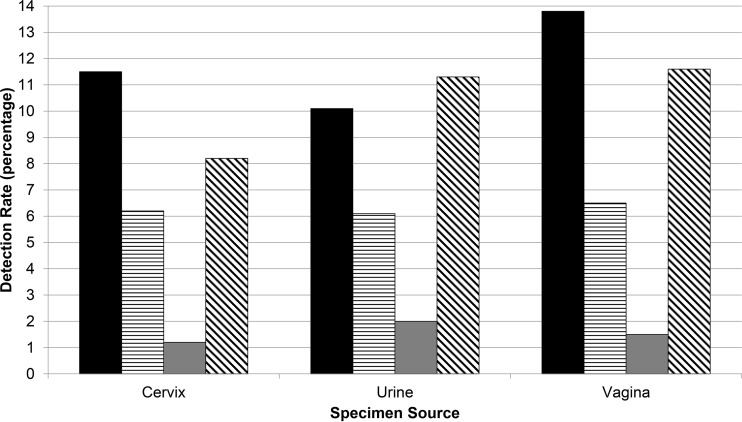
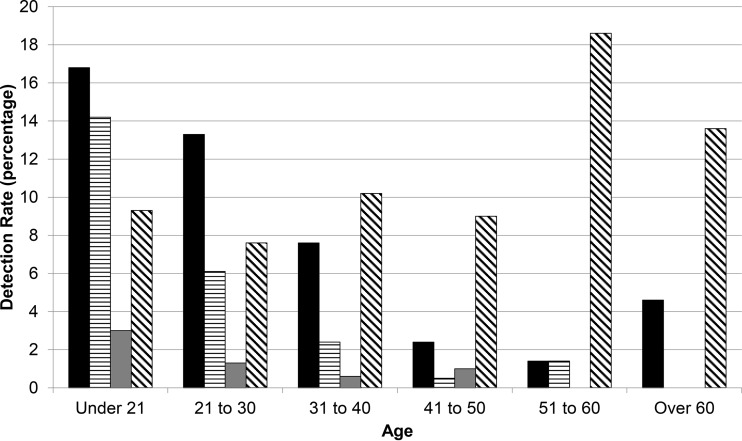
Following analysis of primary cervix, vagina, and first-void female urine specimens for Chlamydia trachomatis, Neisseria gonorrhoeae, and Trichomonas vaginalis via commercial transcription-mediated amplification (TMA), residual material was subjected to Mycoplasma genitalium research-use-only TMA. Representation within a 2,478-specimen retrospective study set was established by comparison to a 6-month audit of clinical C. trachomatis TMA (12,999 specimens) on the basis of the C. trachomatis detection rate, specimen source distribution, clinic location, and age. M. genitalium was detected in 282 (11.4%) patients. This rate was higher than those seen with T. vaginalis (9.0%; P = 0.005), C. trachomatis (6.2%), and N. gonorrhoeae (1.4%). Positive M. genitalium results were confirmed by repeat testing or alternative-target TMA at a rate of 98.7%. The mean age of the M. genitalium-infected females (24.7 years) was lower than that of the T. vaginalis-infected females (mean, 30.1 years; P < 0.0001) and higher than that of the C. trachomatis-infected females (mean, 23.8 years; P = 0.003). Of 566 patient encounters positive for at least one sexually transmitted infection (STI), 35.9% exhibited sole detection of M. genitalium (P ≤ 0.0004 versus sole detection of other STI agents) and 26.1% were solely positive for T. vaginalis (P < 0.0002 versus C. trachomatis). The M. genitalium and T. vaginalis detection rates among 755 patients at urban emergency departments were 14.6% and 13.0%, respectively (P = 0.37). A 10.0% M. genitalium detection rate from other facilities exceeded that of T. vaginalis (7.2%; P = 0.004). Incorporation of M. genitalium TMA into comprehensive testing programs would detect M. genitalium in a significant proportion of females, particularly those in outpatient obstetrics and gynecology (OB/GYN) settings.
Copyright © 2016, American Society for Microbiology. All Rights Reserved.
Figures
References
Publication types
MeSH terms
Substances
LinkOut - more resources
Full Text Sources
Medical
Miscellaneous
