


Factors Influencing the Recurrence Potential of Benign Endometrial Polyps after Hysteroscopic Polypectomy
- PMID: 26660149
- PMCID: PMC4676604
- DOI: 10.1371/journal.pone.0144857
Factors Influencing the Recurrence Potential of Benign Endometrial Polyps after Hysteroscopic Polypectomy
Abstract
Background: An endometrial polyp is a frequently encountered gynecologic disease with abnormal uterine bleeding and infertility being the two common presenting problems, and hysteroscopic polypectomy is an effective method to remove them. The postoperative polyp recurrence might result in reappearance of abnormal uterine bleeding or infertility, whereas factors influencing the postoperative recurrence potential have limited data.
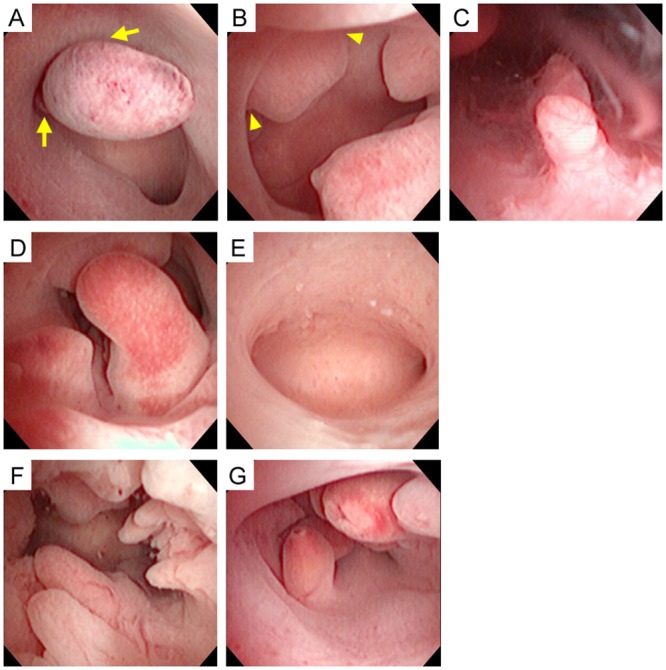
Methods: This case-series report included 168 premenopausal women who suffered from endometrial polyps and underwent hysteroscopic polypectomy. All of them were awaiting a future pregnancy. Office hysteroscopy was done before and after hysteroscopic polypectomy, in which preoperative hysteroscopy examined the number, type, and location of endometrial polyps, and postoperative hysteroscopy checked the polyp recurrence. Surgical indications, either infertility or the presentation of abnormal uterine bleeding, and follow-up duration were recorded.
Results: Seventy-three out of 168 (43%) women had polyp recurrence after hysteroscopic polypectomy. Multivariate logistic regression analysis revealed that more endometrial polyps (P = 0.015) and longer duration of follow-up (P = 0.004) were significantly associated with an increased risk of postoperative polyp recurrence. The type of endometrial polyps was not correlated with polyp recurrence potential, whereas pedunculated type endometrial polyps were closely related to the presentation of abnormal uterine bleeding (P = 0.001).
Conclusions: A higher number of endometrial polyps and longer follow-up duration are associated with a greater potential of polyp recurrence after hysteroscopic polypectomy.
Conflict of interest statement
Figures
Similar articles
-
Pregnancy rates after hysteroscopic polypectomy depending on the size or number of the polyps.Arch Gynecol Obstet. 2008 May;277(5):395-9. doi: 10.1007/s00404-007-0460-z. Epub 2007 Sep 13. Arch Gynecol Obstet. 2008. PMID: 17851673
-
Long-term outcomes after intrauterine morcellation vs hysteroscopic resection of endometrial polyps.J Minim Invasive Gynecol. 2013 Mar-Apr;20(2):215-21. doi: 10.1016/j.jmig.2012.10.013. Epub 2013 Jan 5. J Minim Invasive Gynecol. 2013. PMID: 23295201
-
Hysteroscopic polypectomy in 240 premenopausal and postmenopausal women.Fertil Steril. 2005 Mar;83(3):705-9. doi: 10.1016/j.fertnstert.2004.08.031. Fertil Steril. 2005. PMID: 15749501
-
The clinical significance of small endometrial polyps.Eur J Obstet Gynecol Reprod Biol. 2013 Oct;170(2):497-500. doi: 10.1016/j.ejogrb.2013.07.011. Epub 2013 Jul 30. Eur J Obstet Gynecol Reprod Biol. 2013. PMID: 23910695 Review.
-
Diagnosis and management of endometrial polyps: a critical review of the literature.J Minim Invasive Gynecol. 2011 Sep-Oct;18(5):569-81. doi: 10.1016/j.jmig.2011.05.018. Epub 2011 Jul 23. J Minim Invasive Gynecol. 2011. PMID: 21783430 Review.
Cited by
-
Endometrial polypectomy using tissue removal device or electrosurgical snare: a randomised controlled trial.Facts Views Vis Obgyn. 2022 Sep;14(3):235-243. doi: 10.52054/FVVO.14.3.035. Facts Views Vis Obgyn. 2022. PMID: 36206798 Free PMC article.
-
Retrospective Cohort Study on the Symptomatic Recurrence Pattern after Hysteroscopic Polypectomy.Gynecol Minim Invasive Ther. 2020 Oct 15;9(4):209-214. doi: 10.4103/GMIT.GMIT_102_19. eCollection 2020 Oct-Dec. Gynecol Minim Invasive Ther. 2020. PMID: 33312864 Free PMC article.
-
Optimal time interval between hysteroscopic polypectomy and frozen-thawed blastocyst transfer: A retrospective study.PLoS One. 2020 Oct 20;15(10):e0240882. doi: 10.1371/journal.pone.0240882. eCollection 2020. PLoS One. 2020. PMID: 33079974 Free PMC article.
-
Assessment of Long- and Short-Term Outcomes of Hysteroscopic Polypectomy in Patients with Uterine Polyps.Adv Biomed Res. 2024 Jul 29;13:57. doi: 10.4103/abr.abr_66_23. eCollection 2024. Adv Biomed Res. 2024. PMID: 39411692 Free PMC article.
-
Hysteroscopic polypectomy with endometrial resection preventing the recurrence of endometrial polyps: A single-blinded randomized clinical trial.Caspian J Intern Med. 2022 Spring;13(2):393-397. doi: 10.22088/cjim.13.2.393. Caspian J Intern Med. 2022. PMID: 35919639 Free PMC article.
References
-
- Peterson WF, Novak ER Endometrial polyps. Obstet Gynecol. 1956;8:40–49. - PubMed
-
- Varasteh NN, Neuwirth RS, Levin B, Keltz MD Pregnancy rates after hysteroscopic polypectomy and myomectomy in infertile women. Obstet Gynecol. 1999;94:168–171. - PubMed
-
- Perez-Medina T, Bajo-Arenas J, Salazar F, Redondo T, Sanfrutos L, Alvarez P, et al. Endometrial polyps and their implication in the pregnancy rates of patients undergoing intrauterine insemination: a prospective, randomized study. Hum Reprod. 2005;20:1632–1635. - PubMed
-
- Stamatellos I, Apostolides A, Stamatopoulos P, Bontis J Pregnancy rates after hysteroscopic polypectomy depending on the size or number of the polyps. Arch Gynecol Obstet. 2008;277:395–399. - PubMed
MeSH terms
LinkOut - more resources
Full Text Sources
Other Literature Sources
Medical
