


The Plastomes of Two Species in the Endoparasite Genus Pilostyles (Apodanthaceae) Each Retain Just Five or Six Possibly Functional Genes
- PMID: 26660355
- PMCID: PMC4758247
- DOI: 10.1093/gbe/evv251
The Plastomes of Two Species in the Endoparasite Genus Pilostyles (Apodanthaceae) Each Retain Just Five or Six Possibly Functional Genes
Abstract
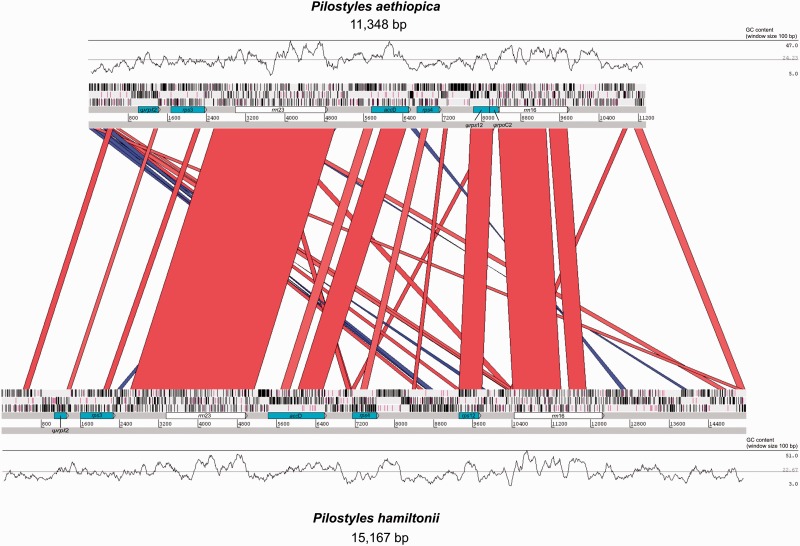
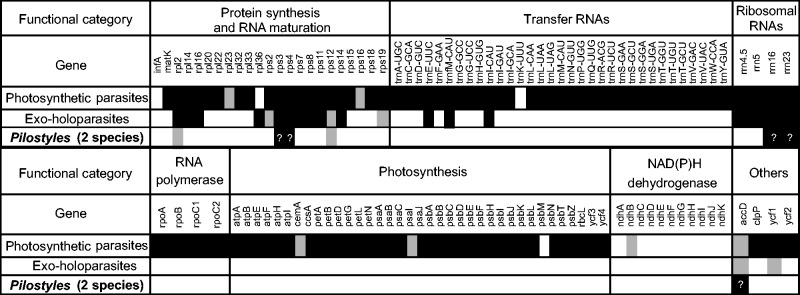
The 23 species of mycoheterotrophic or exoparasitic land plants (from 15 genera and 6 families) studied so far all retain a minimal set of 17 of the normally 116 plastome genes. Only Rafflesia lagascae, an endoparasite concealed in its host except when flowering, has been reported as perhaps lacking a plastome, although it still possesses plastid-like compartments. We analyzed two other endoparasites, the African Apodanthaceae Pilostyles aethiopica and the Australian Pilostyles hamiltonii, both living inside Fabaceae. Illumina and 454 data and Sanger resequencing yielded circularized plastomes of 11,348 and 15,167 bp length, with both species containing five possibly functional genes (accD, rps3, rps4, rrn16, rrn23) and two/three pseudogenes (rpoC2 in P. aethiopica and rpl2 and rps12 in both species; rps12 may be functional in P. hamiltonii). Previously known smallest land plant plastomes contain 27-29 genes, making these Apodanthaceae plastomes the most reduced in size and gene content. A similar extent of divergence might have caused the plastome of Rafflesia to escape detection. The higher plastome degeneration in both these families of endoparasites, Rafflesiaceae and Apodanthaceae, of similar high age, compared with exoparasites points to a difference of plastome function between those two modes of parasitic life.
Keywords: chloroplast genome; endoparasite; gene loss; minimal plastome; photosynthesis.
© The Author 2015. Published by Oxford University Press on behalf of the Society for Molecular Biology and Evolution.
Figures
References
-
- Barbrook AC, Howe CJ, Purton S. 2006. Why are plastid genomes retained in non-photosynthetic organisms? Trends Plant Sci.. 11:101–108. - PubMed
-
- Barow M. 2006. Endopolyploidy in seed plants. Bioessays 28:271–281. - PubMed
-
- Barrett CF, Davis JI. 2012. The plastid genome of the mycoheterotrophic Corallorhiza striata (Orchidaceae) is in the relatively early stages of degradation. Am J Bot. 99:1513–1523. - PubMed
Publication types
MeSH terms
LinkOut - more resources
Full Text Sources
Other Literature Sources
Molecular Biology Databases
Miscellaneous
