Review
. 2016 Jan;38(1):50-63.
doi: 10.1002/bies.201500102. Epub 2015 Dec 10.

The dawn of active genetics

Affiliations
Review

The dawn of active genetics

Valentino M Gantz et al. Bioessays. 2016 Jan.

Abstract

On December 18, 2014, a yellow female fly quietly emerged from her pupal case. What made her unique was that she had only one parent carrying a mutant allele of this classic recessive locus. Then, one generation later, after mating with a wild-type male, all her offspring displayed the same recessive yellow phenotype. Further analysis of other such yellow females revealed that the construct causing the mutation was converting the opposing chromosome with 95% efficiency. These simple results, seen also in mosquitoes and yeast, open the door to a new era of genetics wherein the laws of traditional Mendelian inheritance can be bypassed for a broad variety of purposes. Here, we consider the implications of this fundamentally new form of "active genetics," its applications for gene drives, reversal and amplification strategies, its potential for contributing to cell and gene therapy strategies, and ethical/biosafety considerations associated with such active genetic elements. Also watch the Video Abstract.

Keywords: Drosophila; ERACR; MCR; active genetics; copy cat element; gene drive; mutagenic chain reaction.


Figures

Figure 1
Figure 1
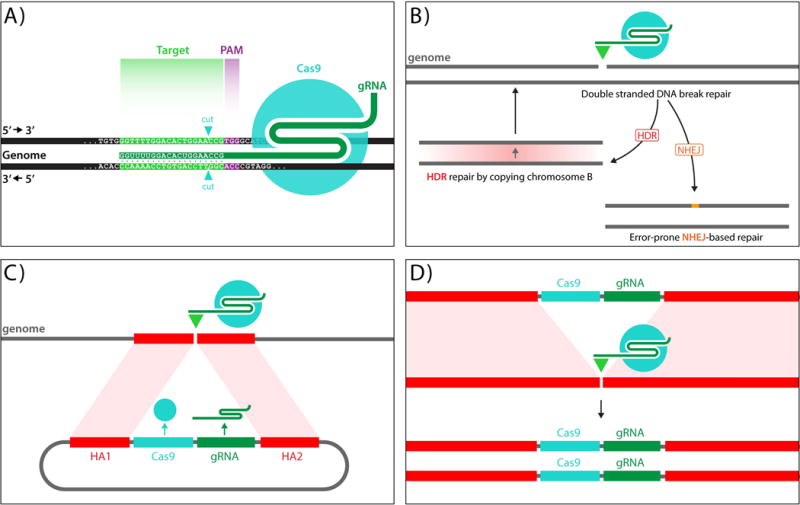
Outline of CRISPR and MCR methods. A) The CRISPR/Cas9 genome editing system consists of two elements, the Cas9 endonuclease, which generates blunt ended double stranded DNA breaks, and a 20 nucleotide guide RNA (gRNA) that binds to Cas9 and targets it to complementary genomic sequences, which in addition must have a so-called PAM sequence (NGG - violet type) recognized by Cas9 that lies immediately 3′ to the 20 nucleotides of gRNA match. B) Double stranded chromosomal breaks caused by targeted cas9/gRNA cleavage can be repaired by either the Rad51-dependent Homology Directed Repair (HDR) pathway, which faithfully copies information from the sister chromosome into the cut site, or the Ku70/80-dependent Non-homologous End-Joining (NHEJ) pathway, which typically results in short insertions/deletions (indels) at the cut site. C,D) MCR mutagenesis scheme: MCR elements (C) consist of three components: 1) a transgene encoding a nuclear targeted form of Cas9 endonuclease, 2) a gRNA directing cleavage to a desired genomic site, and 3) homology arms (HA1 and HA2) from the targeted locus that directly about the gRNA cut site. An injected MCR construct inserts into the genome at the site of gRNA directed cleavage. Once integrated into the genome (D), the MCR element acts on the opposing allele and inserts itself to generate a homozygous insertional mutation.
Figure 2
Figure 2
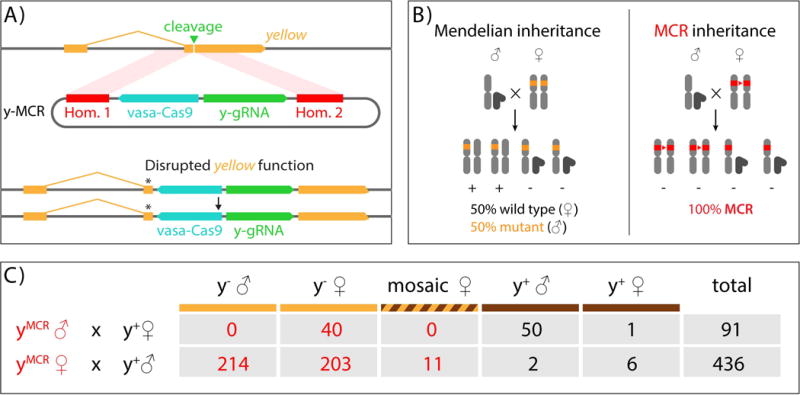
Efficient transmission of y-MCR element. A) Mendelian versus MCR inheritance of a yellow (y) allele. B) Structure of the y-MCR construct and its insertion into the genome at the yellow locus on the X chromosome. C) Summary of results of 8 crosses between F1 y- heterozygous flies and y+ flies (2 male MCR and 6 female MCR crosses) yielding a total of 527 F2 progeny. The MCR transmission rate in the experiments was 97%, which translates into a 95% rate of the MCR allele converting the opposite allele in the germline (conversion % = 2(X – 0.5N)/N where N = total number of flies and X = number of y flies with a y- phenotype or y mosaic phenotype).
Figure 3
Figure 3
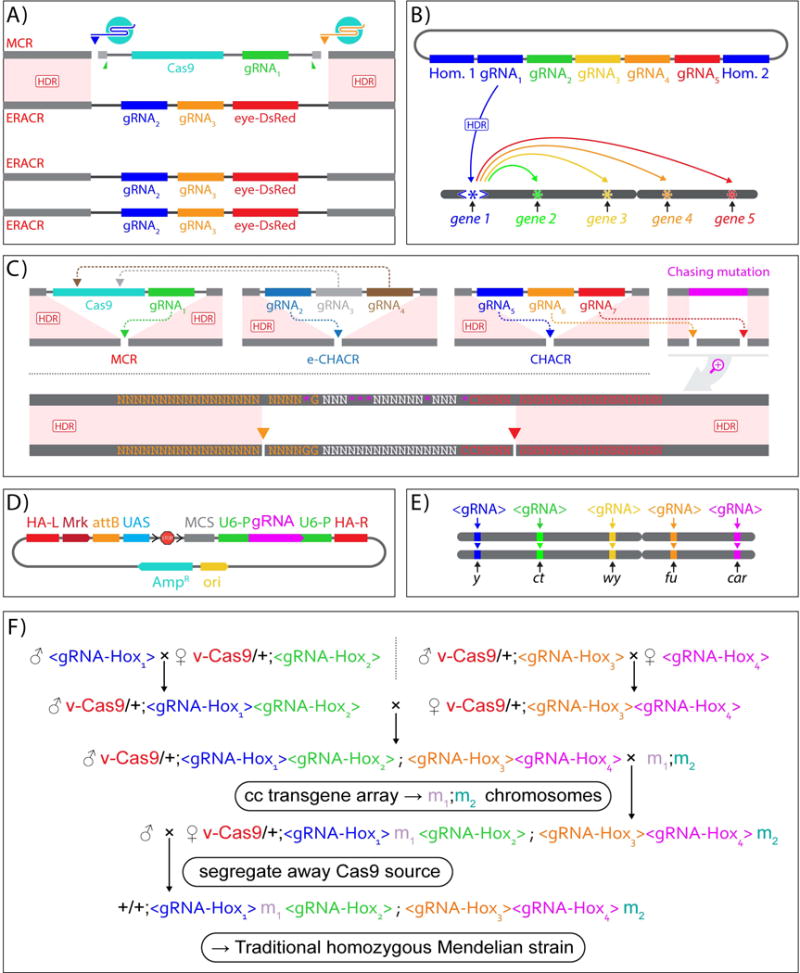
ERACRs, CHACRs, and “copy-cat” constructs: A) ERACRs: “Elements to Reverse the Autocatalytic Chain Reaction” delete MCR elements. In flies carrying both an MCR and an ERACR allele, Cas9 produced by the MCR cuts at sites directed by gRNA-2 and gRNA-3. eye-DsRed = dominant marker. The MCR inserted at a cut site determined by gRNA-1 lying within the deleted segment leading to the ERACR element becoming homozygous. B) CHACRs: “Constructs Hitchhiking on the Autocatalytic Chain Reaction” target other genomic targets. Shown here is an example in which a CHACR serves as a platform to launch an array of gRNAs to diverse targets where they induce standard NHEJ-dependent mutations. C) An MCR element (top left panel) could also be neutralized by CHACR elements used as second-site ERACRs (e-CHACR - inserted at site determined by gRNA2 - top second panel) that carries multiple gRNAs (gRNA3 - teal, gRNA4 - brown) targeting Cas9 in the MCR. Also, CHACRs could be used to drive the spread of unlinked auxiliary elements. Such a CHACR element is shown (top right panel) carrying 3 gRNAs inserted into the cut site of one of these gRNAs (gRNA5 - dark blue), which is in a different location in the genome than the MCR (inserted at a site defined by gRNA1 - green). Thus, like an ERACR, in the presence of an MCR carrying a Cas9 source, the CHACR cuts the opposing chromosome (via cleavage induced by gRNA5) and inserts itself into the resulting DNA gap. In addition, the depicted CHACR carries gRNA6 (orange) and gRNA7 (red), which cut at adjacent sites flanking a edited genomic locus (or existing natural allelic variant - top right panel). The resulting small deletion (region between the gRNA6 and gRNA7 cut sites) will then be repaired via HDR using the edited (pink) sequence. The lower panel shows a magnified view of the top right panel indicating the gene edited residues as pink asterisks and the two cleavage sites for gRNA6 (orange) and gRNA6 (red) relative to the sequences of perfect homology mediating HDR repair. D) “Copy-cat” or cc vectors allow the cloning of transgenes into multiple cloning sites (MCS) as well as matched sets of gRNA(s) flanked by both 5′ (U6p) and 3′ (U6-3′) U6-RNA regulatory elements, and homology arms (HA-L = left, HA-R = right), standard features of cloning vectors such as a bacterial origin of replication (Ori), a gene providing Ampicillin resistance (AmpR), as well as optional use cassettes such as a UAS promoter, an attBϕ31C recombinase donor site allowing for alternative recombinase-driven insertion of the construct into a genomic recipient site (attP), or instead, an attP recipient site to allow recombinase-mediated insertion into the genomically inserted copy-cat element, and an FRT-flanked transcriptional stop cassette (<Stop<). E) cc elements can insert at various loci along a chromosome (D. melanogaster X-chromosome shown as example) which are determined by their particular matched sets of gRNAs and homology arms. In the presence of a cas9 source, these elements will be copied to the sister chromosome, thereby homozygosing the element with the inserted transgene. F) Example of how copy-cat elements could be used in a model vertebrate organism such as a mouse or fish to create a cas9-dependent viable quadruple knock-out of a set of target genes (e.g., redundantly acting Hox gene paralogs). Not shown here for simplicity are various transgene constructs that also could be carried by each of the cc-elements (e.g., CRE/LOX components and fluorescent markers appropriate for expressing and analyzing the ability of a single Hox gene to substitute for the normal sets of genes in a given tissue). These cc elements/mutant alleles could be assembled in two generations. Next, in the maintained presence of cas9, they could be combined with two traditional Mendelian alleles (m1 and m2) by cc-ing the Hox mutant alleles into the mutant background. The source of cas9 then could be removed by segregation, resulting in the complex assembly of mutant alleles and transgenes which would now behave according to standard Mendelian rules.
Figure 4
Figure 4
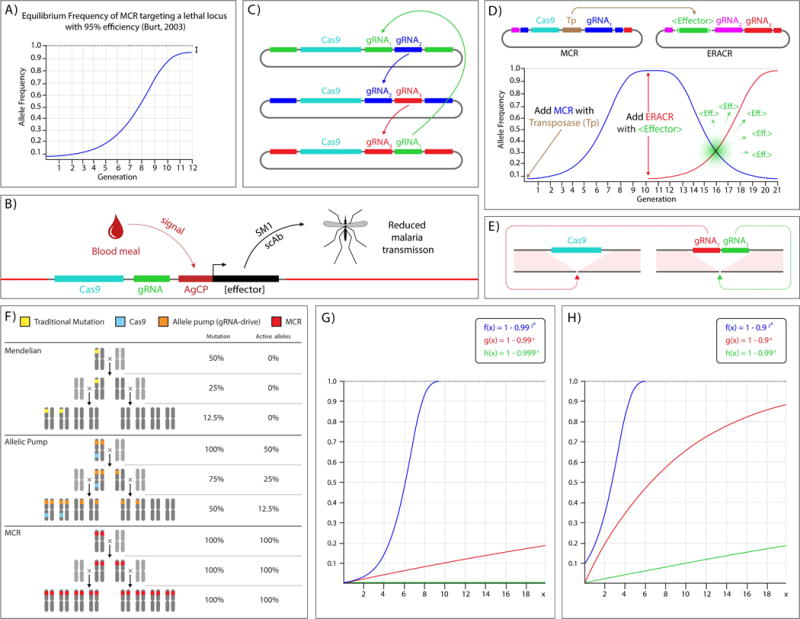
Modeling MCRs, ERACRs, and other elements. A) Modeling of an MCR powered by a germline specific source of cas9 that targets an essential gene based on the modeling of HEGs by Austin Burt. The example assumes that the MCR has a 95% efficiency of conversion (like the y-MCR in Drosophila) = the equilibrium frequency of the MCR allele in that population. B) Application of MCR to attenuate mosquito borne malaria in which an effector cassette encoding the SM1 peptide, which is conditionally activated by a blood meal (AgCP promoter) or a single chain antibody (scFvs) directed against the malarial agent P. falciparum, is inserted along with core MCR components (Cas9 and gRNA) into a non-coding region of the mosquito genome. The SM1 peptide limits passage of P. falciparum through the gut, a required step in its exploitation of that vector host. C) Reinforcing MCRs. A set of three mutually reinforcing MCRs. Each MCR carries two gRNAs, one targeting its own insertion site (color of gRNA matches color of homology arms) and a second gRNA targeting the cut site a companion MCR. If each of these elements behave as in the example shown in panel A, when integrated into the genome and released together they should create a sufficient genetic load to drive the population to extinction. Colors of flanking homology regions and gRNAs in the depicted plasmid constructs are matched to indicate which gRNAs direct cleavage at different genomic sites. Arrows summarize redundant patterns of gRNA cleavage that result in two gRNAs from different MCRs cutting at each chromosomal site. D) Top: A coupled pair of MCR and ERACR constructs designed to launch a transposon burst. The MCR carries a Transposase gene (Tp), while the ERACR carries an effector gene cassette <EF> flanked by inverted transposon ends. Bottom: The MCR (blue curve) seeded at 1:100 spreads through the target population following a logistic growth curve in ≈ 10 generations whereupon the ERACR is added. The ERACR (red curve) then spreads with the same dynamics through the MCR population. In individuals carrying both the MCR and ERACR (maximal in gray zone) the Transposase provided by the MCR mobilizes the transposon born effector cassette to new chromosomal sites. This mobilization is restricted to single generation since the ERACR also deletes the MCR. The result is an amplification of the number of effector cassettes in the population and their dispersion to potentially advantageous new genomic locations. E) Trans-complementing <cas9>; <gRNA> which together create a drive system equivalent to that of a single coupled <cas9; gRNA> MCR element. In this scheme, gRNA1 cleaves at the cas9 insertion site and gRNA2 cleaves at the <gRNA1,2> insertion site. F) Scheme depicting two generations of inheritance for a classic Mendelian allele (top), a copy-cat allelic pump consisting of a separated source of cas9 and a <gRNA> (middle), and an MCR (bottom). This logistic growth curve is defined by the second order recursion formula: fn+1 = fn +fn(1− fn) = 2fn − fn2, where fn is the frequency of the MCR in the population at generation n. This formula has the closed form solution f(n) = 1- (1- c0)(2n), where c0 = the seeding frequency of the MCR, which for low values of c0 can be approximated as expected, by the exponential equation f(n) = c02n. G) Time course of accumulated mutant alleles resulting from 1:100 seeding of an MCR (blue curve), a cas9; <gRNA> allelic pump (red curve), and a standard cas9; gRNA encoding transgenes green curve (buried in the baseline). The additive copy-cat drive can be modeled by the first order recursion formula: fn = fn-1 + c0(1-fn-1) where c0 = g0 (initial fractions of cas9 and gRNAs in the population). The closed form solution for this equation is f(n) = 1- (1- c0)n, which for low values of c0 = g0 can be approximated by the linear equation f(n) = c0(n). For comparison, the standard mutational drive can be represented by fn = fn-1 + c0g0(1-fn-1), which has the closed form solution f(n) = 1- (1- c0g0)n (≈ c0g0(n) for c0 and g0 <<1). H) Same as in panel G but with a seeding ratio of 1:10. Note that the allelic pump in G (red curve) has precisely the same behavior as the standard cas9; gRNA combination in H (green curve). Note that the growth curve for the copy-cat allelic pump seeding at c0 = g0 = 1% is identical to that of the standard non-drive mutagenesis scheme seeded at c0 = g0 = 10% (asterisks indicate equal endpoints).
Figure 5
Figure 5
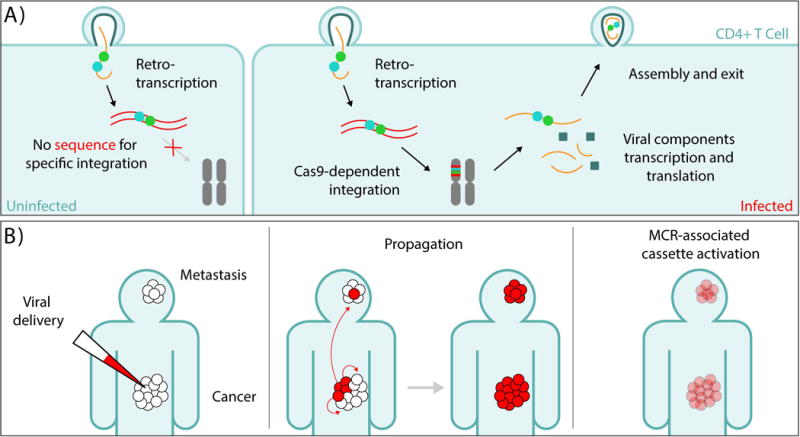
Potential applications of MCR technology to gene therapy. A) MCR-based spread of an Integrase-deficient Cas9/gRNA-dependent retroviral (e.g., HIV) construct directing its insertion into a chromosomal inserted provirus thereby rendering that proviral element inactive (e.g., reference). Induction and maturation of such targeted proviruses should lead to the production of assembled viruses which could then infect all other CD4+ helper T-cells but only integrates into the genomes of cells carrying proviral insertions. This within-organism spread of the MCR construct could eventually incapacitate all proviruses leading to the eventual clearance of the HIV infection. B) An analogous retro-virally propagated MCR element directs its insertion into a cancer-specific genomic sequence. Infection and spread of this element throughout the body should lead to its selective insertion in cancer cells (in primary and metastatic tumors). When testing of patient cells indicates that the MCR has spread effectively to all cancer cells, an effector cassette carried by the MCR could be activated (e.g., by a hormone) to induce apoptosis or flag cells for destruction by the immune system.
Figure 6
Figure 6
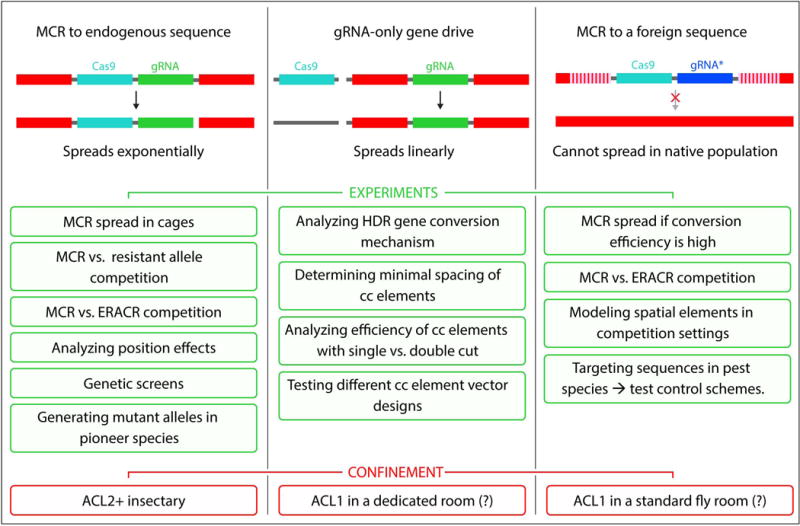
Biosafety options for sample experiments for different active genetic elements: Top: Schemes depicting an MCR targeting an endogenous sequence (left), a split cas9; allelic pump (middle), and an MCR targeting an exogenous sequence (right). Bottom: Types of experiments and recommended physical confinement strategies suitable for each type of active element. ACL = Arthropod Containment Levels. ACL1 corresponds to containment of arthropods judged to present a BioSafety Level 1 (BSL1) concern, which applies to standard laboratory organisms (e.g., flies or harmless strains of E. coli used for cloning) while ACL2 applies to insect vectors carrying BSL2 rated pathogens (e.g., mosquitoes carrying malarial parasites or tsetse flies carrying trypanosomes). For relevant current federal regulations on recombinant DNA and confinement procedures see references. Question marks indicate tentative suggested levels of confinement for the different drive configurations.

References

    1. Barrangou R. The roles of CRISPR-Cas systems in adaptive immunity and beyond. Curr Opin Immunol. 2015;32C:36–41. - PubMed
    1. Gasiunas G, Sinkunas T, Siksnys V. Molecular mechanisms of CRISPR-mediated microbial immunity. Cell Mol Life Sci. 2014;71(3):449–65. - PMC - PubMed
    1. Westra ER, Buckling A, Fineran PC. CRISPR-Cas systems: beyond adaptive immunity. Nat Rev Microbiol. 2014;12(5):317–26. - PubMed
    1. Jiang F, Doudna JA. The structural biology of CRISPR-Cas systems. Curr Opin Struct Biol. 2015;30:100–111. - PMC - PubMed
    1. Bassett AR, Liu JL. CRISPR/Cas9 and genome editing in Drosophila. J Genet Genomics. 2014;41(1):7–19. - PubMed