. 2016 Jun;36(6):1098-110.
doi: 10.1177/0271678X15606724. Epub 2015 Oct 5.

Caloric restriction improves diabetes-induced cognitive deficits by attenuating neurogranin-associated calcium signaling in high-fat diet-fed mice

Affiliations

Caloric restriction improves diabetes-induced cognitive deficits by attenuating neurogranin-associated calcium signaling in high-fat diet-fed mice

Hwajin Kim et al. J Cereb Blood Flow Metab. 2016 Jun.

Abstract

Diabetes-induced cognitive decline has been recognized in human patients of type 2 diabetes mellitus and mouse model of obesity, but the underlying mechanisms or therapeutic targets are not clearly identified. We investigated the effect of caloric restriction on diabetes-induced memory deficits and searched a molecular mechanism of caloric restriction-mediated neuroprotection. C57BL/6 mice were fed a high-fat diet for 40 weeks and RNA-seq analysis was performed in the hippocampus of high-fat diet-fed mice. To investigate caloric restriction effect on differential expression of genes, mice were fed high-fat diet for 20 weeks and continued on high-fat diet or subjected to caloric restriction (2 g/day) for 12 weeks. High-fat diet-fed mice exhibited insulin resistance, glial activation, blood-brain barrier leakage, and memory deficits, in that we identified neurogranin, a down-regulated gene in high-fat diet-fed mice using RNA-seq analysis; neurogranin regulates Ca(2+)/calmodulin-dependent synaptic function. Caloric restriction increased insulin sensitivity, reduced high-fat diet-induced blood-brain barrier leakage and glial activation, and improved memory deficit. Furthermore, caloric restriction reversed high-fat diet-induced expression of neurogranin and the activation of Ca(2+)/calmodulin-dependent protein kinase II and calpain as well as the downstream effectors. Our results suggest that neurogranin is an important factor of high-fat diet-induced memory deficits on which caloric restriction has a therapeutic effect by regulating neurogranin-associated calcium signaling.

Keywords: Calcium; caloric restriction; cognitive impairment; diabetes; hippocampus.


Figures

Figure 1.
Figure 1.
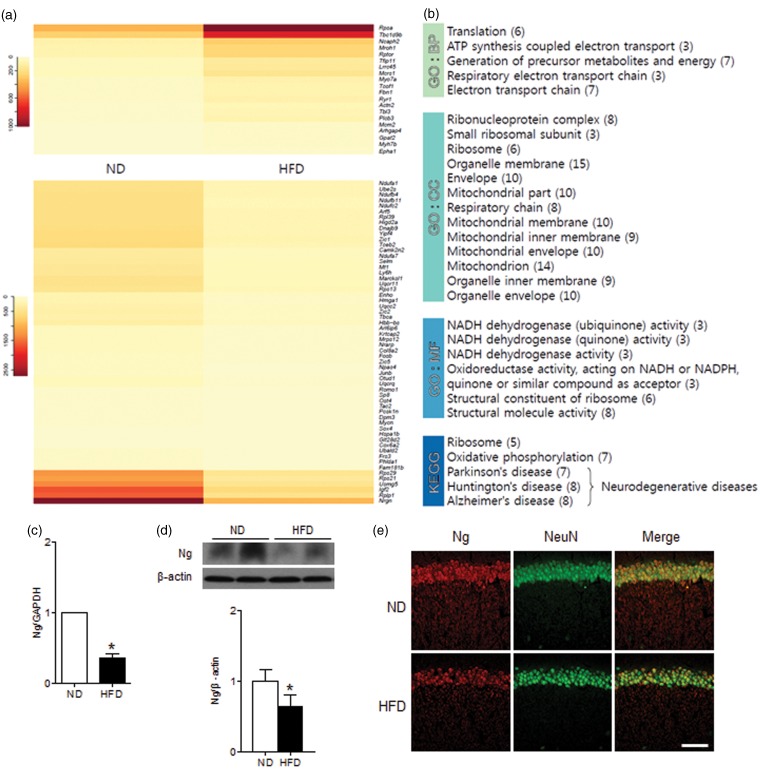
RNA-seq analysis of DEGs in the hippocampus of ND-fed and HFD-fed mice. (a) The differential expression of genes in ND-fed versus HFD-fed mice was color shaded after NGS-based RNA-seq analysis. Genes shown in red had up-regulated expression, and those shown in yellow had down-regulated expression (Supplementary Table 3). (b) The identified genes were functionally clustered by gene ontology (GO) analysis (biological process (BP), cellular component (CC), and molecular function (MF)) and Kyoto Encyclopedia of Genes and Genomes (KEGG) pathway analysis. (c) Relative gene expression of Ng is shown by qRT-PCR. (d) Protein expression of Ng is shown by western blots. Values were normalized by GAPDH or β-actin. (e) Immunofluorescence staining of Ng and NeuN. Data are presented as mean ± SEM. *p < 0.05 for HFD-fed versus ND-fed mice. Scale bar = 100 µm.
Figure 2.
Figure 2.
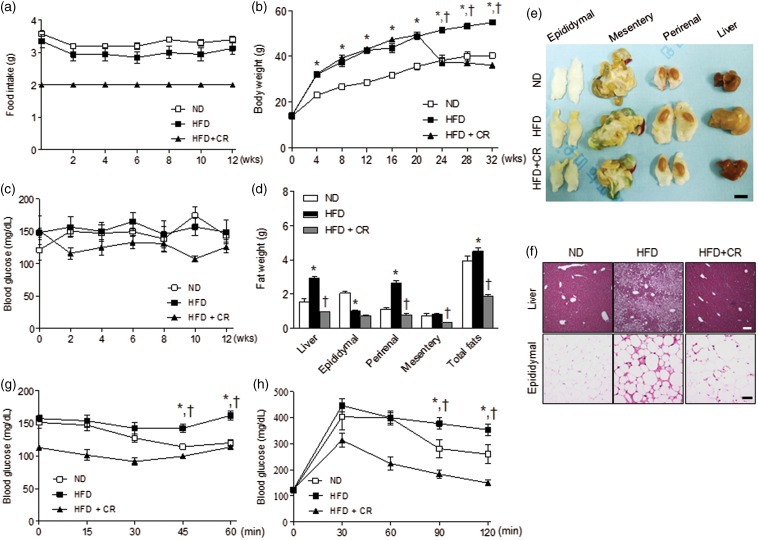
Effects of CR on the diabetic phenotype of HFD-fed mice. (a) Food intake; (b) body weight; (c) fasting blood glucose; (d) weight changes in liver and intraabdominal fats (epididymal, mesentery, and perirenal fat); (e) gross morphology of liver and intraabdominal fats; (f) lipid accumulation in hepatocytes and macrophage infiltration in adipocytes shown by H&E staining; and insulin (g) and glucose (h) tolerance tests in ND, HFD, and HFD-fed caloric-restricted (HFD+CR) mice. Data are presented as mean ± SEM. *p < 0.05 for HFD-fed versus ND-fed mice. p < 0.05 for HFD+CR versus HFD-fed mice. Scale bar = 1 cm (in (e)), or 100 µm (in (f)).
Figure 3.
Figure 3.
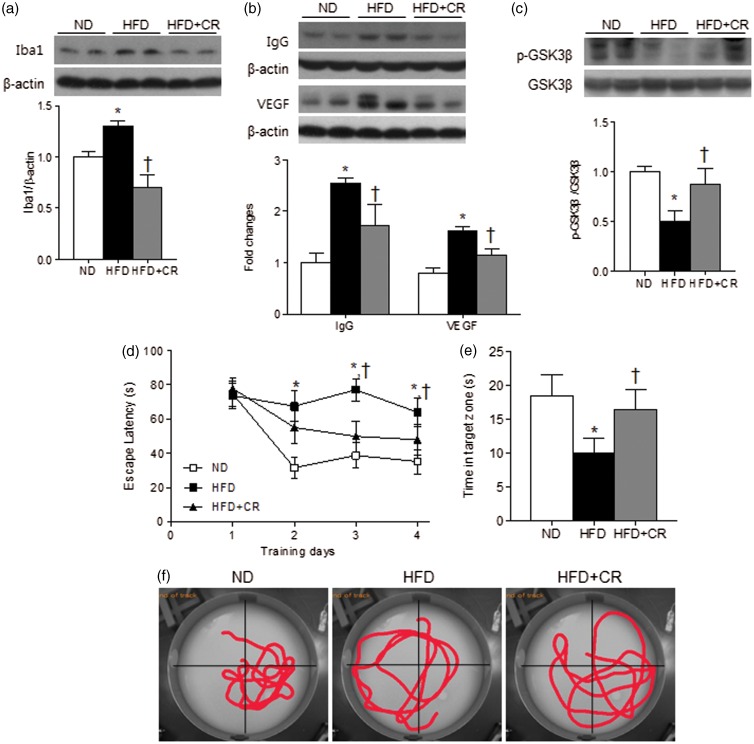
Effects of CR on glial activation, BBB leakage, and memory deficits in HFD-fed mice. Representative western blots and protein quantification of (a) Iba-1, (b) IgG and VEGF, and (c) p-GSK3β in the hippocampus of ND, HFD, and HFD+CR mice. Band intensity was normalized to β-actin or GSK3β. (d) Escape latency over four days of training trials; (e) average time spent in the target zone during probe trials; and (f) representative swimming trajectories of ND, HFD, and HFD+CR mice. Data are presented as mean ± SEM. *p < 0.05 for HFD-fed versus ND-fed mice. p < 0.05 for HFD+CR versus HFD-fed mice.
Figure 4.
Figure 4.
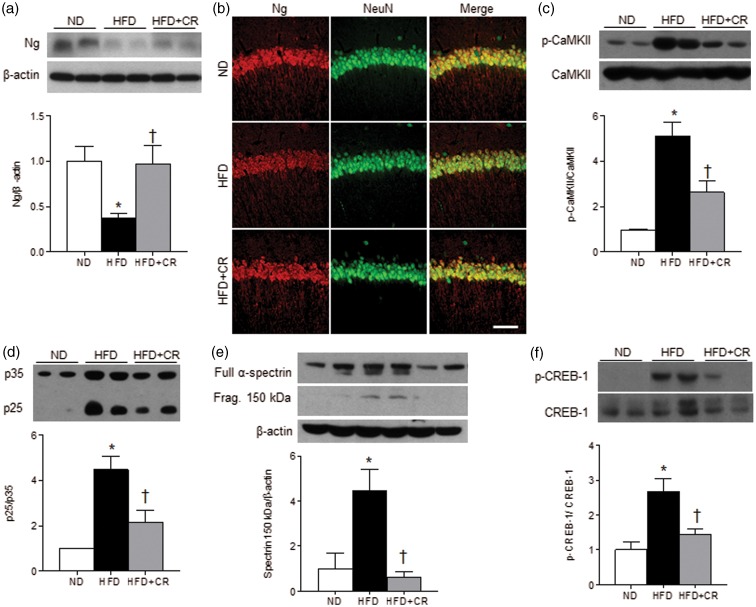
Effects of CR on the hippocampal expression of Ng and downstream proteins. Representative western blots and protein quantification of (a) Ng in the hippocampus of ND, HFD, and HFD+CR mice. (b) Immunofluorescence staining of Ng in the hippocampal CA1 region. Representative western blots and protein quantification of (c) p-CaMKII and CaMKII, (d) p35 and p25, (e) full length α-spectrin and the fragment, and (f) p-CREB-1 and CREB-1. Data are presented as mean ± SEM. *p < 0.05 for HFD-fed versus ND-fed mice. p < 0.05 for HFD+CR versus HFD-fed mice. Scale bar = 100 µm.

References

    1. Strachan MW, Reynolds RM, Marioni RE, et al. Cognitive function, dementia and type 2 diabetes mellitus in the elderly. Nat Rev Endocrinol 2011; 7: 108–114. - PubMed
    1. Biessels GJ, Staekenborg S, Brunner E, et al. Risk of dementia in diabetes mellitus: a systematic review. Lancet Neurol 2006; 5: 64–74. - PubMed
    1. Kroner Z. The relationship between Alzheimer’s disease and diabetes: type 3 diabetes? Alternat Med Rev 2009; 14: 373–379. - PubMed
    1. Nguyen JC, Killcross AS, Jenkins TA. Obesity and cognitive decline: role of inflammation and vascular changes. Front Neurosci 2014; 8: 375. - PMC - PubMed
    1. Huber JD. Diabetes, cognitive function, and the blood-brain barrier. Curr Pharm Des 2008; 14: 1594–1600. - PubMed

Publication types