Review
. 2016 Apr;56(4):980-93.
doi: 10.1111/trf.13442. Epub 2015 Dec 12.

Metabolomics in transfusion medicine

Affiliations
Review

Metabolomics in transfusion medicine

Travis Nemkov et al. Transfusion. 2016 Apr.

Abstract

Biochemical investigations on the regulatory mechanisms of red blood cell (RBC) and platelet (PLT) metabolism have fostered a century of advances in the field of transfusion medicine. Owing to these advances, storage of RBCs and PLT concentrates has become a lifesaving practice in clinical and military settings. There, however, remains room for improvement, especially with regard to the introduction of novel storage and/or rejuvenation solutions, alternative cell processing strategies (e.g., pathogen inactivation technologies), and quality testing (e.g., evaluation of novel containers with alternative plasticizers). Recent advancements in mass spectrometry-based metabolomics and systems biology, the bioinformatics integration of omics data, promise to speed up the design and testing of innovative storage strategies developed to improve the quality, safety, and effectiveness of blood products. Here we review the currently available metabolomics technologies and briefly describe the routine workflow for transfusion medicine-relevant studies. The goal is to provide transfusion medicine experts with adequate tools to navigate through the otherwise overwhelming amount of metabolomics data burgeoning in the field during the past few years. Descriptive metabolomics data have represented the first step omics researchers have taken into the field of transfusion medicine. However, to up the ante, clinical and omics experts will need to merge their expertise to investigate correlative and mechanistic relationships among metabolic variables and transfusion-relevant variables, such as 24-hour in vivo recovery for transfused RBCs. Integration with systems biology models will potentially allow for in silico prediction of metabolic phenotypes, thus streamlining the design and testing of alternative storage strategies and/or solutions.


Conflict of interest statement

CONFLICT OF INTEREST

TN, KCH, and AD are part of Endura LLC. LJD and AD are consultants for New Health Sciences, Inc.

Figures
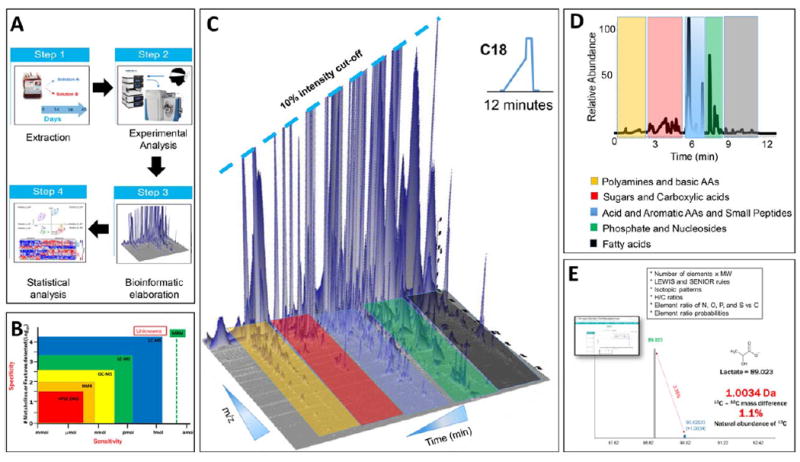
Fig. 1
Fig. 1
(A) Overview of the metabolomics workflow. (B) General sensitivity and specificity attributes for NMR and MS technologies. Targeted MS-based approaches such as multiple reaction monitoring (MRM) increase sensitivity of the assays, at the expense of the total number of compounds monitored in one analysis. (C and D) Representative three-dimensional and two-dimensional spectrum of a routine 12-minute run of RBC extracts. (E) Representative schematic of metabolite identity assignment on the basis of accurate intact mass, chromatographic retention times, isotopic patterns, and the seven golden rules for the heuristic determination of compound identifications on the basis of MS profiles.
Fig. 2
Fig. 2
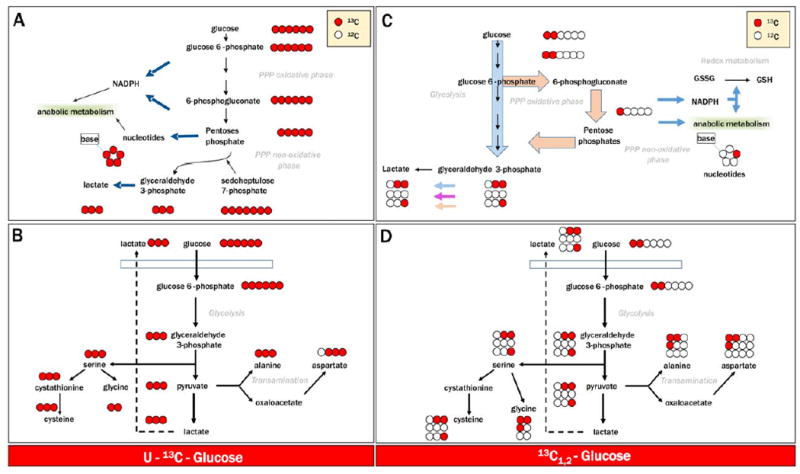
Flux balance analysis and tracing experiments upon incubation of blood cell products with heavy labeled substrates has been made amenable to routine analysis by the introduction of state-of-the-art NMR- and MS-based analytical technologies. Here we show four representative examples of isotopologue distributions upon labeling of glycolysis-pentose phosphate pathway and serine biosynthesis-transaminase activity pathway, after incubation of cells with uniformly labeled 13C1-6-glucose (A and B) or glucose labeled only at Carbon Positions 1 and 2 (13C1,2-glucose—C and D), respectively.
Fig. 3
Fig. 3
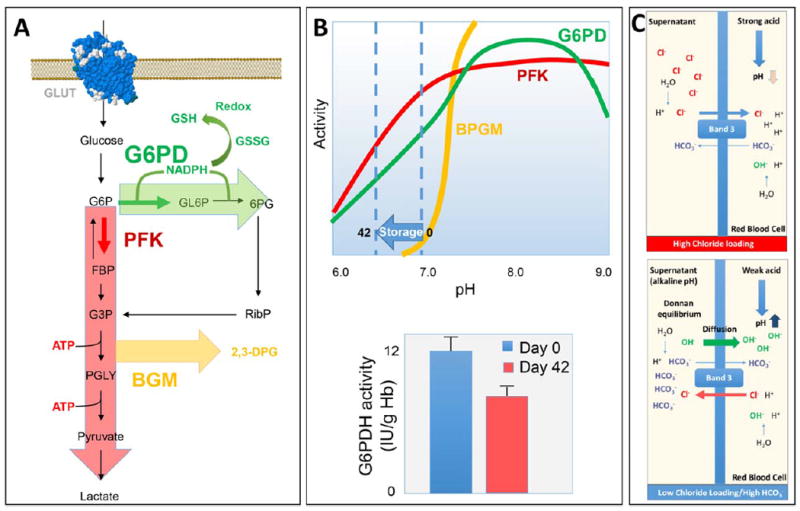
(A) Overview of the main glucose oxidation pathways in RBCs. (B) pH dependency of the activity of rate-limiting enzymes of glycolysis, pentose phosphate pathway, and Rapoport-Luebering shunt are shown. (C) Schematized representation of the combined effect on pH mediated by the chloride shift and Donnan equilibrium, either in chloride-rich (top panel) or chloride-free and high-bicarbonate (bottom panel) ASs for RBC storage.
Fig. 4
Fig. 4
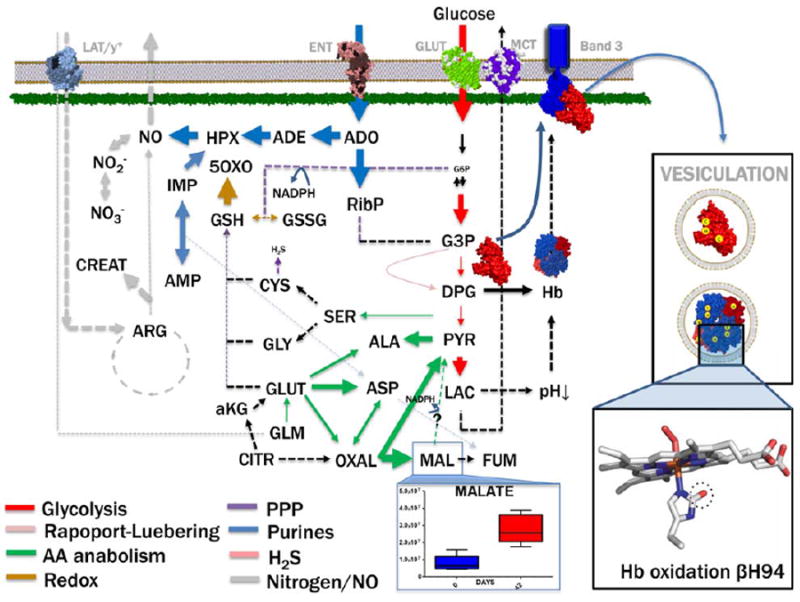
An overview of the main metabolic pathways affected by the storage lesion in RBCs during routine storage in the blood bank. Lipolysis and lipid oxidation are excluded for simplification. Of note, omics technologies, such as proteomics and interactomics,, have revealed the unanticipated complexity of the RBC metabolic machinery, suggesting that cytosolic versions of Krebs cycle enzymes (e.g., malate dehydrogenase, alanine and aspartate transaminases, ATP citrate lyase, fumarase, and pyruvate carboxylase) might allow the mature RBC to metabolize tri- and dicarboxylates, as an alternative route to generate reducing coenzymes NADH and NADPH other than glycolysis and the pentose phosphate pathway. Malate levels in RBCs stored in AS-3 are adapted from D’Alessandro et al. Oxidative stress–dependent modulation of metabolic enzymes (G6PDH) and functional proteins involved in oxygen transport and oxygen-dependent metabolic modulation are adapted from Wither et al. and Haines et al. (under review).
Fig. 5
Fig. 5
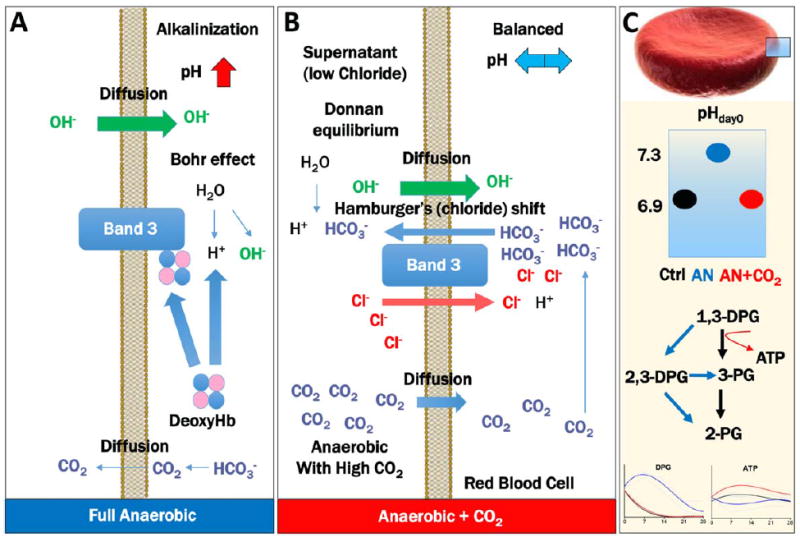
Anaerobic storage of RBCs has been shown to convey some metabolic benefits, especially in relation to energy metabolism. It can be argued that complete anaerobiosis or sustained hypoxia (O2 < 10%) promotes intracellular alkalinization, by removing CO2 along with oxygen, promoting bicarbonate (HCO3) ion loss by backward reactions of carbonic anhydrase to produce CO2, which then diffuses through the membrane (A). To balance ion homeostasis, Donnan equilibrium promotes OH diffusion inside the cells. Both these events, together with deoxyhemoglobin scavenging of the Bohr proton to stabilize the T state of hemoglobin, result in the intracellular alkalinization of the cytosol. To disentangle the relative contribution to hypoxia and pH, Dumont and colleagues recently stored RBCs in presence of 5% CO2, which promotes pH balance despite hypoxic conditions, through the mechanisms (B). Briefly, intracellular bicarbonate ions increase upon CO2 diffusion inside the cells and conversion to bicarbonate by carbonic anhydrases; excess bicarbonate ions are exchanged with chloride anions through the Hamburger’s (chloride) shift, a Band 3–dependent anion-exchange mechanism; finally, increased intracellular levels of chloride, a stronger acid than bicarbonate, result in the acidification of the cytosolic milieu. (C) Illustrates that supplementation of CO2 under hypoxic conditions promotes initial pH normalization to control levels (black), resulting in higher ATP and lower DPG in comparison to hypoxic RBCs without CO2 supplementation (blue). Other than based on a pH effect on BPGM activity (see Fig. 2), this phenomenon is also driven by the loss of ATP generation when trioses are rerouted through the Rapoport-Luebering shunt (C).

References

    1. Rous P, Turner JR. The preservation of living red blood cells in vitro. J Exp Med. 1916;23:219–37. - PMC - PubMed
    1. Blood safety and availability [Internet] Geneva: WHO; 2015. [2015 Sep 23]. Available from: http://www.who.int/entity/mediacentre/factsheets/fs279/en/index.html.
    1. Holst LB, Petersen MW, Haase N, et al. Restrictive versus liberal transfusion strategy for red blood cell transfusion: systematic review of randomised trials with meta-analysis and trial sequential analysis. BMJ. 2015;350:h1354. - PMC - PubMed
    1. Carson JL, Sieber F, Cook DR, et al. Liberal versus restrictive blood transfusion strategy: 3-year survival and cause of death results from the FOCUS randomised controlled trial. Lancet. 2015;385:1183–9. - PMC - PubMed
    1. Spitalnik SL, Triulzi D, Devine DV, et al. 2015 proceedings of the National Heart, Lung, and Blood Institute’s State of the Science in Transfusion Medicine symposium. Transfusion. 2015;55:2282–90. - PMC - PubMed