


Verticillium longisporum, the invisible threat to oilseed rape and other brassicaceous plant hosts
- PMID: 26663851
- PMCID: PMC6638321
- DOI: 10.1111/mpp.12350
Verticillium longisporum, the invisible threat to oilseed rape and other brassicaceous plant hosts
Abstract
Introduction: The causal agents of Verticillium wilts are globally distributed pathogens that cause significant crop losses every year. Most Verticillium wilts are caused by V. dahliae, which is pathogenic on a broad range of plant hosts, whereas other pathogenic Verticillium species have more restricted host ranges. In contrast, V. longisporum appears to prefer brassicaceous plants and poses an increasing problem to oilseed rape production.
Taxonomy: Kingdom Fungi; Phylum Ascomycota; Class Sordariomycetes; Subclass Hypocreomycetida; Family Plectosphaerellaceae; genus Verticillium.
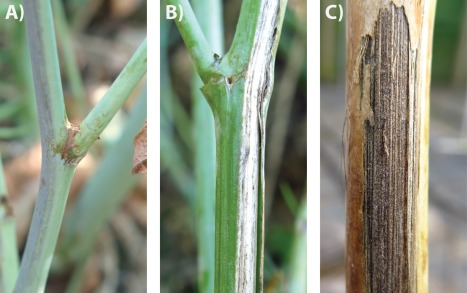
Disease symptoms: Dark unilateral stripes appear on the stems of apparently healthy looking oilseed rape plants at the end of the growing season. Microsclerotia are subsequently formed in the stem cortex beneath the epidermis.
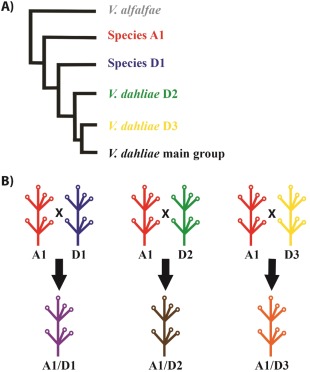
Genome: Verticillium longisporum is the only non-haploid species in the Verticillium genus, as it is an amphidiploid hybrid that carries almost twice as much genetic material as the other Verticillium species as a result of interspecific hybridization.
Disease management: There is no effective fungicide treatment to control Verticillium diseases, and resistance breeding is the preferred strategy for disease management. However, only a few Verticillium wilt resistance genes have been identified, and monogenic resistance against V. longisporum has not yet been found. Quantitative resistance exists mainly in the Brassica C-genome of parental cabbage lines and may be introgressed in oilseed rape breeding lines.
Common name: Oilseed rape colonized by V. longisporum does not develop wilting symptoms, and therefore the common name of Verticillium wilt is unsuitable for this crop. Therefore, we propose 'Verticillium stem striping' as the common name for Verticillium infections of oilseed rape.
Keywords: Arabidopsis; Brassica; amphidiploid; disease management; host range; pathogenicity; vascular wilt.
© 2015 BSPP and John Wiley & Sons Ltd.
Figures
References
-
- Acharya, B.R. and Assmann, S.M. (2009) Hormone interactions in stomatal function. Plant Mol. Biol. 69, 451–462. - PubMed
-
- Babadoost, M. , Chen, W. , Bratsch, A.D. and Eastman, C.E. (2004) Verticillium longisporum and Fusarium solani: two new species in the complex of internal discoloration of horseradish roots. Plant Pathol. 53, 669–676.
-
- Bell, A.A. and Wheeler, M.H. (1986) Biosynthesis and functions of fungal melanins. Annu. Rev. Phytopathol. 24, 411–451.
-
- Berlanger, I. and Powelson, M.L. (2000) Verticillium wilt. The Plant Health Instructor. Available at: http://www.apsnet.org/edcenter/intropp/lessons/fungi/ascomycetes/Pages/V.... doi: 10.1094/PHI-I-PHI-1-2000-0801-01. Updated 2005. - DOI
-
- Berry, P. , Cook, S. , Ellis, S. , Gladders, P. and Roques, S. (2012) HGCA Oilseed rape guide (Boys E., ed.). Stoneleigh Park, Kenilworth, Warwickshire: HGCA Publications.
Publication types
MeSH terms
LinkOut - more resources
Full Text Sources
Other Literature Sources
