


Prediction of Poor Ovarian response by Biochemical and Biophysical Markers: A Logistic Regression Model
- PMID: 26664002
- PMCID: PMC4666210
- DOI: 10.1007/s13224-014-0639-8
Prediction of Poor Ovarian response by Biochemical and Biophysical Markers: A Logistic Regression Model
Abstract
Objectives: To study correlation between ovarian reserve with biophysical markers (antral follicle count and ovarian volume) and biochemical markers (S. FSH, S. Inhibin B, and S. AMH) and use these markers to predict poor ovarian response to ovarian induction.
Methods: This is a prospective observational study. One hundred infertile women attending the Obst & Gynae Dept, KGMU were recruited. Blood samples were collected on day 2/day 3 for assessment of S. FSH, S. Inhibin B, and S. AMH and TVS were done for antral follicle count and ovarian volume. Clomephene citrate 100 mg 1OD was given from day 2 to 6, and patients were followed up with serial USG measurements. The numbers of dominant follicles (> or = 14 mm) at the time of hCG administration were counted. Patients with <3 follicles in the 1st cycle were subjected to the 2nd cycle of clomephene 100 mg 1OD from day 2 to day 6 with Inj HMG 150 IU given i.m. starting from day 8 and every alternate day until at least one leading follicle attained ≥18 mm. Development of <3 follicles at end of the 2nd cycle was considered as poor response.
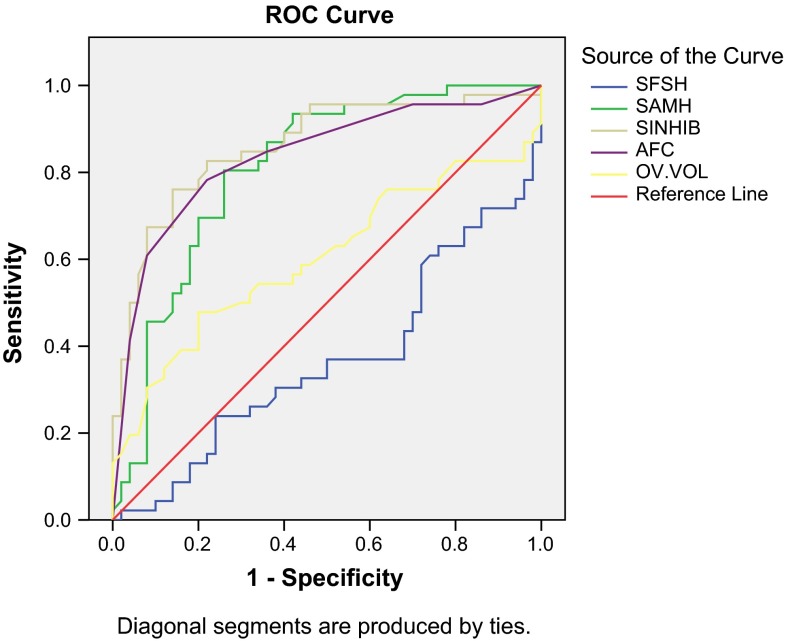
Results: Univariate analyses showed that s. inhibin B presented the highest (ROCAUC = 0.862) discriminating potential for predicting poor ovarian response, In multivariate logistic regression model, the variables age, FSH, AMH, INHIBIN B, and AFC remained significant, and the resulting model showed a predicted accuracy of 84.4 %.
Conclusion: A derived multimarker computation by a logistic regression model for predicting poor ovarian response was obtained through this study. Thus, potential poor responders could be identified easily, and appropriate ovarian stimulation protocol could be devised for such pts.
Keywords: Anti-mullerian hormone; Antral follicle count; Inhibin B; Logistic regression analysis; Poor responders.
Figures
References
-
- Elgindy EA, El-Haieg DO, El-Sebaey A, et al. Anti-Müllerian hormone: correlation of early follicular, ovulatory and midluteal levels with ovarian response and cycle outcome in intracytoplasmic sperm injection patients. Fertil Steril. 2007. - PubMed
-
- Van der steeg JW et al. Prediction models in reproductive medicine.
-
- Ferraretti AP, La Marca A, Fauser BCJM, et al. On behalf of the ESHRE working group on poor ovarian response definition; ESHRE consensus on the definition of ‘poor response’ to ovarian stimulation for in vitro fertilization: the Bologna criteria. Hum Reprod. 2011 pp. 1–9 - PubMed
-
- James P, Toner MD. Ovarian reserve, female age and the chance for successful pregnancy. Fertil Steril. 1991;55(4):784–791. - PubMed
LinkOut - more resources
Full Text Sources
Other Literature Sources