


Serological Evidence of Rift Valley Fever Virus Circulation in Domestic Cattle and African Buffalo in Northern Botswana (2010-2011)
- PMID: 26664990
- PMCID: PMC4672236
- DOI: 10.3389/fvets.2015.00063
Serological Evidence of Rift Valley Fever Virus Circulation in Domestic Cattle and African Buffalo in Northern Botswana (2010-2011)
Abstract
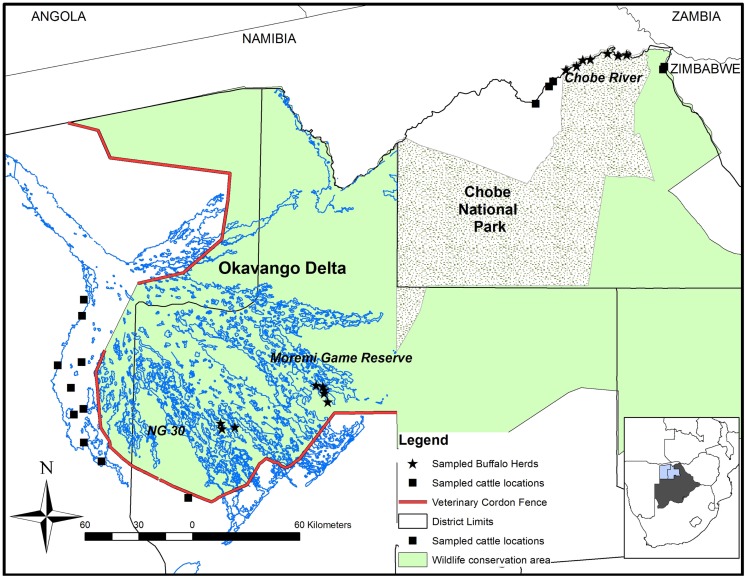
Rift Valley fever (RVF) is endemic in many countries in Sub-Saharan Africa and is responsible for severe outbreaks in livestock characterized by a sudden onset of abortions and high neonatal mortality. During the last decade, several outbreaks have occurred in Southern Africa, with a very limited number of cases reported in Botswana. To date, published information on the occurrence of RVF in wild and domestic animals from Botswana is very scarce and outdated, despite being critical to national and regional disease control. To address this gap, 863 cattle and 150 buffalo sampled at the interface between livestock areas and the Chobe National Park (CNP) and the Okavango Delta (OD) were screened for the presence of RVF virus (RVFV) neutralizing antibodies. Antibodies were detected in 5.7% (n = 863), 95% confidence intervals (CI) (4.3-7.5%) of cattle and 12.7% (n = 150), 95% CI (7.8-19.5%) of buffalo samples. The overall prevalence was significantly higher (p = 0.0016) for buffalo [12.7%] than for cattle [5.7%]. Equally, when comparing RVF seroprevalence in both wildlife areas for all pooled bovid species, it was significantly higher in CNP than in OD (9.5 vs. 4%, respectively; p = 0.0004). Our data provide the first evidence of wide circulation of RVFV in both buffalo and cattle populations in Northern Botswana and highlight the need for further epidemiological and ecological investigations on RVF at the wildlife-livestock-human interface in this region.
Keywords: African buffalo; Botswana; Rift Valley fever; Syncerus caffer; cattle; neutralizing antibodies; one health; serology.
Figures
References
-
- Paweska JT, Jansen Van Vuren P. Chapter 8: Rift Valley fever virus: a virus with potential for global emergence. In: Johnson N, editor. The Role of Animals in Emerging Viral Diseases. London: Elsevier Academic Press; (2013). p. 169–200.
-
- Swanepoel R, Paweska J. Rift Valley fever. In: Oxford Textbook of Zoonoses: Biology, Clinical Practice, and Public Health. Oxford: Oxford University Press; (2011). p. 423–31.
-
- Paweska JT. Chapter: Rift Valley fever. In: Ergonul O, Can F, Akova M, Madof L, editors. Clinical Case Study of Emerging Infectious Diseases. London: Elsevier Academic Press; (2014). p. 73–93.
LinkOut - more resources
Full Text Sources
Other Literature Sources
Miscellaneous
