


Toward earlier identification and preventative intervention in schizophrenia: evidence from the London Child Health and Development Study
- PMID: 26670311
- PMCID: PMC4823320
- DOI: 10.1007/s00127-015-1151-x
Toward earlier identification and preventative intervention in schizophrenia: evidence from the London Child Health and Development Study
Abstract
Purpose: The London Child Health and Development Study (CHADS) is a prospective, longitudinal investigation of children, sampled from the general community aged 9-11 years and assessed biennially, who present premorbid risk markers for schizophrenia. The study aims to characterise developmental trajectories of psychological, cognitive, and biological functioning in at-risk children and identify potential targets for early preventative intervention. This review summarises CHADS findings, discusses these in the context of recent theory regarding aetiology and prevention of schizophrenia, and highlights challenges to be addressed with future research.
Methods: We review (1) epidemiological information on the prevalence and correlates of developmental antecedents of schizophrenia in the general child population, (2) evidence of psychosocial, cognitive, and biological dysfunctions in at-risk children presenting multiple antecedents of schizophrenia and at-risk children with a family history of schizophrenia, and (3) related findings from an associated sample of help-seeking children receiving intervention.
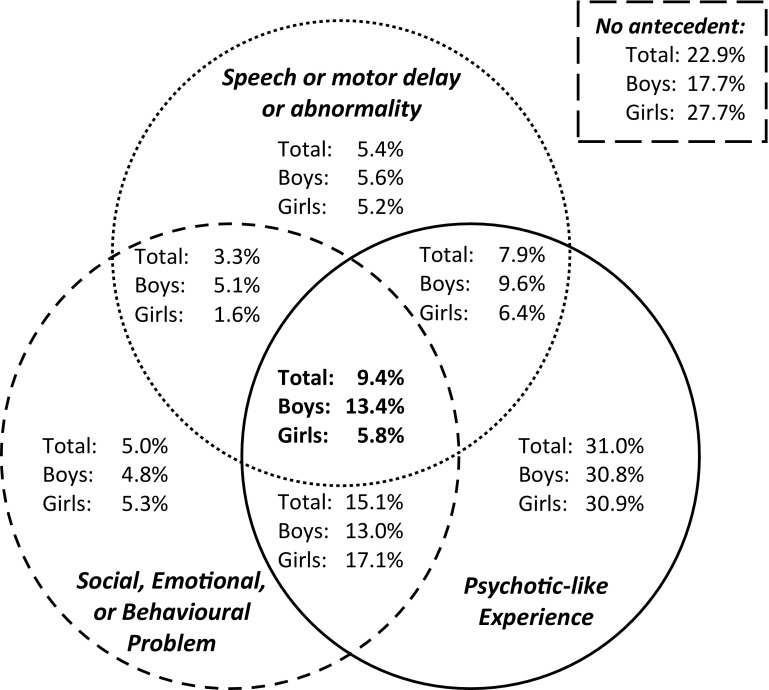
Results: Community-based screening of 9-11-year olds identified ~9 % with a triad of antecedents of schizophrenia [including psychotic-like experiences (PLEs)] who are putatively at-risk of psychosis; these children reported greater exposure and responsivity to stressors, impairments in general intelligence and specific cognitive functions, brain structure and function abnormalities, and neuromotor dysfunction. Preliminary evidence suggests distressing PLEs are a viable target for cognitive-behavioural intervention in at-risk children.
Conclusions: Intervention in early, premorbid phases of illness might alleviate current difficulties and avert future schizophrenia using benign treatments. The CHADS programme has identified several markers that may index early pathophysiology and constitute potential targets for preventative intervention.
Keywords: Adolescence; Developmental psychopathology; High-risk; Psychosis; Psychotic-like experiences.
Figures
Comment in
-
Childhood antecedents of schizophrenia: Will understanding aetiopathogenesis result in schizophrenia prevention?Soc Psychiatry Psychiatr Epidemiol. 2016 Apr;51(4):493-5. doi: 10.1007/s00127-016-1184-9. Epub 2016 Jan 29. Soc Psychiatry Psychiatr Epidemiol. 2016. PMID: 26825648 No abstract available.
References
-
- Fusar-Poli P, Borgwardt S, Bechdolf A, Addington J, Riecher-Rossler A, Schultze-Lutter F, Keshavan M, Wood S, Ruhrmann S, Seidman LJ, Valmaggia L, Cannon T, Velthorst E, De Haan L, Cornblatt B, Bonoldi I, Birchwood M, McGlashan T, Carpenter W, McGorry P, Klosterkotter J, McGuire P, Yung A. The psychosis high-risk state: a comprehensive state-of-the-art review. JAMA Psychiatry. 2013;70(1):107–120. doi: 10.1001/jamapsychiatry.2013.269. - DOI - PMC - PubMed
-
- Fusar-Poli P, Bonoldi I, Yung AR, Borgwardt S, Kempton MJ, Valmaggia L, Barale F, Caverzasi E, McGuire P. Predicting psychosis: meta-analysis of transition outcomes in individuals at high clinical risk. Arch Gen Psychiatry. 2012;69(3):220–229. doi: 10.1001/archgenpsychiatry.2011.1472. - DOI - PubMed
Publication types
MeSH terms
Grants and funding
LinkOut - more resources
Full Text Sources
Other Literature Sources
Medical
