


Early Childhood Education to Promote Health Equity: A Community Guide Systematic Review
- PMID: 26672406
- PMCID: PMC4969181
- DOI: 10.1097/PHH.0000000000000378
Early Childhood Education to Promote Health Equity: A Community Guide Systematic Review
Abstract
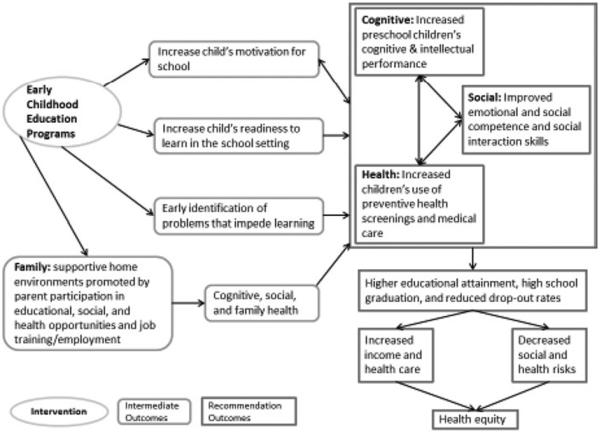
Context: Children in low-income and racial and ethnic minority families often experience delays in development by 3 years of age and may benefit from center-based early childhood education.
Design: A meta-analysis on the effects of early childhood education by Kay and Pennucci best met Community Guide criteria and forms the basis of this review.
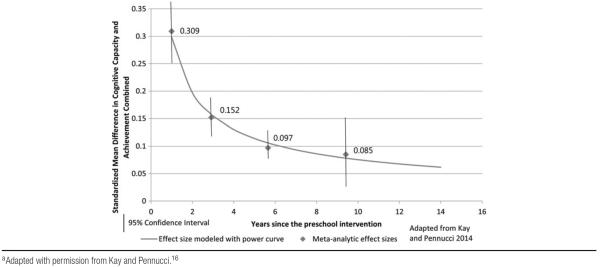
Results: There were increases in intervention compared with control children in standardized test scores (median = 0.29 SD) and high school graduation (median = 0.20 SD) and decreases in grade retention (median = 0.23 SD) and special education assignment (median = 0.28 SD). There were decreases in crime (median = 0.23 SD) and teen births (median = 0.46 SD) and increases in emotional self-regulation (median = 0.21 SD) and emotional development (median = 0.04 SD). All effects were favorable, but not all were statistically significant. Effects were also long-lasting.
Conclusions: Because many programs are designed to increase enrollment for high-risk students and communities, they are likely to advance health equity.
Figures
References
-
- Commission on Social Determinants of Health . Closing the Gap in a Generation: Health Equity Through Action on the Social Determinants of Health. Final Report of the Commission on Social Determinants of Health. World Health Organization; Geneva, Switzerland: 2008.
-
- Feinstein L, Sabates R, Anderson TM, Sorhaindo A, Hammong C. What are the effects of education on health?. Paper presented at: Measuring the Effects of Education on Health and Civic Engagement. Proceedings of the Copenhagen Symposium; Copenhagen, Denmark. 2006.
-
- Zill N, West J, US Department of Education. National Center for Education Statistics . Entering Kindergarten: A Portrait of American Children When They Begin School: Findings From The Condition of Education 2000. US Department of Education, National Center for Education Statistics; Washington, DC: 2001. NCES 2001-035.
-
- Hart B, Risley TR. The early catastrophe: the 30 million word gap by age 3. Am Educ. 2003:4–9.
-
- Farkas G, Beron K. The detailed age trajectory of oral vocabulary knowledge: differences by class and race. Soc Sci Res. 2004;33:464–497.
Publication types
MeSH terms
Grants and funding
LinkOut - more resources
Full Text Sources
Other Literature Sources
Miscellaneous
