. 2016 Mar;8(3):389-99.
doi: 10.2217/epi.15.114. Epub 2015 Dec 17.

Validation of a DNA methylation microarray for 850,000 CpG sites of the human genome enriched in enhancer sequences

Affiliations

Validation of a DNA methylation microarray for 850,000 CpG sites of the human genome enriched in enhancer sequences

Sebastian Moran et al. Epigenomics. 2016 Mar.

Abstract

Aim: DNA methylation is the best known epigenetic mark. Cancer and other pathologies show an altered DNA methylome. However, delivering complete DNA methylation maps is compromised by the price and labor-intensive interpretation of single nucleotide methods.

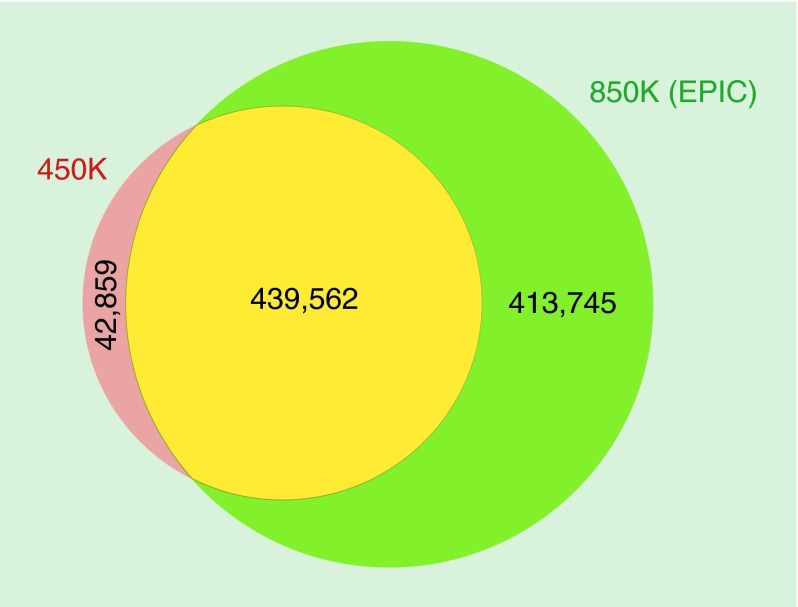
Material & methods: Following the success of the HumanMethylation450 BeadChip (Infinium) methylation microarray (450K), we report the technical and biological validation of the newly developed MethylationEPIC BeadChip (Infinium) microarray that covers over 850,000 CpG methylation sites (850K). The 850K microarray contains >90% of the 450K sites, but adds 333,265 CpGs located in enhancer regions identified by the ENCODE and FANTOM5 projects.

Results & conclusion: The 850K array demonstrates high reproducibility at the 450K CpG sites, is consistent among technical replicates, is reliable in the matched study of fresh frozen versus formalin-fixed paraffin-embeded samples and is also useful for 5-hydroxymethylcytosine. These results highlight the value of the MethylationEPIC BeadChip as a useful tool for the analysis of the DNA methylation profile of the human genome.

Keywords: 5-hydroxymethylcytosine; CpG sites; DNA methylation; epigenetics; microarray; paraffin; validation.


Conflict of interest statement

Financial & competing interests disclosure This project has received funding from the European Research Council (ERC) under the European Union's Horizon 2020 research and innovation program (grant agreement No 640696) and under the European Community's Seventh Framework Programme (FP7/2007–2013)/ERC grant agreement no. 268626 and from Ministerio de Economía y Competitividad (MINECO), co-financed by the European Development Regional Fund, ‘A way to achieve Europe’ ERDF, under grant no. SAF2014-55000-R, the Instituto de Salud Carlos III (ISCIII) by the Spanish Cancer Research Network (RTICC) no. RD12/0036/0039, the Cellex Foundation, the AGAUR 2014SGR633 grant and the Health and Science Departments of the Catalan government (Generalitat de Catalunya). ME is an ICREA Research Professor. The authors have no other relevant affiliations or financial involvement with any organization or entity with a financial interest in or financial conflict with the subject matter or materials discussed in the manuscript apart from those disclosed. No writing assistance was utilized in the production of this manuscript.

Figures
<b>Figure 1.</b>
Figure 1.. Venn diagram showing the degree of CpG overlapping (yellow) between the Infinium HumanMethylation450 BeadChip (450K; red) and the MethylationEPIC BeadChip (850K; green) microarrays.
<b>Figure 2.</b>
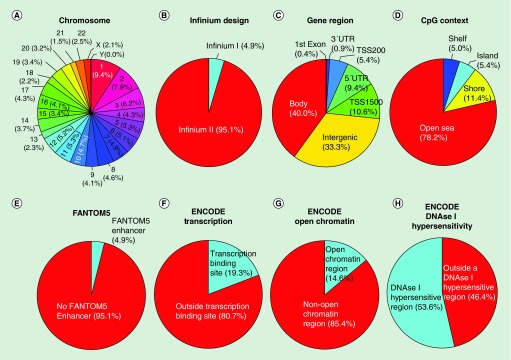
Figure 2.. Genomic and functional context of the newly added 413,759 CpG sites in the MethylationEPIC BeadChip microarray (850K).
(A) Chromosome location; (B) Infinium design chemistry (Infinium I, II); (C) UCSC gene region feature category (TSS200, TSS1500, 5′UTR, 1stExon, body, 3′UTR); (D) location of the CpG relative to the CpG island (open sea, island, shore, shelf); (E) FANTOM5 associated enhancer regions; (F) ENCODE project annotation for transcription binding site; (G) open chromatin, and (H) DNase I hypersensitive regions.
<b>Figure 3.</b>
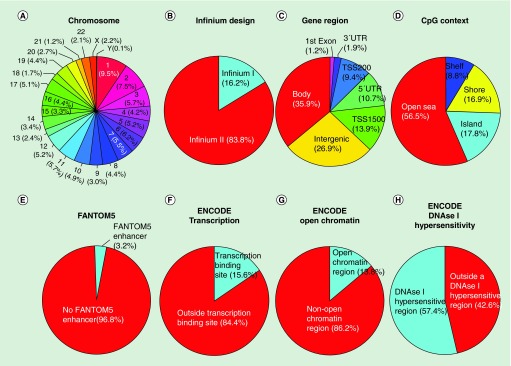
Figure 3.. Genomic and functional context of the 853,307 CpG sites in the MethylationEPIC BeadChip microarray (850K).
(A) Chromosome location; (B) Infinium design chemistry (Infinium I, II); (C) UCSC gene region feature category (TSS200, TSS1500, 5′UTR, 1st Exon, Body, 3′UTR); (D) location of the CpG relative to the CpG island (open sea, island, shore, shelf); (E) FANTOM5 associated enhancer regions; (F) ENCODE project annotation for transcription binding site; (G) open chromatin and (H) DNase I hypersensitive regions.
<b>Figure 4.</b>
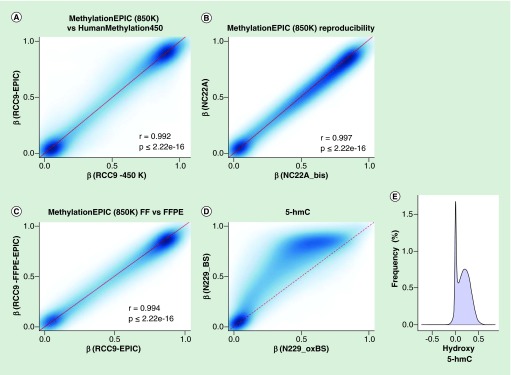
Figure 4.. Technical and biological validation of the 850K MethylationEPIC microarray.
Comparison of methylation values from HumanMethylation450 and their corresponding shared CpG sites present on MethylationEPIC microarray (A) for a renal tumor sample (RCC9). Assay reproducibility (B) of methylation measurements when using technical replicates on a normal colon (NC22A) sample. Correlation plot (C) of the methylation values obtained from a FFPE sample (RCC9-FFPE) when compared with its match biopsy of the same tumor that was preserved as FF (RCC9). 5-hmC value representation (D), where the same sample was treated as per conventional bifsulfite conversion or as per oxBS. Differences on oxBS with bifsulfite conversion are due to the level of 5-hydroxymethylation, where the absence of 5-hmC has been modeled as a discontinue red line. Frequency of hydroxymethylaton values (E) as a result of subtracting the oxBS values (due to 5-mC) from the BS values (due to 5-mC + 5-hmC) for each CpG site included on the 850K array. 5-hmC: 5-hydroxymethylation; FF: Fresh frozen; FFPE: Formalin-fixed paraffin-embedded; oxBS: Oxidative bisulfite conversion.
<b>Figure 5.</b>
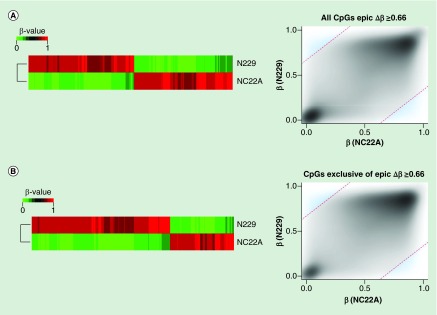
Figure 5.. Biological validation of the 850K DNA methylation microarray.
(A) Differentially methylated CpG sites (Δβ ≥0.66 ) on MethylationEPIC BeadChip microarray from a normal colon sample (NC22A), and normal sorted brain neurons (N229). Heatmap representation of differentially methylated CpG sites (left) and methylation values distribution (right) of samples where methylation differences threshold has been denoted as a discontinued red line (Δβ ≥0.66), and those values considered as differentially methylated have been highlighted in blue. (B) Differentially methylated CpG sites (Δβ ≥0.66), among the newly added 413,759 CpG sites of the MethylationEPIC BeadChip microarray, for a normal colon sample (NC22A), and normal sorted brain neurons (N229). Heatmap representation of differentially methylated CpG sites (left) and methylation values distribution (right) of samples where methylation differences threshold has been denoted as a discontinued red line (Δβ ≥0.66), and those values considered as differentially methylated have been highlighted in blue.

References

    1. Law JA, Jacobsen SE. Establishing maintaining and modifying DNA methylation patterns in plants and animals. Nat. Rev. Genet. 2010;11(3):204–220. - PMC - PubMed
    1. Jones PA, Baylin SB. The epigenomics of cancer. Cell. 2007;128(4):683–692. - PMC - PubMed
    1. Feinberg AP. An epigenetic approach to cancer etiology. Cancer J. 2007;13(1):70–74. - PubMed
    1. Weidman JR, Dolinoy DC, Murphy SK, Jirtle RL. Cancer susceptibility: epigenetic manifestation of environmental exposures. Cancer J. 2007;13(1):9–16. - PubMed
    1. Esteller M. Epigenetics in cancer. N. Engl. J. Med. 2008;358(11):1148–1159. - PubMed

Publication types