


Personalized Preclinical Trials in BRAF Inhibitor-Resistant Patient-Derived Xenograft Models Identify Second-Line Combination Therapies
- PMID: 26673799
- PMCID: PMC4818716
- DOI: 10.1158/1078-0432.CCR-15-1762
Personalized Preclinical Trials in BRAF Inhibitor-Resistant Patient-Derived Xenograft Models Identify Second-Line Combination Therapies
Abstract
Purpose: To test second-line personalized medicine combination therapies, based on genomic and proteomic data, in patient-derived xenograft (PDX) models.
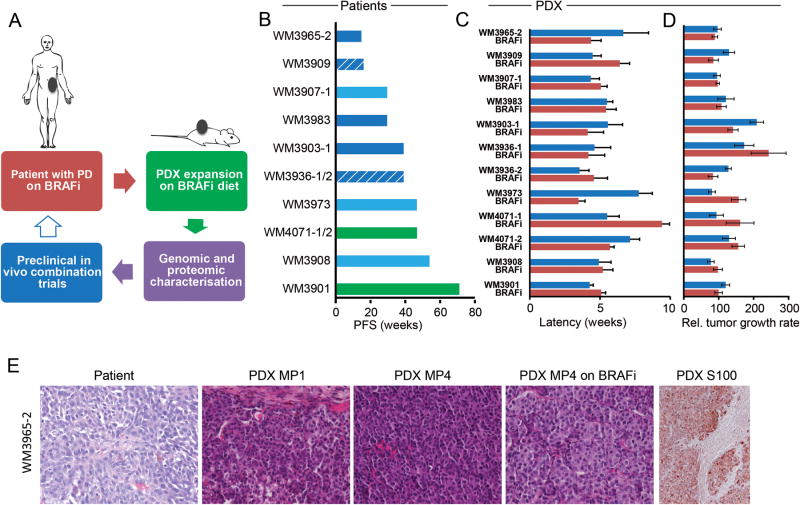
Experimental design: We established 12 PDXs from BRAF inhibitor-progressed melanoma patients. Following expansion, PDXs were analyzed using targeted sequencing and reverse-phase protein arrays. By using multi-arm preclinical trial designs, we identified efficacious precision medicine approaches.
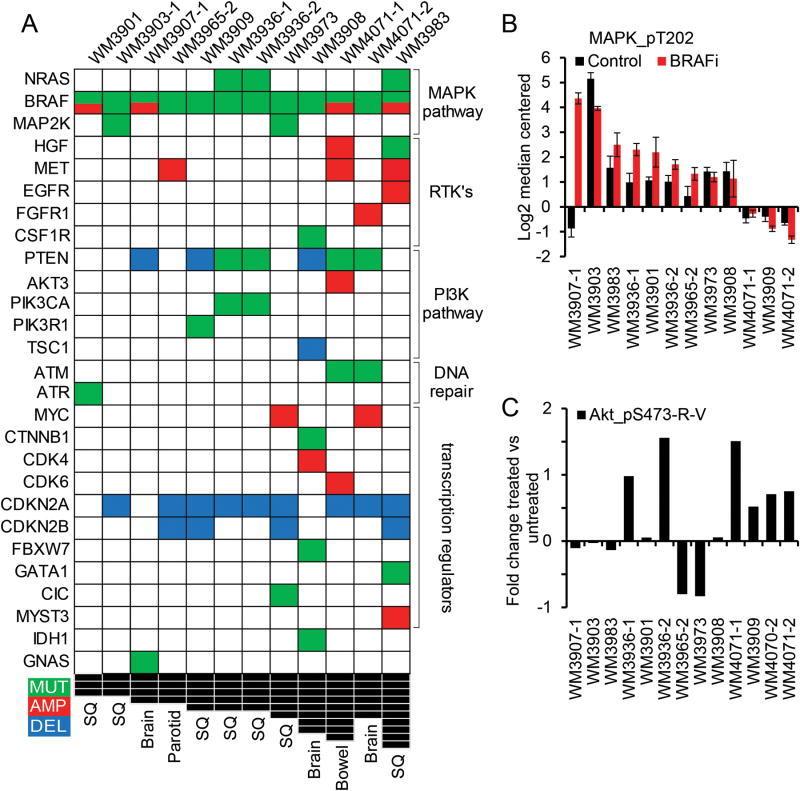
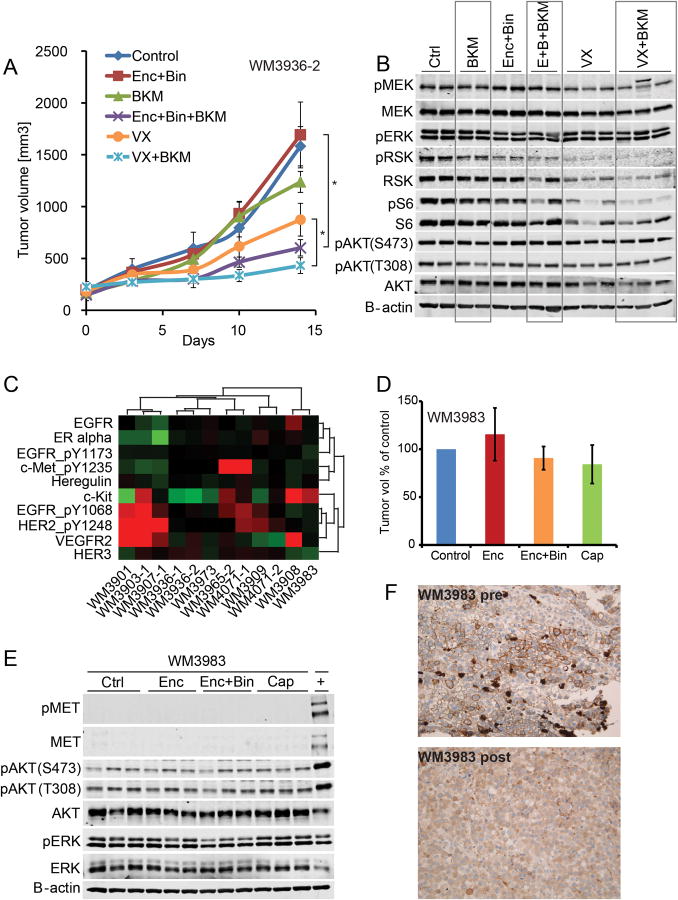
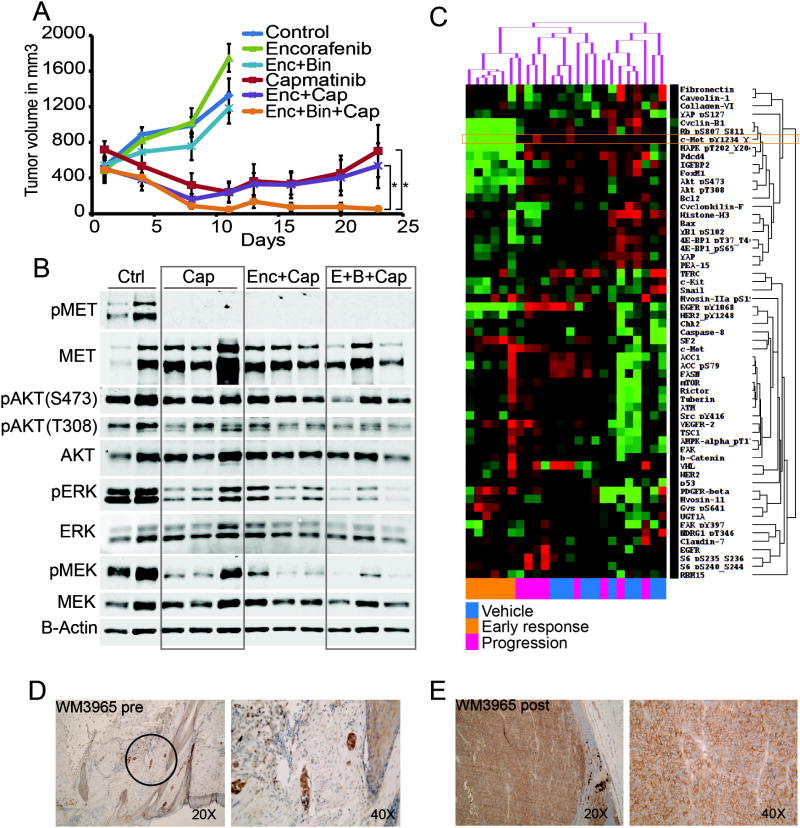
Results: We identified alterations previously described as drivers of resistance: NRAS mutations in 3 PDXs, MAP2K1 (MEK1) mutations in 2, BRAF amplification in 4, and aberrant PTEN in 7. At the protein level, re-activation of phospho-MAPK predominated, with parallel activation of PI3K in a subset. Second-line efficacy of the pan-PI3K inhibitor BKM120 with either BRAF (encorafenib)/MEK (binimetinib) inhibitor combination or the ERK inhibitor VX-11e was confirmed in vivo Amplification of MET was observed in 3 PDX models, a higher frequency than expected and a possible novel mechanism of resistance. Importantly, MET amplification alone did not predict sensitivity to the MET inhibitor capmatinib. In contrast, capmatinib as single agent resulted in significant but transient tumor regression in a PDX with resistance to BRAF/MEK combination therapy and high pMET. The triple combination capmatinib/encorafenib/binimetinib resulted in complete and sustained tumor regression in all animals.
Conclusions: Genomic and proteomic data integration identifies dual-core pathway inhibition as well as MET as combinatorial targets. These studies provide evidence for biomarker development to appropriately select personalized therapies of patients and avoid treatment failures. See related commentary by Hartsough and Aplin, p. 1550.
©2015 American Association for Cancer Research.
Conflict of interest statement
Figures
Comment in
-
Of Mice and Melanoma: PDX System for Modeling Personalized Medicine.Clin Cancer Res. 2016 Apr 1;22(7):1550-2. doi: 10.1158/1078-0432.CCR-15-3054. Epub 2016 Feb 3. Clin Cancer Res. 2016. PMID: 26842234 Free PMC article.
-
Using avatars to win the fight over BRAF inhibitor resistance.Pigment Cell Melanoma Res. 2016 Jul;29(4):398-9. doi: 10.1111/pcmr.12473. Epub 2016 May 17. Pigment Cell Melanoma Res. 2016. PMID: 27185579 Free PMC article. No abstract available.
References
-
- Robert C, Karaszewska B, Schachter J, Rutkowski P, Mackiewicz A, Stroiakovski D, et al. Improved overall survival in melanoma with combined dabrafenib and trametinib. N Engl J Med. 2015;372:30–9. - PubMed
Publication types
MeSH terms
Substances
Grants and funding
LinkOut - more resources
Full Text Sources
Other Literature Sources
Medical
Research Materials
Miscellaneous
