. 2015 Dec 16:15:965.
doi: 10.1186/s12885-015-1960-z.

Plantamajoside, a potential anti-tumor herbal medicine inhibits breast cancer growth and pulmonary metastasis by decreasing the activity of matrix metalloproteinase-9 and -2

Affiliations

Plantamajoside, a potential anti-tumor herbal medicine inhibits breast cancer growth and pulmonary metastasis by decreasing the activity of matrix metalloproteinase-9 and -2

Shimin Pei et al. BMC Cancer. .

Abstract

Background: Metastasis is the major cause of death in breast cancers. MMPs play a key role in tumor microenvironment that facilitates metastasis. The existing researches suggest that the high expression of gelatinase A and B (MMP2 and MMP9) promote the metastasis of breast cancer. Therefore, gelatinase inhibitor can effectively suppress tumor metastasis. However, at present, there is no dramatically effective gelatinase inhibitor against breast cancer.

Methods: We screened gelatinase inhibitor among Chinese herbal medicine by molecular docking technology; investigated the proliferation, migration and invasion of MDA-MB-231 human breast cancer cell line and 4T1 mouse breast cancer cell line in response to the treatment with the screened inhibitor by wound assay, invasion assay and gelatin zymography; then further examined the effects of inhibitor on allograft mammary tumors of mice by immunohistochemistry.

Results: We successfully screened an Chinese herbal medicine-Plantamajoside(PMS)-which can reduce the gelatinase activity of MMP9 and MMP2. In vitro, PMS can inhibit the proliferation, migration and invasion of MDA-MB-231 human breast cancer cell line and 4T1 mouse breast cancer cell line by decreasing MMP9 and MMP2 activity. In vivo, oral administration of PMS to the mice bearing 4T1 cells induced tumors resulted in significant reduction in allograft tumor volume and weights, significant decrease in microvascular density and significant lower lung metastasis rate.

Conclusions: Our results indicate that as a promising anti-cancer agent, PMS may inhibit growth and metastasis of breast cancer by inhibiting the activity of MMP9 and MMP2.


Figures
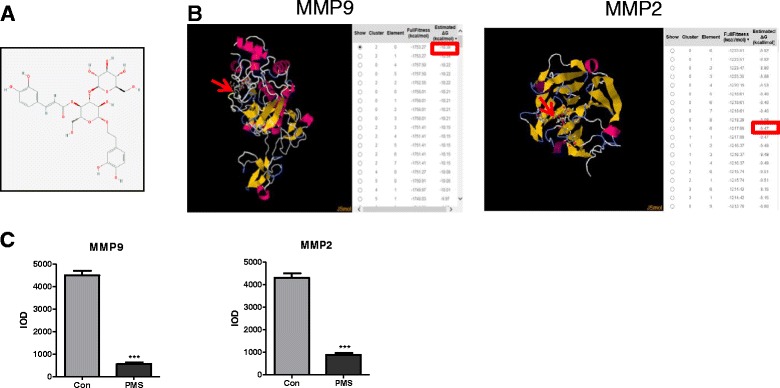
Fig. 1
Fig. 1
Plantamajoside(PMS) affects the activity of MMP9 and MMP2. a A diagram of the structure of PMS(PubChem CID:5281788). b The molecular docking of PMS to MMP9 and MMP2. We can see the PMS molecule (indicated with red arrow) combined with MMP9 or MMP2, and the minimum ∆G (circled in red square)value were -10.39 and -9.51 kcal/mol respectively. c Detected IOD of substrate activated by MMP9 and MMP2 treated with solvent or PMS. Data represent the mean ± S.D. of three independent experiments. The *** indicates extremely significance different
Fig. 2
Fig. 2
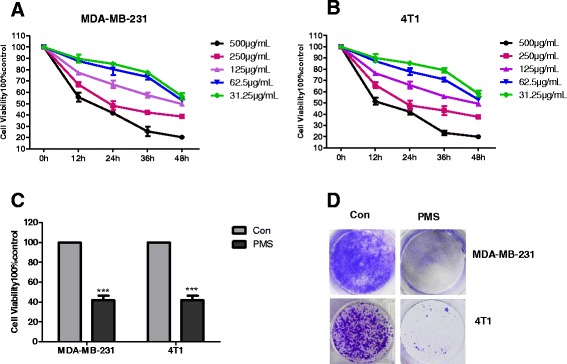
Cell viability decreased after treatment of PMS. Cell viability was analyzed using Cell Counting Kit 8 at 0, 12,24,36,48 h after 31.25, 62.5, 125, 250, 500 μg/m L PMS treatment in (a) MDA-MB-231 and (b) 4T1 cells. c Cell viability was detected after 36 h 250 μg/mL PMS treatment. Data represent the mean ± S.D. of three independent experiments. d Colony formation of MDA-MB-231 and 4T1 cells. Cells were treated with 100 μg/mL PMS for 36 h, followed with crystal violet staining of attached cells at 10 days. Similar results were obtained from independent experiments. The *** indicates extremely significance different
Fig. 3
Fig. 3
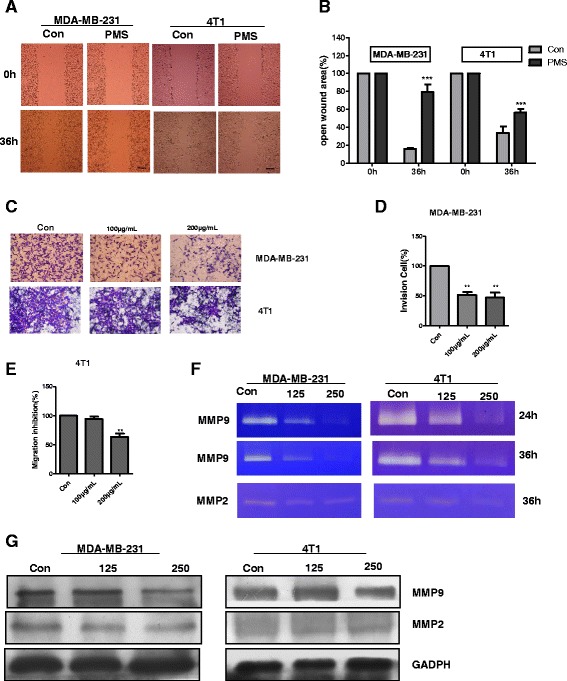
PMS inhibits migration and invasion of MDA-MB-231 or 4T1 cells by decreasing the activity of MMP insdead of the expression of MMP. a and b Effect of PMS on cellular migration by wound assay. a Confluent monolayers of cells were culture with solvent and with 200 μg/ mL PMS and the migration was evaluated by wound assay at 36 h. Scale bar = 100 μm. b The analysis of % open wound area was performed by the Tscratch software corresponding to the images in a. Data represent the mean ± S.D. of three independent experiments. c–e Effect of PMS on cellular invasion by transwell assay. c Cells were cultured with solvent or with 100, 200 μg/mL PMS onto the upper well coated with Matrigel. After 36 h treatment, cells passed though the Matrigel into the lower well were stained and counted. Scale bar = 25 μm (d) and (e) Analysis the % of invasion in comparison with control cell(100 %) corresponding to the images in c. Data represent the mean ± S.D. of three independent experiments. f PMS inhibits the activity of MMP9 and MMP2 secreted by MDA-MB-231 and 4T1 cells in vitro. The effect of PMS on MMP9 activity was tested by in gel zymography assay. Cells were cultured onto 6-well plates with solvent and with 125, 250 μg/mL PMS. After 24 h and/or 36 h treatment, cell supernatant was collected and performed Zymography. g Western Blotting showing the expression of MMP9 and MMP2 after 36 h treatment with solvent or 125, 250 μg/mL PMS. Similar results were obtained from independent experiments. The ** indicates significance different. The *** indicates extremely significance different
Fig. 4
Fig. 4
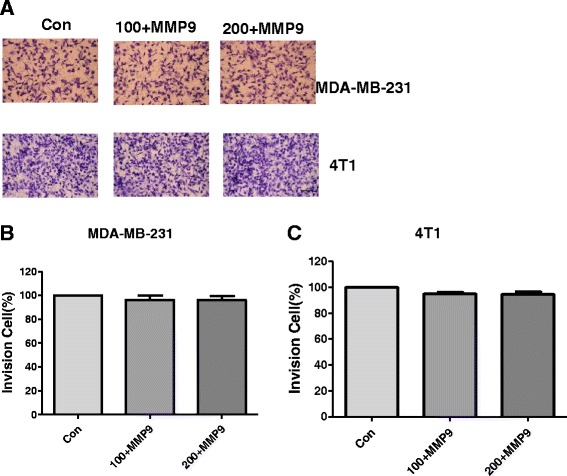
The invasion inhibition effect of PMS on MDA-MB-231 or 4T1 cells can be rescued by exogenous MMP9. a Cells were cultured with solvent or with 100, 200 μg/mL PMS onto the upper well coated with Matrigel. After 36 h treatment, exogenous MMP9 was added to the PMS treatment well for 36 h, cells passed though the Matrigel into the lower well were stained and counted. Scale bar = 25um. b and c Analysis the % of invasion in comparison with control cell(100 %) corresponding to the images in a. Data represent the mean ± S.D. of three independent experiments
Fig. 5
Fig. 5
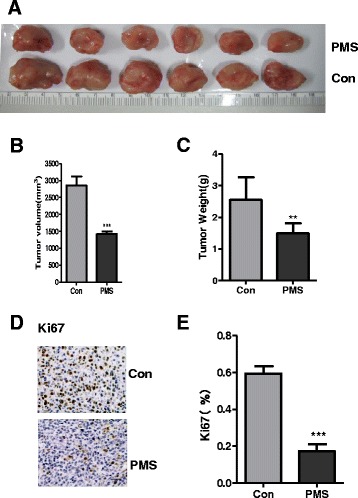
The antitumor effect of PMS treatment in vivo. Mice were injected s.c. with 1.5 × 106 4T1 cells. a–c The fifth day after the injection, mice were treated daily with PMS at 200 mg/kg by oral gavage for 21 consecutive days. a Representative tumors at the end of the experiment, (b) tumor volume, (c) tumor weight at indicated time points after treatment was calculated. d Paraffin-embedded sections of control or treated tumor tissues from mice were analyzed by Ki67 IHC staining. e Quantitative analysis of Ki67 staining corresponding to the images in d. Data represent the mean ± S.D. of three independent experiments. Scale bar = 25 μm. The ** indicates significance different. The *** indicates extremely significance different
Fig. 6
Fig. 6
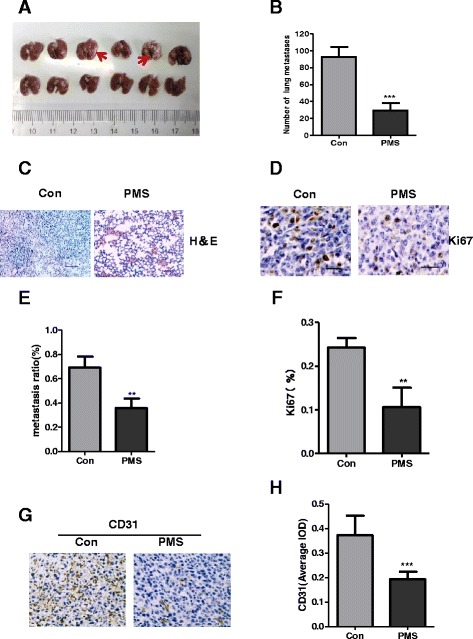
PMS inhibited tumor metastasis via decreasing angiogenesis. The complete lungs were fixed after autopsy and the number of lung metastases foci (arrow) was counted (a). b Quantitative analysis of metastases corresponding to the images in a. Paraffin-embedded sections of control or treated lung tissues from mice were analyzed by (c) H&E staining (Scale bar = 100 μm) and analyzed by (d) Ki67 IHC staining(Scale bar = 25 μm). e and f Quantitative analysis of metastases or Ki67 staining corresponding to the images in a and b respectively. Data represent the mean ± S.D. of three independent experiments. g Paraffin-embedded sections of control or treated tumor tissues from mice were analyzed by CD31 IHC staining. Scale bar = 25 μm. h Quantitative analysis of CD31 staining corresponding to the images in g. Data represent the mean ± S.D. of three independent experiments. The ** indicates significance different. The *** indicates extremely significance different

References

    1. Filipova A, Seifrtova M, Mokry J, Dvorak J, Rezacova M, Filip S, et al. Breast cancer and cancer stem cells a mini-review. Tumori. 2014;100(4):363–369. - PubMed
    1. Bohl CR, Harihar S, Denning WL, Sharma R, Welch DR. Metastasis suppressors in breast cancers: mechanistic insights and clinical potential. J Mol Med. 2014;92(1):13–30. doi: 10.1007/s00109-013-1109-y. - DOI - PMC - PubMed
    1. Gaffan J, Dacre J, Jones A. Educating undergraduate medical students about oncology: a literature review. J Clin Oncol. 2006;24:1932–1939. doi: 10.1200/JCO.2005.02.6617. - DOI - PubMed
    1. Bethan P, David L. The metastatic niche: adapting the foreign soil. Nat Rev Cancer. 2009;9(4):285–293. doi: 10.1038/nrc2621. - DOI - PMC - PubMed
    1. Kohrmann A, Kammerer U, Kapp M, Dietl J, Anacker J. Expression of matrix metalloproteinases (MMPs) in primary human breast cancer and breast cancer cell lines: new findings and review of the literature. BMC Cancer. 2009;9:188. doi: 10.1186/1471-2407-9-188. - DOI - PMC - PubMed

Publication types

MeSH terms