


Causal Role of Motor Simulation in Turn-Taking Behavior
- PMID: 26674875
- PMCID: PMC4679828
- DOI: 10.1523/JNEUROSCI.1850-15.2015
Causal Role of Motor Simulation in Turn-Taking Behavior
Abstract
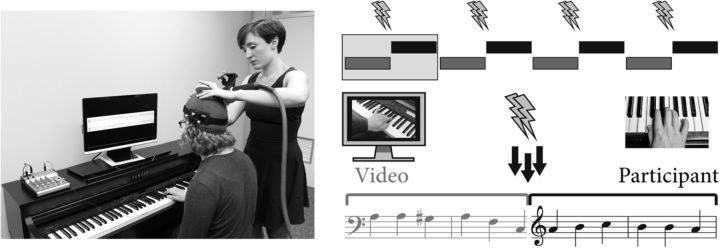
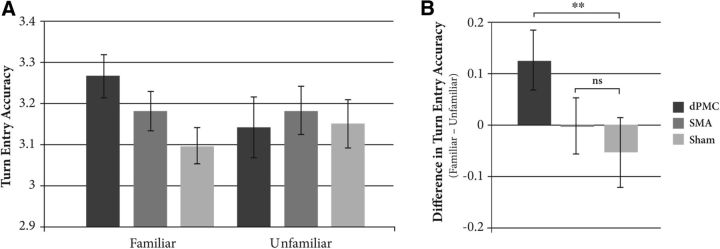
Overlap between sensory and motor representations has been documented for a range of human actions, from grasping (Rizzolatti et al., 1996b) to playing a musical instrument (Novembre and Keller, 2014). Such overlap suggests that individuals use motor simulation to predict the outcome of observed actions (Wolpert, 1997). Here we investigate motor simulation as a basis of human communication. Using a musical turn-taking task, we show that pianists call on motor representations of their partner's part to predict when to come in for their own turn. Pianists played alternating solos with a videoed partner, and double-pulse transcranial magnetic stimulation was applied around the turn-switch to temporarily disrupt processing in two cortical regions implicated previously in different forms of motor simulation: (1) the dorsal premotor cortex (dPMC), associated with automatic motor resonance during passive observation of hand actions, especially when the actions are familiar (Lahav et al., 2007); and (2) the supplementary motor area (SMA), involved in active motor imagery, especially when the actions are familiar (Baumann et al., 2007). Stimulation of the right dPMC decreased the temporal accuracy of pianists' (right-hand) entries relative to sham when the partner's (left-hand) part had been rehearsed previously. This effect did not occur for dPMC stimulation without rehearsal or for SMA stimulation. These findings support the role of the dPMC in predicting the time course of observed actions via resonance-based motor simulation during turn-taking. Because turn-taking spans multiple modes of human interaction, we suggest that simulation is a foundational mechanism underlying the temporal dynamics of joint action.
Significance statement: Even during passive observation, seeing or hearing somebody execute an action from within our repertoire activates motor cortices of our brain. But what is the functional relevance of such "motor simulation"? By combining a musical duet task with a real-time repetitive transcranial magnetic stimulation protocol, we provide evidence indicating that the dorsal premotor cortex plays a causal role in accurate turn-taking coordination between a pianist and their observed interaction partner. Given that turn-taking behavior is a fundamental feature of human communication, we suggest that simulation is a foundational mechanism underlying the temporal dynamics of communicative joint action.
Keywords: TMS; joint action; motor simulation; music performance; premotor cortex; turn-taking.
Copyright © 2015 the authors 0270-6474/15/3516516-05$15.00/0.
Figures
References
Publication types
MeSH terms
LinkOut - more resources
Full Text Sources
Miscellaneous
