. 2016 Jun;41(7):1917-28.
doi: 10.1038/npp.2015.362. Epub 2015 Dec 17.

Glucagon-Like Peptide-1 Receptor Activation in the Ventral Tegmental Area Decreases the Reinforcing Efficacy of Cocaine

Affiliations

Glucagon-Like Peptide-1 Receptor Activation in the Ventral Tegmental Area Decreases the Reinforcing Efficacy of Cocaine

Heath D Schmidt et al. Neuropsychopharmacology. 2016 Jun.

Abstract

Cocaine addiction continues to be a significant public health problem for which there are currently no effective FDA-approved treatments. Thus, there is a clear need to identify and develop novel pharmacotherapies for cocaine addiction. Recent evidence indicates that activation of glucagon-like peptide-1 (GLP-1) receptors in the ventral tegmental area (VTA) reduces intake of highly palatable food. As the neural circuits and neurobiological mechanisms underlying drug taking overlap to some degree with those regulating food intake, these findings suggest that activation of central GLP-1 receptors may also attenuate cocaine taking. Here, we show that intra-VTA administration of the GLP-1 receptor agonist exendin-4 (0.05 μg) significantly reduced cocaine, but not sucrose, self-administration in rats. We also demonstrate that cocaine taking is associated with elevated plasma corticosterone levels and that systemic infusion of cocaine activates GLP-1-expressing neurons in the nucleus tractus solitarius (NTS), a hindbrain nucleus that projects monosynaptically to the VTA. To determine the potential mechanisms by which cocaine activates NTS GLP-1-expressing neurons, we microinjected corticosterone (0.5 μg) directly into the hindbrain fourth ventricle. Intraventricular corticosterone attenuated cocaine self-administration and this effect was blocked in animals pretreated with the GLP-1 receptor antagonist exendin-(9-39) (10 μg) in the VTA. Finally, AAV-shRNA-mediated knockdown of VTA GLP-1 receptors was sufficient to augment cocaine self-administration. Taken together, these findings indicate that increased activation of NTS GLP-1-expressing neurons by corticosterone may represent a homeostatic response to cocaine taking, thereby reducing the reinforcing efficacy of cocaine. Therefore, central GLP-1 receptors may represent a novel target for cocaine addiction pharmacotherapies.


Figures
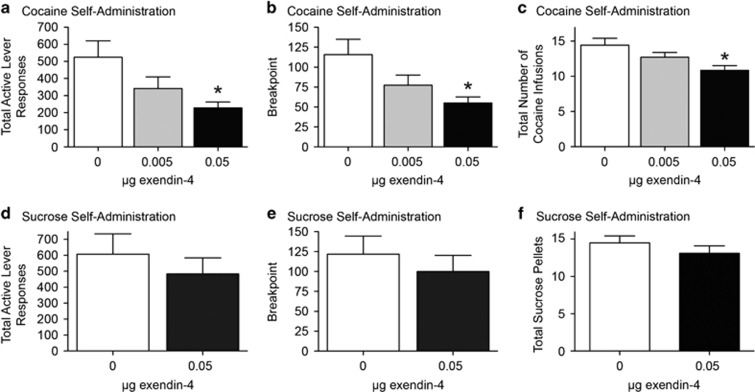
Figure 1
Figure 1
Administration of the GLP-1 receptor agonist exendin-4 into the VTA dose-dependently attenuates cocaine self-administration maintained on a PR schedule of reinforcement. Rats were pretreated with infusions of vehicle and 0.005 or 0.05 μg exendin-4 directly into the VTA before a cocaine (0.75 mg/kg/infusion) self-administration test session (n=7 per treatment). Total number of active lever responses (a), breakpoints (b), and total cocaine infusions (c) (mean±SEM) were significantly different between rats pretreated with intra-VTA infusions of vehicle and 0.05 μg exendin-4. *P<0.05 (Tukey's HSD). Intra-VTA administration of exendin-4 does not affect sucrose self-administration. No significant differences in total active lever responses (d), breakpoints (e), and total sucrose pellets self-administered (f) (mean±SEM) were noted in rats pretreated with vehicle or 0.05 μg exendin-4 in the VTA before sucrose PR test sessions (n=10 per treatment; p>0.05, paired t-test).
Figure 2
Figure 2
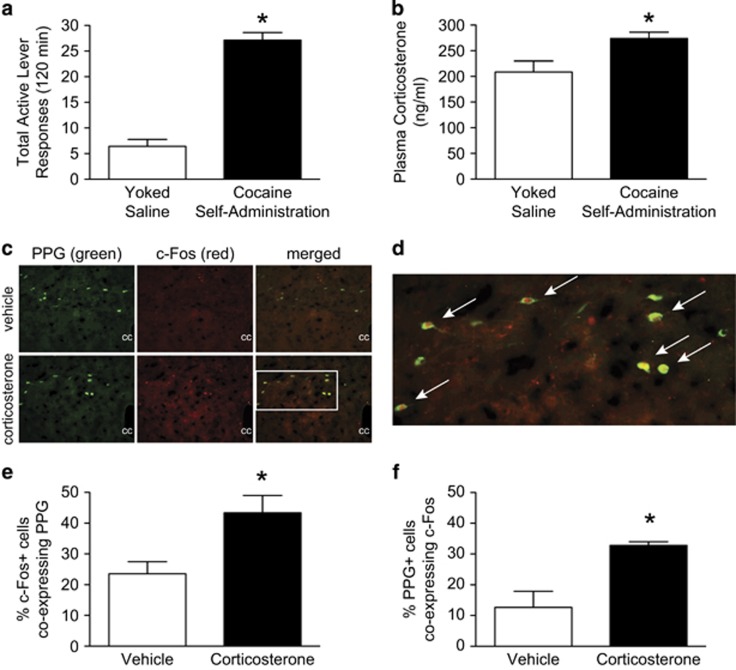
Cocaine self-administration is associated with increased plasma corticosterone levels and peripheral corticosterone administration increases activation of PPG-expressing neurons in the NTS. (a) Total active lever responses (mean±SEM) are shown for cocaine-experienced rats and yoked-saline controls. (b) Plasma corticosterone levels were significantly different in cocaine-experienced rats when compared with yoked-saline controls (n=14 per treatment). *P<0.01 for total active lever responses and plasma corticosterone levels between treatments (unpaired t-test). (c) Representative immunofluorescent micrographs (× 10) showing activation of NTS GLP-1-producing neurons, as measured using double immunohistochemistry for PPG (green) and c-fos (red), was increased in rats treated with corticosterone (15 mg/kg, s.c.) vs vehicle. (d) High-magnification image (× 20) of the insert in (c) showing neuron colocalization of PPG and c-fos immunoreactivity in the NTS of a corticosterone-treated rat. Total percentages of c-Fos-positive (+) cells coexpressing PPG (e) and PPG-positive (+) cells coexpressing c-Fos (f) were significantly increased in the NTS of rats treated with corticosterone (n=4) compared with vehicle-treated controls (n=3); cc, central canal. A full color version of this figure is available at the Neuropsychopharmacology journal online.
Figure 3
Figure 3
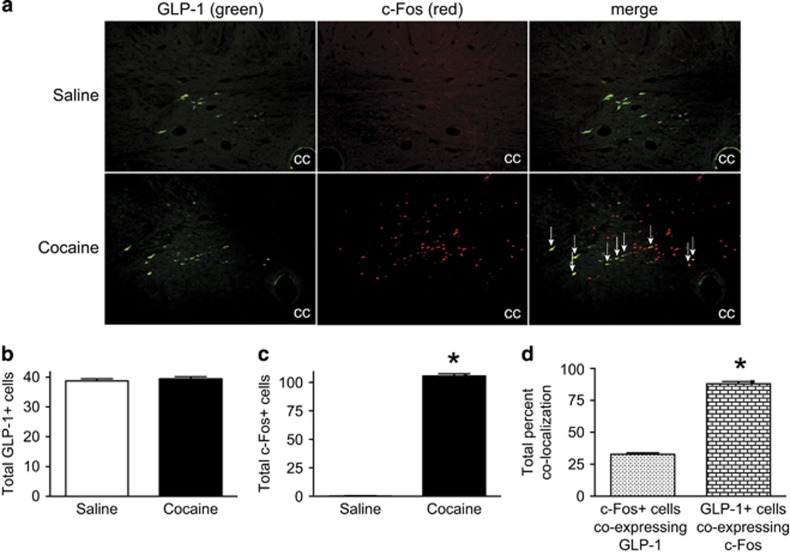
Cocaine administration is associated with increased activation of GLP-1-expressing neurons in the NTS. (a) Representative images of cells in the NTS double labeled for GLP-1 (green) and c-Fos (red) are shown for rats receiving systemic 10 mg/kg cocaine or saline. Although total NTS GLP-1-positive cells (b) were not different between cocaine-treated rats and saline controls, there was significant increase in total c-Fos-positive cells (c) in the NTS of rats receiving cocaine compared with saline controls. (d) Quantification of colabeling in NTS neurons revealed that 70.4±1.42% of GLP-1-expressing neurons in the NTS are c-Fos positive in cocaine-treated rats (n=4/treatment); cc, central canal. *P<0.05. A full color version of this figure is available at the Neuropsychopharmacology journal online.
Figure 4
Figure 4
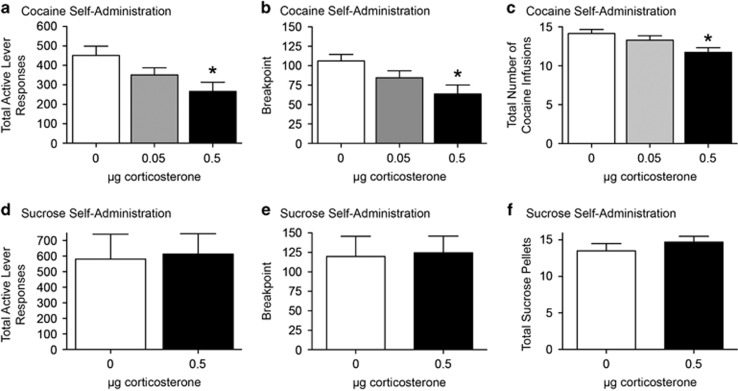
Administration of corticosterone directly into the fourth ventricle dose-dependently attenuated cocaine self-administration. Total number of active lever responses (a), breakpoints (b), and total cocaine infusions (c) (mean±SEM) following microinjections of vehicle and 0.05 and 0.5 μg corticosterone into the fourth ventricle of rats self-administering cocaine on a PR schedule of reinforcement (n=7 per treatment). *P<0.05 for active lever responding and breakpoints between vehicle and 0.5 μg corticosterone (Tukey's HSD). Infusions of corticosterone directly into the fourth ventricle had no effect on sucrose self-administration. Total active lever responses (d), breakpoints (e), and total sucrose pellets (f) (mean±SEM) in rats (n=10 per treatment) self-administering sucrose pellets on a PR schedule of reinforcement. There were no significant differences between treatments (p>0.05, paired t-test).
Figure 5
Figure 5
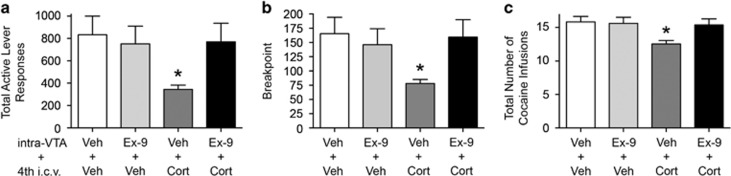
Corticosterone-mediated attenuation of cocaine self-administration is prevented in rats pretreated with infusions of the GLP-1 receptor antagonist exendin-(9–39) into the VTA. Intra-VTA infusions of 10.0 μg exendin-(9–39) prevented intracerebroventricular 0.5 μg corticosterone-mediated reductions in total active lever responses (a), breakpoints (b), and total cocaine infusions (c). There were significant differences in active lever responding and breakpoints between vehicle+corticosterone and all other treatments (*p<0.05, Bonferroni correction, n=13 per treatment).
Figure 6
Figure 6
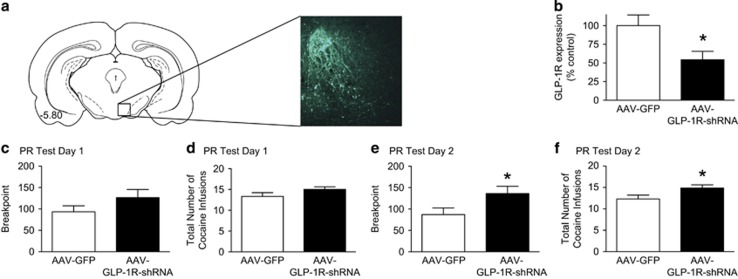
Decreased GLP-1 receptor expression in the VTA is sufficient to augment cocaine self-administration on a PR schedule of reinforcement. (a) Coronal section depicting VTA-targeted infusions AAV-GFP (n=10) and AAV-GLP-1R-shRNA (n=9). The insert shows GFP-expressing cells in the VTA 14 days after infection in a representative micrograph. (b) Endogenous GLP-1 receptor expression was significantly reduced (~47%) in the VTA of rats treated with AAV-GLP-1R-shRNA compared with controls 14 days after infection. Nonsignificant trends toward increased breakpoints (c) (p<0.17) and total cocaine infusions (d) (p<0.15) were observed in rats infused with AAV-GLP-1R-shRNA when compared with controls during the first PR test session. Statistically significant increases in breakpoints (e) and total cocaine infusions (f) were observed between treatments during the second PR test session (*p<0.05, unpaired t-tests).

References

    1. Alhadeff AL, Rupprecht LE, Hayes MR (2012). GLP-1 neurons in the nucleus of the solitary tract project directly to the ventral tegmental area and nucleus accumbens to control for food intake. Endocrinology 153: 647–658. - PMC - PubMed
    1. Arnold JM, Roberts DC (1997). A critique of fixed and progressive ratio schedules used to examine the neural substrates of drug reinforcement. Pharmacol Biochem Behav 57: 441–447. - PubMed
    1. Barrera JG, Jones KR, Herman JP, D'Alessio DA, Woods SC, Seeley RJ (2011). Hyperphagia and increased fat accumulation in two models of chronic CNS glucagon-like peptide-1 loss of function. J Neurosci 31: 3904–3913. - PMC - PubMed
    1. Buffalari DM, Rinaman L (2014). Cocaine self-administration and extinction alter medullary noradrenergic and limbic forebrain cFos responses to acute, noncontingent cocaine injections in adult rats. Neuroscience 281C: 241–250. - PMC - PubMed
    1. Buse JB, Rosenstock J, Sesti G, Schmidt WE, Montanya E, Brett JH et al (2009). Liraglutide once a day versus exenatide twice a day for type 2 diabetes: a 26-week randomised, parallel-group, multinational, open-label trial (LEAD-6). Lancet 374: 39–47. - PubMed

MeSH terms