


Maltreatment Exposure, Brain Structure, and Fear Conditioning in Children and Adolescents
- PMID: 26677946
- PMCID: PMC4908632
- DOI: 10.1038/npp.2015.365
Maltreatment Exposure, Brain Structure, and Fear Conditioning in Children and Adolescents
Abstract
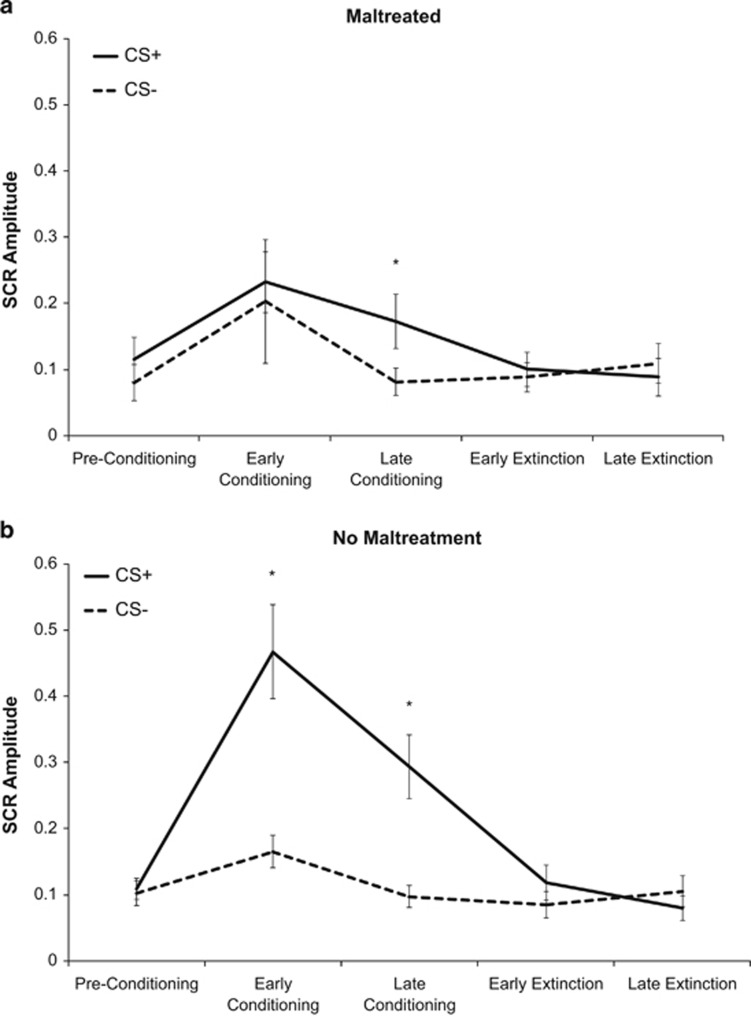
Alterations in learning processes and the neural circuitry that supports fear conditioning and extinction represent mechanisms through which trauma exposure might influence risk for psychopathology. Few studies examine how trauma or neural structure relates to fear conditioning in children. Children (n=94) aged 6-18 years, 40.4% (n=38) with exposure to maltreatment (physical abuse, sexual abuse, or domestic violence), completed a fear conditioning paradigm utilizing blue and yellow bells as conditioned stimuli (CS+/CS-) and an aversive alarm noise as the unconditioned stimulus. Skin conductance responses (SCR) and self-reported fear were acquired. Magnetic resonance imaging data were acquired from 60 children. Children without maltreatment exposure exhibited strong differential conditioning to the CS+ vs CS-, based on SCR and self-reported fear. In contrast, maltreated children exhibited blunted SCR to the CS+ and failed to exhibit differential SCR to the CS+ vs CS- during early conditioning. Amygdala and hippocampal volume were reduced among children with maltreatment exposure and were negatively associated with SCR to the CS+ during early conditioning in the total sample, although these associations were negative only among non-maltreated children and were positive among maltreated children. The association of maltreatment with externalizing psychopathology was mediated by this perturbed pattern of fear conditioning. Child maltreatment is associated with failure to discriminate between threat and safety cues during fear conditioning in children. Poor threat-safety discrimination might reflect either enhanced fear generalization or a deficit in associative learning, which may in turn represent a central mechanism underlying the development of maltreatment-related externalizing psychopathology in children.
Figures
References
-
- Achenbach TM (1991) Integrative Guide for the 1991 CBCL/4-18, YSR and TRF Profiles. Department of Psychiatry, University of Vermont: Burlington, VT, USA.
-
- Beauchaine TP, Katkin ES, Strassberg Z, Snarr J (2001). Disinhibitory psychopathology in male adolescents: discriminating conduct disorder from attention-deficit/hyperactivity disorder through concurrent assessment of multiple autonomic states. J Abnorm Psychol 110: 610–624. - PubMed
-
- Bernstein DP, Ahluvalia T, Pogge D, Handelsman L (1997). Validity of the Childhood Trauma Questionnaire in an adolescent psychiatric population. J Am Acad Child Adolesc Psychiatry 36: 340–348. - PubMed
-
- Bifulco A, Brown GW, Lillie A, Jarvis J (1997). Memories of childhood neglect and abuse: corroboration in a series of sisters. J Child Psychol Psychiatry 38: 365–374. - PubMed
-
- Birmaher B, Khetarpal S, Brent D, Cully M, Balach L, Kaufman J et al (1997). The Screen for Child Anxiety Related Emotional Disorders (SCARED): scale construction and psychometric characteristics. J Am Acad Child Adolesc Psychiatry 36: 545–553. - PubMed
Publication types
MeSH terms
Grants and funding
LinkOut - more resources
Full Text Sources
Other Literature Sources
Medical
Molecular Biology Databases
