


Antenatal dietary supplementation with myo-inositol in women during pregnancy for preventing gestational diabetes
- PMID: 26678256
- PMCID: PMC6599829
- DOI: 10.1002/14651858.CD011507.pub2
Antenatal dietary supplementation with myo-inositol in women during pregnancy for preventing gestational diabetes
Update in
-
Antenatal dietary supplementation with myo-inositol for preventing gestational diabetes.Cochrane Database Syst Rev. 2023 Feb 15;2(2):CD011507. doi: 10.1002/14651858.CD011507.pub3. Cochrane Database Syst Rev. 2023. PMID: 36790138 Free PMC article. Review.
Abstract
Background: Gestational diabetes, glucose intolerance with onset or first recognition during pregnancy, is a rising problem worldwide. Both non-pharmacological and pharmacological approaches to the prevention of gestational diabetes have been, and continue to be explored. Myo-inositol, an isomer of inositol, is a naturally occurring sugar commonly found in cereals, corn, legumes and meat. It is one of the intracellular mediators of the insulin signal and correlated with insulin sensitivity in type 2 diabetes. The potential beneficial effect on improving insulin sensitivity suggests that myo-inositol may be useful for women in preventing gestational diabetes.
Objectives: To assess if antenatal dietary supplementation with myo-inositol is safe and effective, for the mother and fetus, in preventing gestational diabetes.
Search methods: We searched the Pregnancy and Childbirth Group's Trials Register, ClinicalTrials.gov, WHO ICTRP (2 November 2015) and reference lists of retrieved studies.
Selection criteria: We sought published and unpublished randomised controlled trials, including conference abstracts, assessing the effects of myo-inositol for the prevention of gestational diabetes mellitus (GDM). Quasi-randomised and cross-over trials were not eligible for inclusion, but cluster designs were eligible. Participants in the trials were pregnant women. Women with pre-existing type 1 or type 2 diabetes were excluded. Trials that compared the administration of any dose of myo-inositol, alone or in a combination preparation were eligible for inclusion. Trials that used no treatment, placebo or another intervention as the comparator were eligible for inclusion.
Data collection and analysis: Two review authors independently assessed trials for inclusion, risk of bias and extracted the data. Data were checked for accuracy.
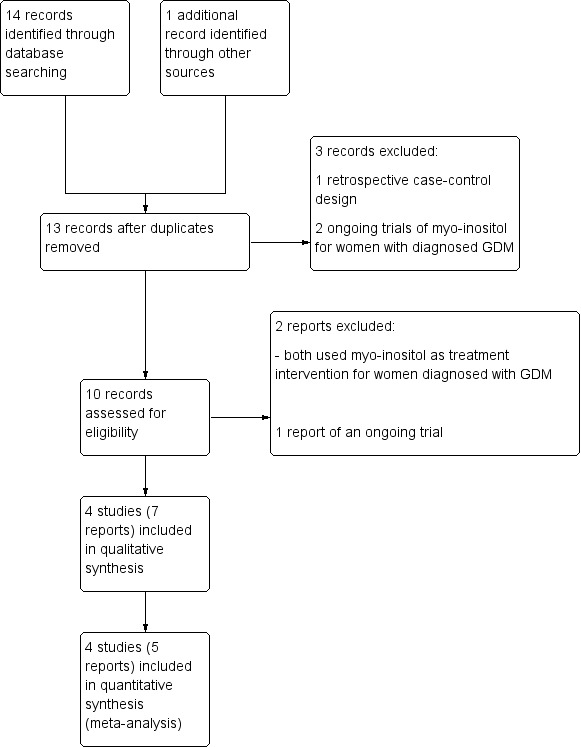
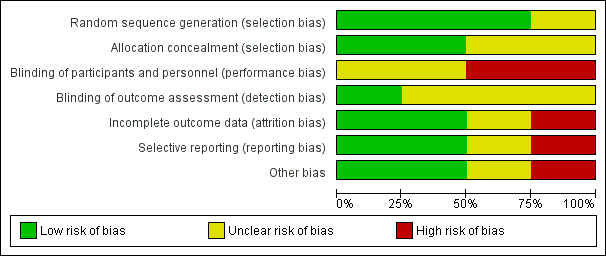
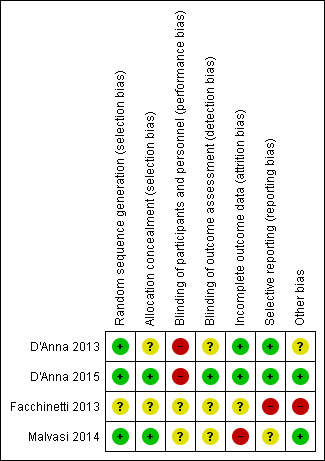
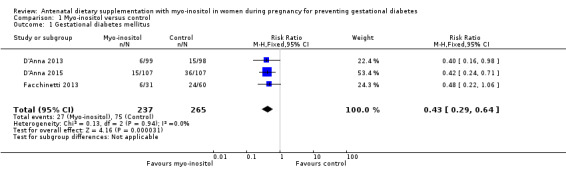
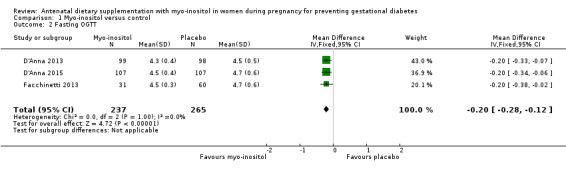
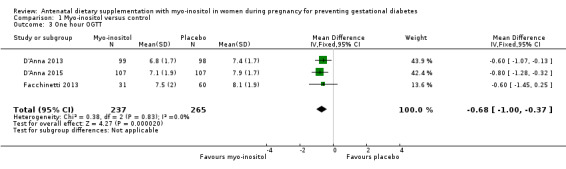
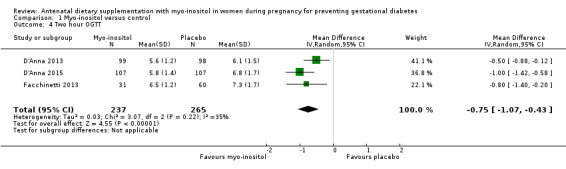
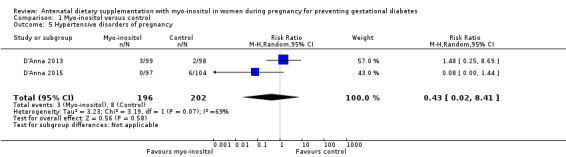
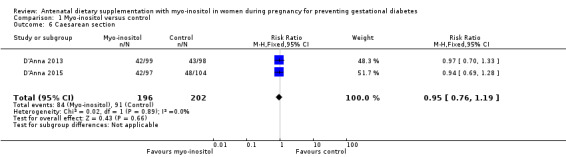
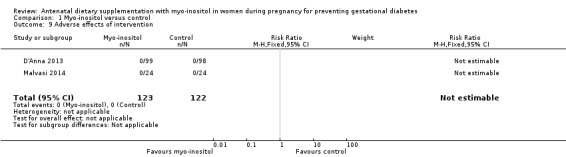
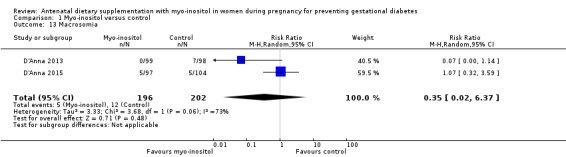
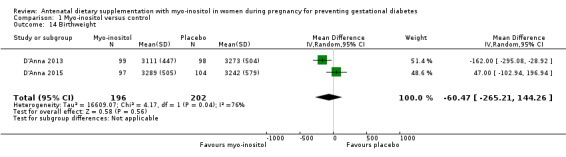
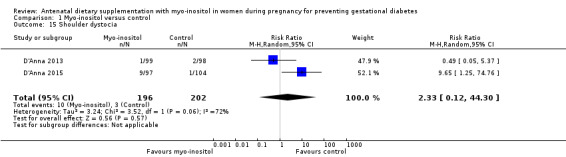
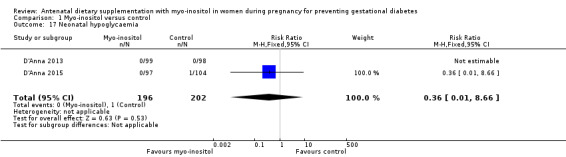
Main results: We included four randomised controlled trials (all conducted in Italy) reporting on 567 women who were less than 11 weeks' to 24 weeks' pregnant at the start of the trials. The trials had small sample sizes and one trial only reported an interim analysis. Two trials were open-label. The overall risk of bias was unclear.For the mother, supplementation with myo-inositol was associated with a reduction in the incidence of gestational diabetes compared with control (risk ratio (RR) 0.43, 95% confidence interval (CI) 0.29 to 0.64; three trials; n = 502 women). Using GRADE methods this evidence was assessed as low with downgrading due to unclear risk of bias for allocation concealment in two of the included trials and lack of generalisability of findings. For women who received myo-inositol supplementation, the incidence of GDM ranged from 8% to 18%; for women in the control group, the incidence of GDM was 28%, using International Association of Diabetes and Pregnancy Study Groups Consensus Panel 2010 criteria to diagnose GDM.Two trials reported on hypertensive disorders of pregnancy, a primary maternal outcome of this review. There was no clear difference in risk of hypertensive disorders of pregnancy between the myo-inositol and control groups (average RR 0.43, 95% CI 0.02 to 8.41; two trials; n = 398 women; Tau(2) = 3.23; I(2) = 69%). Using GRADE methods, this evidence was assessed as very low, with downgrading due to wide confidence intervals with very low event rates, a small sample size, and lack of blinding and unclear allocation concealment methods, and a lack of generalisability. For women who received myo-inositol the risk of hypertensive disorders of pregnancy ranged from 0% to 33%; for women in the control group the risk was 4%.For the infant, none of the included trials reported on the primary neonatal outcomes of this systematic review (large-for-gestational age, perinatal mortality, mortality or morbidity composite).In terms of this review's secondary outcomes, there was no clear difference in the risk of caesarean section between the myo-inositol and control groups (RR 0.95, 95% CI 0.76 to 1.19; two trials; n = 398 women). Using GRADE methods, this evidence was assessed as low, with downgrading due to unclear risk of bias in one trial and lack of generalisability. For women who received myo-inositol supplementation, the risk of having a caesarean section ranged from 34% to 54%; for women in the control group the was 45%. There were no maternal adverse effects of therapy in the two trials that reported on this outcome (the other two trials did not report this outcome).Two trials found no clear difference in the risk of macrosomia between infants whose mothers received myo-inositol supplementation compared with controls (average RR 0.35, 95% CI 0.02 to 6.37; two trials; n = 398 infants;Tau(2) = 3.33; I(2) = 73%). Similarly, there was no clear difference between groups in terms of neonatal hypoglycaemia (RR 0.36, 95% CI 0.01 to 8.66) or shoulder dystocia (average RR 2.33, 95% CI 0.12 to 44.30, Tau(2) = 3.24; I(2) = 72%).There was a lack of data available for a large number of maternal and neonatal secondary outcomes, and no data for any of the long-term childhood or adulthood outcomes, or for health service cost outcomes.
Authors' conclusions: Evidence from four trials of antenatal dietary supplementation with myo-inositol during pregnancy shows a potential benefit for reducing the incidence of gestational diabetes. No data were reported for any of this review's primary neonatal outcomes. There were very little outcome data for the majority of this review's secondary outcomes. There is no clear evidence of a difference for macrosomia when compared with control.The current evidence is based on small trials that are not powered to detect differences in outcomes including perinatal mortality and serious infant morbidity. All of the included studies were conducted in Italy which raises concerns about the lack of generalisability of the evidence to other settings. There is evidence of inconsistency and indirectness and as a result, many of the judgements on the quality of the evidence were downgraded to low or very low quality (GRADEpro Guideline Development Tool).Further trials for this promising antenatal intervention for preventing gestational diabetes are encouraged and should include pregnant women of different ethnicities and varying risk factors and use of myo-inositol (different doses, frequency and timing of administration) in comparison with placebo, diet and exercise or pharmacological interventions. Outcomes should include potential harms including adverse effects.
Conflict of interest statement
Professor Caroline Crowther, Dr Julie Brown and Dr Jane Aslweiler are investigators on a planned trial of myo‐inositol supplements in pregnancy for the prevention of gestational diabetes. If this trial is eligible for inclusion in this review, Professor Caroline Crowher, Dr Julie Brown and Dr Jane Aslweiler will not be involved in any aspect of data extraction or risk of bias relating to this trial. Tineke Crawford and another researcher not involved in the trial will deal with the handling of these data.
Figures
References
References to studies included in this review
D'Anna 2013 {published data only}
-
- D'Anna R, Scilipoti A, Giordano D, Caruso C, Cannata ML, Interdonato ML, et al. Myo‐inositol supplementation and onset of gestational diabetes mellitus in pregnant women with a family history of type 2 diabetes: a prospective, randomized, placebo‐controlled study. Diabetes Care 2013;36(4):854‐8. - PMC - PubMed
-
- Unfer V. Efficacy of Myo‐inositol in preventing gestational diabetes in high‐risk pregnant women. ClinicalTrials.gov (http://clinicaltrials.gov/) [accessed 1 November 2014] 2011.
D'Anna 2015 {published data only}
-
- D'Anna R. Myo‐inositol for preventing gestational diabetes in overweight and obese women. ClinicalTrials.gov (http://clinicaltrials.gov/) [accessed 21 May 2013] 2010.
-
- D'Anna R, Benedetto A, Scilipoti A, Santamaria A, Interdonato ML, Petrella E, et al. Myo‐Inositol supplementation for prevention of gestational diabetes in obese pregnant women. a randomized controlled trial. Obstetrics & Gynecology 2015;126(2):310‐5. - PubMed
-
- D'Anna R, Santamaria A, Corrado F, Benedetto A, Petrella E, Facchinetti F. Myo‐inositol in the prevention of gestational diabetes and its complications. Pregnancy Hypertension 2015;5(1):6. [DOI: 10.1016/j.preghy.2014.10.015] - DOI
Facchinetti 2013 {published data only}
-
- Facchinetti F, Pignatti L, Interdonato ML, Neri I, Bellei G, D'Anna R. Myoinositol supplementation in pregnancies at risk for gestational diabetes. Interim analysis of a randomized controlled trial. American Journal of Obstetrics and Gynecology 2013;208(1 Suppl):S36.
Malvasi 2014 {published data only}
-
- Malvasi A, Casciaro F, Minervini MM, Kosmas I, Mynbaev OA, Pacella E, et al. Myo‐inositol, D‐chiro‐inositol, folic acid and manganese in second trimester of pregnancy: a preliminary investigation. European Review for Medical and Pharmacological Sciences 2014;18(2):270‐4. - PubMed
References to studies excluded from this review
Corrado 2011 {published data only}
-
- Corrado F, D'Anna R, Vieste G, Giordano D, Pintaudi B, Santamaria A, et al. The effect of myoinositol supplementation on insulin resistance in patients with gestational diabetes. Diabetic Medicine 2011;28(8):972‐5. - PubMed
Matarrelli 2013 {published data only}
-
- Matarrelli B, Vitacolonna E, D'angelo M, Pavone G, Mattei PA, Liberati M, et al. Effect of dietary myo‐inositol supplementation in pregnancy on the incidence of maternal gestational diabetes mellitus and fetal outcomes: a randomized controlled trial. Journal of Maternal‐Fetal & Neonatal Medicine 2013;26(10):967‐72. - PubMed
References to ongoing studies
Farren 2013 {published data only}
-
- Farren M. A trial to investigate the role of the food supplement inositol in the general health of those at risk of developing gestational diabetes mellitus. ISRCTN Registry (http://www.isrctn.com/) (accessed 18 February 2015) 2013.
Additional references
Alberti 1998
-
- Alberti K, Zimmet P. Definition, diagnosis and classification of diabetes mellitus. Part 1: Diagnosis and classification of diabetes mellitus: World Health Organization Report. Diabetic Medicine 1998;15(7):539‐53. - PubMed
Ali 2011
-
- Ali S, Dornhorst A. Diabetes in pregnancy: health risks and management. Postgraduate Medical Journal 2011;87(1028):417‐27. - PubMed
Bain 2015
Carlomagno 2011
-
- Carlomagno G, Unfer V, Buffo S, D'Ambrosio F. Myo‐inositol in the treatment of premenstrual dysphoric disorder. Human Psychopharmacology: Clinical and Experimental 2011;26(7):526‐30. - PubMed
Chiswick 2015
-
- Chiswick C, Reynolds R, Denison F, Drake A, Forbes S, Newby D, et al. Effect of metformin on maternal and fetal outcomes in obese pregnant women (EMPOWaR): a randomised, double‐blind, placebo‐controlled trial. Lancet Diabetes Endocrinology 2015;3(10):778‐86. [DOI: 10.1016/S2213-8587(15)00219-3] - DOI - PMC - PubMed
Croze 2013
-
- Croze ML, Soulage CO. Potential role and therapeutic interests of myo‐inositol in metabolic diseases. Biochimie 2013;95(10):1811‐27. - PubMed
D'Anna 2012
-
- D'Anna R, Bendetto V, Rizzo P, Raffone E, Interdanto ML, Corado F, et al. Myo‐inositol may prevent gestational diabetes in PCOS women. Gynecological Endocrinology 2012;28(6):440‐2. - PubMed
Di Benedetto 2013
-
- Benedetto A, Giunta A, Ruffo MC, Cannizzaro D. New evidence on inositol supplementation in gestational diabetes [Nuove evidenze sul ruolo della supplementazione con inositolo nel diabete gestazionale]. Giornale Italiano di Diabetologia e Metabolismo 2013;33(4):199‐203.
Ferrara 2007
-
- Ferrara A. Increasing prevalence of gestational diabetes mellitus. Diabetes Care 2007;30 (Suppl. 2):S141‐S146. - PubMed
Genazzani 2008
-
- Genazzani AD, Lanzoni C, Ricchieri F, Jasonni VM. Myo‐inositol administration positively affects hyperinsulinemia and hormonal parameters in overweight patients with polycystic ovarian syndrome. Gynecological Endocrinology 2008;24:139‐44. - PubMed
Glueck 2008
-
- Glueck CJ, Pranikoff J, Aregawi D, Wang P. Prevention of gestational diabetes by metformin plus diet in patients with polycystic ovarian syndrome. Fertility and Sterility 2008;89:625‐34. - PubMed
Han 2012
Higgins 2011
-
- Higgins JPT, Green S, editors. Cochrane Handbook for Systematic Reviews of Interventions Version 5.1.0 [updated March 2011]. The Cochrane Collaboration, 2011. Available from www.cochrane‐handbook.org.
IADPSG 2010
Kennington 1990
-
- Kennington AS, Hill CR, Craig J, Bogardus C, Raz I, Ortmeyer HK, et. al. Low urinary chiro‐inositol excretion in non‐insulin‐dependent diabetes mellitus. New England Journal of Medicine 1990;323:373‐8. - PubMed
Kim 2002
-
- Kim C, Newton KM, Knopp RH. Gestational diabetes and the incidence of type 2 diabetes: a systematic review. Diabetes Care 2002;25:1862‐8. - PubMed
Minozzi 2008
-
- Minozzi M, D'Andrea G, Unfer V. Treatment of hirsutism with myo‐inositol: a prospective clinical study. Reproductive Biomedicine Online 2008;17(4):579‐82. - PubMed
MoH 2014
-
- MInistry of Health. Screening, diagnosis and management of gestational diabetes in New Zealand: a clinical practice guideline. Wellington: Ministry of Health, 2014.
Nankervis 2013
-
- Nankervis A, Conn J. Gestational diabetes mellitus‐negotiating the confusion. Australian Family Physician 2013;42(8):528‐31. - PubMed
Nestler 1999
-
- Nestler JE, Jakubowicz DJ, Reamer P, Gunn RD, Allan G. Ovulatory and metabolic effects of D‐chiro‐inositol in the polycystic ovary syndrome. New England Journal of Medicine 1999;340:1314‐20. - PubMed
NICE 2015
-
- National Institute for Health and Clinical Excellence. Diabetes in Pregnancy: Management of Diabetes and its Complications from Pre‐conception to the Postnatal Period. NICE guidelines [NG3]. London: NICE, 2015.
Nordio 2013
Papaleo 2007
-
- Papaleo E, Unfer V, Baillargeon JP, Santis L, Fusi F, Brigante C, et al. Myoinositol in patients with polycystic ovarian syndrome: a novel method for ovulation induction. Gynecological Endocrinology 2007;23:700‐3. - PubMed
Pettitt 1983
-
- Pettitt DJ, Baird HR, Aleck KA, Bennett PH, Knowler WC. Excessive obesity in offspring of Pima Indian women with diabetes during pregnancy. New England Journal of Medicine 1983;308:242‐5. - PubMed
Pettitt 1988
-
- Pettitt DJ, Aleck KA, Baird HR, Carraher MJ, Bennett PH, Knowler WC. Congenital susceptibility to NIDDM: role of intrauterine environment. Diabetes 1988;37:622‐8. - PubMed
RevMan 2014 [Computer program]
-
- The Nordic Cochrane Centre, The Cochrane Collaboration. Review Manager (RevMan). Version 5.3. Copenhagen: The Nordic Cochrane Centre, The Cochrane Collaboration, 2014.
Rogozinska 2015
Silverman 1998
-
- Silverman BL, Rizzo TA, Cho NH, Metzger BE. Long‐term effects of the intrauterine environment: The Northwestern University Diabetes in Pregnancy Center. Diabetes Care 1998;21 (Suppl. 2):B142‐B149. - PubMed
Suzuki 1994
-
- Suzuki S, Kawasaki H, Satoh Y. Urinary chiro‐inositol excretion is an index marker of insulin sensitivity in Japanese type 2 diabetes. Diabetes Care 1994;17:1465‐8. - PubMed
Tang 2012
-
- Tang T, Lord JM, Norman RJ, Yasmin E, Balen AH. Insulin‐sensitising drugs (metformin, rosiglitazone, pioglitazone, D‐chiro‐inositol) for women with polycystic ovary syndrome, oligo amenorrhoea and subfertility. Cochrane Database of Systematic Reviews 2012, Issue 5. [DOI: 10.1002/14651858.CD003053.pub5] - DOI - PubMed
Tieu 2008
Unfer 2011
-
- Unfer V, Raffone E, Rizzo P, Buffo S. Effect of a supplementation with myo‐inositol plus melatonin on oocyte quality in women who failed to conceive in previous in vitro fertilization cycles for poor oocyte quality: a prospective, longitudinal, cohort study. Gynecological Endocrinology 2011;27:857‐61. - PubMed
Publication types
MeSH terms
Substances
LinkOut - more resources
Full Text Sources
Medical
