


Expression of PAM50 Genes in Lung Cancer: Evidence that Interactions between Hormone Receptors and HER2/HER3 Contribute to Poor Outcome
- PMID: 26678909
- PMCID: PMC4681883
- DOI: 10.1016/j.neo.2015.11.002
Expression of PAM50 Genes in Lung Cancer: Evidence that Interactions between Hormone Receptors and HER2/HER3 Contribute to Poor Outcome
Abstract
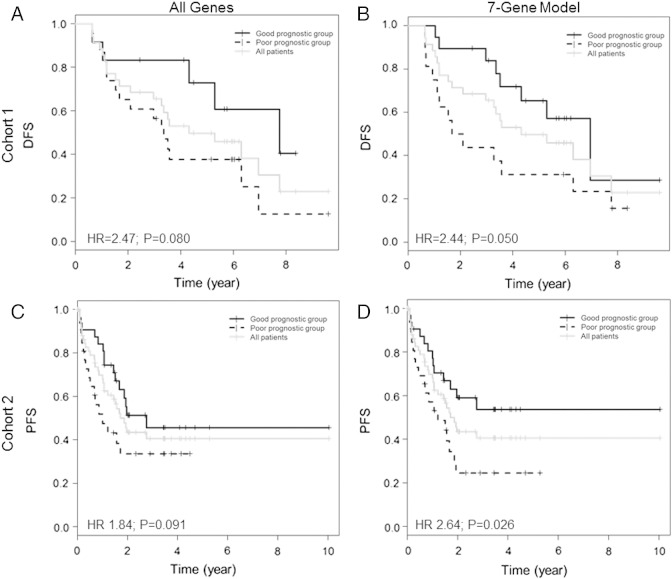
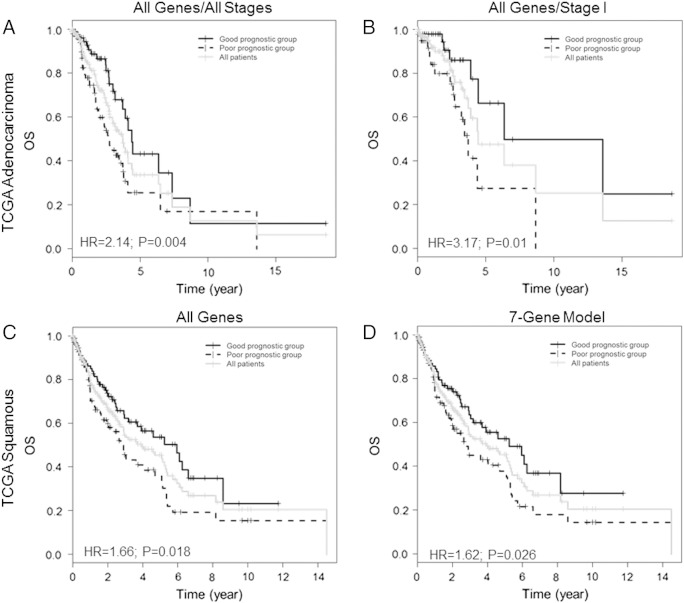
Non-small cell lung cancers (NSCLCs) frequently express estrogen receptor (ER) β, and estrogen signaling is active in many lung tumors. We investigated the ability of genes contained in the prediction analysis of microarray 50 (PAM50) breast cancer risk predictor gene signature to provide prognostic information in NSCLC. Supervised principal component analysis of mRNA expression data was used to evaluate the ability of the PAM50 panel to provide prognostic information in a stage I NSCLC cohort, in an all-stage NSCLC cohort, and in The Cancer Genome Atlas data. Immunohistochemistry was used to determine status of ERβ and other proteins in lung tumor tissue. Associations with prognosis were observed in the stage I cohort. Cross-validation identified seven genes that, when analyzed together, consistently showed survival associations. In pathway analysis, the seven-gene panel described one network containing the ER and progesterone receptor, as well as human epidermal growth factor receptor (HER)2/HER3 and neuregulin-1. NSCLC cases also showed a significant association between ERβ and HER2 protein expression. Cases positive for HER2 expression were more likely to express HER3, and ERβ-positive cases were less likely to be both HER2 and HER3 negative. Prognostic ability of genes in the PAM50 panel was verified in an ERβ-positive cohort representing all NSCLC stages. In The Cancer Genome Atlas data sets, the PAM50 gene set was prognostic in both adenocarcinoma and squamous cell carcinoma, whereas the seven-gene panel was prognostic only in squamous cell carcinoma. Genes in the PAM50 panel, including those linking ER and HER2, identify lung cancer patients at risk for poor outcome, especially among ERβ-positive cases and squamous cell carcinoma.
Copyright © 2015 The Authors. Published by Elsevier Inc. All rights reserved.
Figures

References
-
- Goldstraw P, Crowley J, Chansky K, Giroux DJ, Groome PA, Rami-Porta R, Postmus PE, Rusch V, Sobin L. The IASLC Lung Cancer Staging Project: proposals for the revision of the TNM staging groupings in the forthcoming (seventh) edition of the TNM classification of malignant tumors. J Thorac Oncol. 2007;2:706–714. - PubMed
-
- Strauss GM, Herndon JE, II, Maddaus MA, Johnstone DW, Johnson EA, Harpole DH, Gillenwater HH, Watson DM, Sugarbaker DJ, Schilsky RL. Adjuvant paclitaxel plus carboplatin compared with observation in stage IB non–small-cell lung cancer: CALGB 9633 with the Cancer and Leukemia Group B, Radiation Therapy Oncology Group, and North Central Cancer Treatment Group Study Groups. J Clin Oncol. 2008;26:5043–5051. - PMC - PubMed
-
- Siegfried JM. Women and lung cancer: does oestrogen play a role? Lancet Oncol. 2001;2:506–513. - PubMed
-
- Stabile LP, Siegfried JM. Estrogen receptor pathways in lung cancer. Curr Oncol Rep. 2004;6:259–267. - PubMed
-
- Hershberger PA, Vasquez AC, Kanterewicz B, Land S, Siegfried JM, Nichols M. Regulation of endogenous gene expression in human non–small cell lung cancer cells by estrogen receptor ligands. Cancer Res. 2005;65:1598–1605. - PubMed
Publication types
MeSH terms
Substances
Grants and funding
LinkOut - more resources
Full Text Sources
Other Literature Sources
Medical
Research Materials
Miscellaneous
