


The EPIC Kids Study: a randomized family-focused YMCA-based intervention to prevent type 2 diabetes in at-risk youth
- PMID: 26679186
- PMCID: PMC4683710
- DOI: 10.1186/s12889-015-2595-3
The EPIC Kids Study: a randomized family-focused YMCA-based intervention to prevent type 2 diabetes in at-risk youth
Abstract
Background: It is well established that behavioral lifestyle interventions resulting in modest weight reduction in adults can prevent or delay type 2 diabetes mellitus; however in children, successful weight management interventions are rarely found outside of controlled clinical settings. The lack of effective community-based programs is a barrier to reducing obesity prevalence and diabetes risk in children. The objective of our study is to develop and test a group-randomized family-centered community-based type 2 diabetes prevention intervention targeting at-risk children, 9- to 12-years-old.
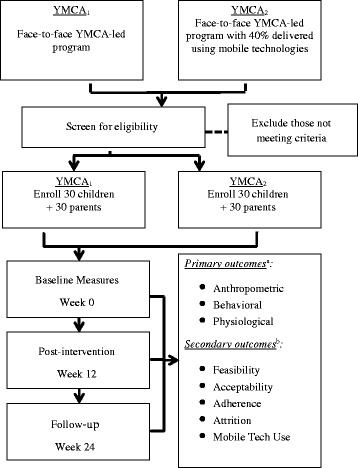
Methods/design: Using participatory methods, the adult-focused YMCA Diabetes Prevention Program was adapted for families, creating a novel lifestyle behavior change program focused on healthy eating, physical activity, and a supportive home environment. The program will be tested in sixty 9- to 12-year-old children at risk of diabetes and sixty parents over 12 consecutive weeks with two intervention formats randomized by location: a face-to-face instructor-led program, or a hybrid program with alternating face-to-face and mobile technology-delivered content. Anthropometric, behavioral, psychosocial and physiological outcomes will be assessed at baseline, post-intervention (12 weeks), and follow-up (24 weeks). Secondary outcomes are participant acceptability, feasibility, and adherence. The RE-AIM framework (reach, efficacy, adoption, implementation, and maintenance) will guide intervention implementation and evaluation. Changes at 12 weeks will be assessed using a paired t-test combining both delivery formats. Exploratory models using linear regression analysis will estimate the magnitude of the difference between the face-to-face and hybrid format. The sample size of 60 children, informed by a previous YMCA intervention in which -4.3 % change in overweight (SE = 1.1) was observed over 6 months, will give us 80 % power to detect an effect size of this magnitude, assuming a one-sided test at alpha = 0.05.
Discussion: The proposed study capitalizes on a partnership with the YMCA, a popular and widespread community organization, and uses mobile technologies to extend program reach while potentially reducing burden associated with weekly attendance. The long-term goal is to create a scalable, replicable, and sustainable pediatric "diabesity" prevention program that overcomes existing barriers to the translation of efficacious interventions into effective community programs.
Trial registration: ClinicalTrials.gov, NCT02421198 on April 15, 2015.
Figures
References
Publication types
MeSH terms
Associated data
Grants and funding
LinkOut - more resources
Full Text Sources
Other Literature Sources
Medical
Miscellaneous
