Family Planning Supply Environment in Kinshasa, DRC: Survey Findings and Their Value in Advancing Family Planning Programming
- PMID: 26681709
- PMCID: PMC4682587
- DOI: 10.9745/GHSP-D-15-00298
Family Planning Supply Environment in Kinshasa, DRC: Survey Findings and Their Value in Advancing Family Planning Programming
Abstract
Background: Modern contraceptive prevalence was 14.1% in 2007 in Kinshasa, the capital city of the Democratic Republic of the Congo (DRC). Yet virtually nothing was known about the family planning supply environment.
Methods: Three surveys of health facilities were conducted in 2012, 2013, and 2014 to determine the number, spatial distribution, and attributes of sites providing family planning services. The 2012 and 2013 surveys aimed to identify the universe of family planning facilities while obtaining a limited set of data on "readiness" to provide family planning services (defined as having at least 3 modern methods, at least 1 person training in family planning in the last 3 years, and an information system to track distribution of products to clients) and output (measured by couple-years of protection, or CYP). In contrast, the 2014 survey, conducted under the umbrella of the Performance Monitoring and Accountability 2020 (PMA2020) project, was based on 2-stage cluster sampling. This article provides detailed analysis of the 2012 and 2013 surveys, including bivariate and multivariate analysis of correlates of readiness to provide services and of output.
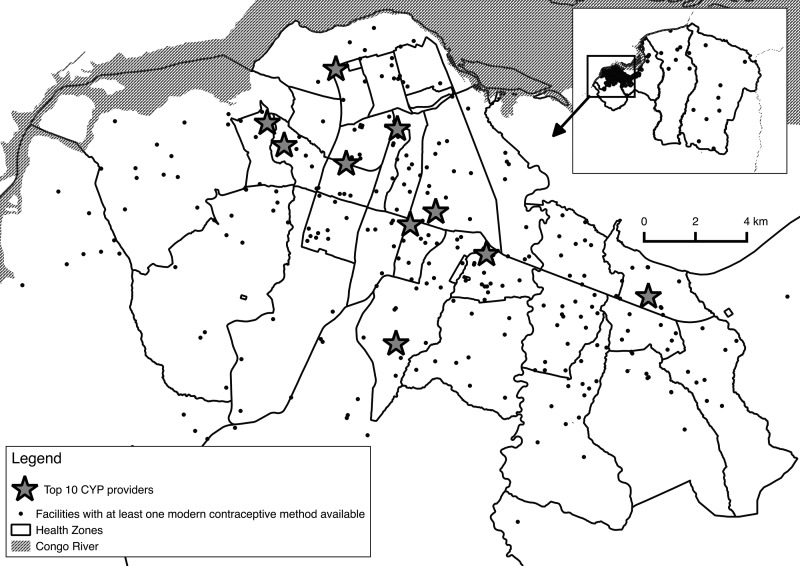
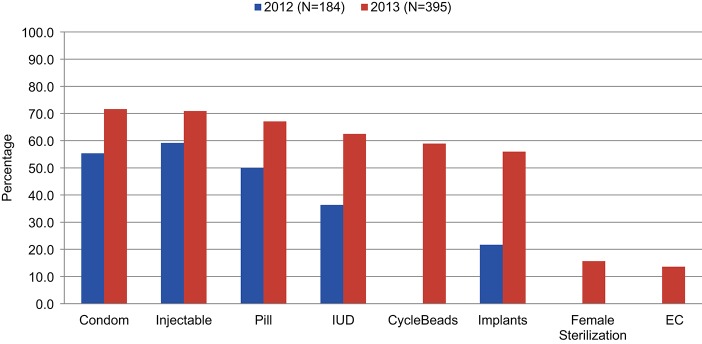
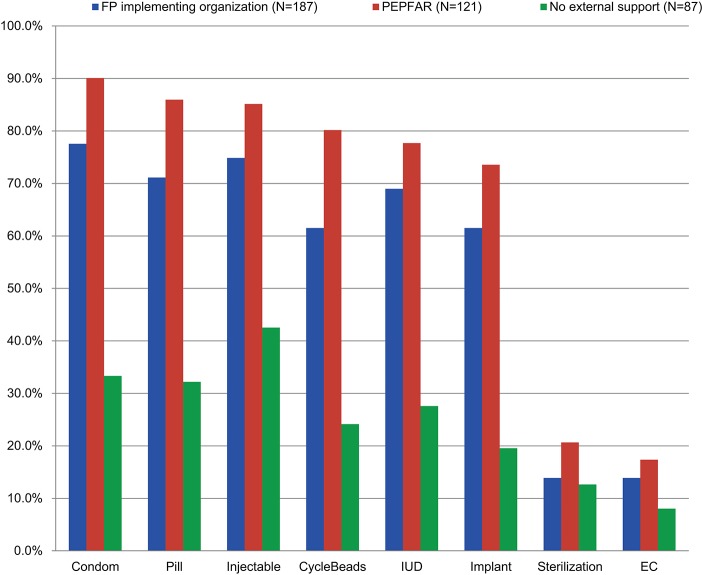
Results: We identified 184 health facilities that reported providing at least 1 contraceptive method in 2012 and 395 facilities in 2013. The percentage of sites defined as "ready" to provide services increased from 44.1% in 2012 to 63.3% in 2013. For the 3-month period between January and March 2013, facilities distributed between 0 and 879.2 CYP (mean, 39.7). Nearly half (49%) of the CYP was attributable to implants, followed by IUDs (24%), CycleBeads (11%), and injectables (8%). In 2013, facilities supported by PEPFAR (n = 121) were more likely than other facilities to be rated as ready to provide services (P<.0001); however, PEPFAR-supported sites generated less CYP on average than sites supported by family planning implementing agencies (P<.0001). Multivariate analysis showed 3 variables were associated with CYP: type of health facility, length of time in operation, and number of contraceptive methods available. Clinics generated higher (3-month) CYP than hospitals and health centers by 65.3 and 61.5 units, respectively (P<.01). The mean CYP for facilities in operation for 4-6 years was 26.9 units higher (P<.05), and 50.2 units higher for those operating 7+ years (P<.01), than the reference group of facilities in operation for 1 year or less. For each additional method available at a facility, CYP increased by almost 8 units (P<.01).
Conclusions: Findings from these surveys suggest that lack of physical access is not the defining reason for low contraceptive use in Kinshasa, although it is highly likely that other service-related factors contribute to low service utilization. The results contributed to increasing the momentum for family planning in the DRC in many ways, including mobilizing partners to increase contraceptive access and increasing donor investment in family planning in the DRC.
© Kayembe et al.
Figures
References
-
- Ministère du Plan et Suivi de la Mise en œuvre de la Révolution de la Modernité (MPSMRM); Ministere de la Sante Publique (MSP); ICF International. Enquête demographique et de santé en République Démocratique du Congo 2013-2014. Rockville (MD): MPSMRM; 2014. Co-published by MSP and ICF International Available from: http://dhsprogram.com/pubs/pdf/FR300/FR300.pdf
-
- Ministère du Plan; Macro International. Enquête démographique et de santé, République Démocratique du Congo 2007. Calverton (MD): Ministère du Plan; 2008. Co-published by Macro International Available from: http://dhsprogram.com/publications/publication-FR208-DHS-Final-Reports.cfm
-
- Performance Monitoring and Accountability 2020 (PMA2020) Project. PMA2014/Kinshasa [DRC-Round 2; family planning brief]. Baltimore (MD): PMA2020; 2015. Available from: http://pma2020.org/sites/default/files/DRC-R2-EN-FPBrief-v8-2015-07-14_0...
Publication types
MeSH terms
Substances
LinkOut - more resources
Full Text Sources
Medical