


Participant Experiences in the Environmental Determinants of Diabetes in the Young Study: Common Reasons for Withdrawing
- PMID: 26682228
- PMCID: PMC4670659
- DOI: 10.1155/2016/2720650
Participant Experiences in the Environmental Determinants of Diabetes in the Young Study: Common Reasons for Withdrawing
Abstract
Background: To characterize participant reasons for withdrawing from a diabetes focused longitudinal clinical observational trial (TEDDY) during the first three study years.
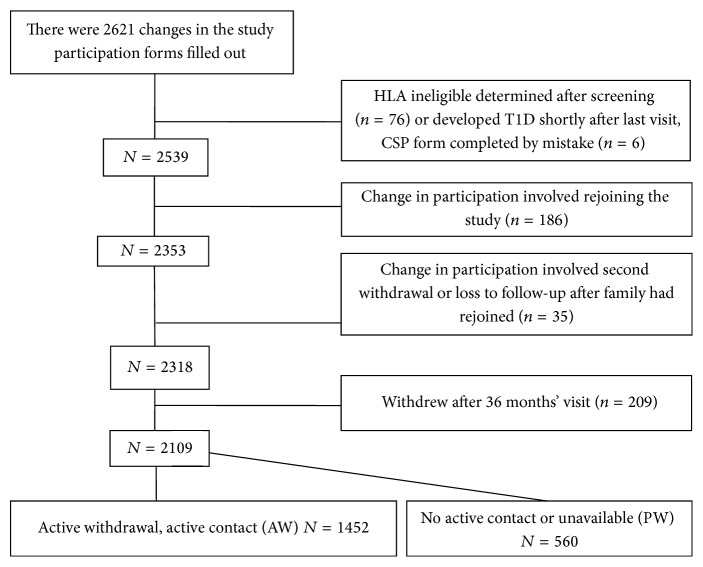
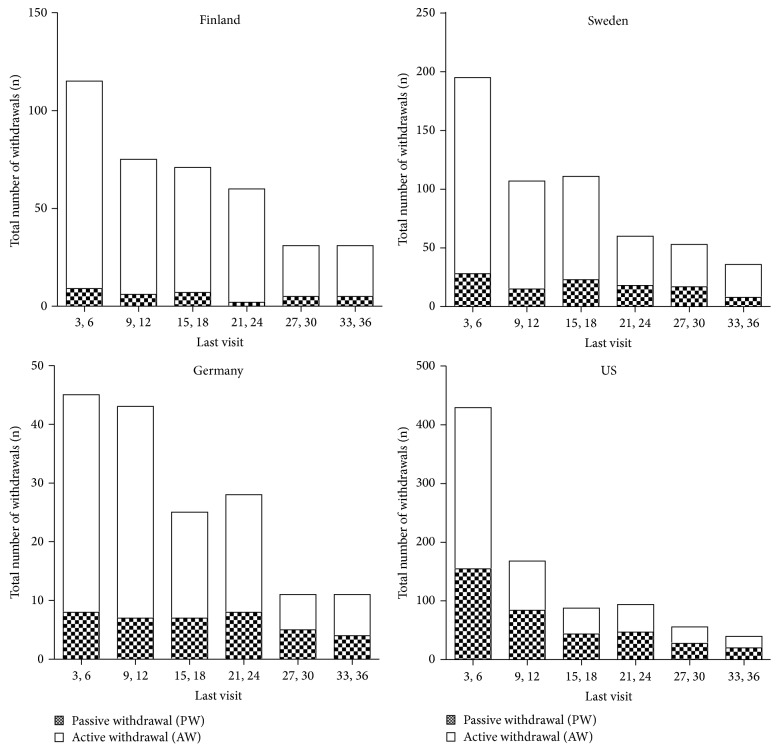
Methods: 8677 children were recruited into the TEDDY study. At participant withdrawal staff recorded any reason parents provided for withdrawal. Reasons were categorized into (1) family characteristics and (2) protocol reasons. Families who informed staff of their withdrawal were classified as active withdrawals (AW); families without a final contact were considered passive withdrawals (PW).
Results: Withdrawal was highest during the first study year (n = 1220). Most families were AW (n = 1549; 73.4%). PW was more common in the United States (n = 1001; 37.8%) and among young mothers (p = 0.001). The most frequent protocol characteristic was blood draw (55%) and the most common family reason was not having enough time (66%). The blood draw was more common among female participants; being too busy was more common among males. Both reasons were associated with study satisfaction.
Conclusions: Results suggest that, for families of children genetically at risk for diabetes, procedures that can be painful/frightening should be used with caution. Study procedures must also be considered for the demands placed on participants. Study satisfaction should be regularly assessed as an indicator of risk for withdrawal.
Figures
References
-
- Driscoll K. A., Killian M., Johnson S. B., Silverstein J. H., Deeb L. C. Predictors of study completion and withdrawal in a randomized clinical trial of a pediatric diabetes adherence intervention. Contemporary Clinical Trials. 2009;30(3):212–220. doi: 10.1016/j.cct.2009.01.008. - DOI - PMC - PubMed
-
- Williams N. A., Coday M., Somes G., Tylavsky F. A., Richey P. A., Hare M. Risk factors for poor attendance in a family-based pediatric obesity intervention program for young children. Journal of Developmental and Behavioral Pediatrics. 2010;31(9):705–712. doi: 10.1097/DBP.0b013e3181f17b1c. - DOI - PMC - PubMed
Publication types
MeSH terms
Grants and funding
- U01 DK63861/DK/NIDDK NIH HHS/United States
- UC4 DK63863/DK/NIDDK NIH HHS/United States
- U01 DK63821/DK/NIDDK NIH HHS/United States
- UC4 DK63865/DK/NIDDK NIH HHS/United States
- U01 DK063861/DK/NIDDK NIH HHS/United States
- U01 DK063790/DK/NIDDK NIH HHS/United States
- UL1 TR001082/TR/NCATS NIH HHS/United States
- U01 DK063821/DK/NIDDK NIH HHS/United States
- UC4DK63861/DK/NIDDK NIH HHS/United States
- UC4 DK63821/DK/NIDDK NIH HHS/United States
- UC4 DK063863/DK/NIDDK NIH HHS/United States
- UL1 TR000064/TR/NCATS NIH HHS/United States
- UC4 DK63836/DK/NIDDK NIH HHS/United States
- U01 DK063836/DK/NIDDK NIH HHS/United States
- U01 DK063829/DK/NIDDK NIH HHS/United States
- U01 DK063865/DK/NIDDK NIH HHS/United States
- UC4 DK095300/DK/NIDDK NIH HHS/United States
- UC4 DK95300/DK/NIDDK NIH HHS/United States
- UC4DK63829/DK/NIDDK NIH HHS/United States
- UC4 DK063861/DK/NIDDK NIH HHS/United States
- U01 DK63865/DK/NIDDK NIH HHS/United States
- UC4 DK063829/DK/NIDDK NIH HHS/United States
- U01DK63836/DK/NIDDK NIH HHS/United States
- UC4 DK063821/DK/NIDDK NIH HHS/United States
- UC4 DK117483/DK/NIDDK NIH HHS/United States
- UC4 DK063836/DK/NIDDK NIH HHS/United States
- UC4 DK112243/DK/NIDDK NIH HHS/United States
- HHSN267200700014C/DK/NIDDK NIH HHS/United States
- U01DK63829/DK/NIDDK NIH HHS/United States
- U01DK63863/DK/NIDDK NIH HHS/United States
- U01 DK063863/DK/NIDDK NIH HHS/United States
- U01 DK63790/DK/NIDDK NIH HHS/United States
- UC4 DK063865/DK/NIDDK NIH HHS/United States
- UC4 DK106955/DK/NIDDK NIH HHS/United States
- UC4 DK100238/DK/NIDDK NIH HHS/United States
LinkOut - more resources
Full Text Sources
Other Literature Sources
Medical
