. 2015 Dec 18;108(5):djv380.
doi: 10.1093/jnci/djv380. Print 2016 May.

Whole-Body and Microenvironmental Localization of Radium-223 in Naïve and Mouse Models of Prostate Cancer Metastasis

Affiliations

Whole-Body and Microenvironmental Localization of Radium-223 in Naïve and Mouse Models of Prostate Cancer Metastasis

Diane S Abou et al. J Natl Cancer Inst. .

Abstract

Background: Bone-metastatic, castration-resistant prostate cancer (bmCRPC) represents a lethal stage of the most common noncutaneous cancer in men. The recent introduction of Radium-223 dichloride, a bone-seeking alpha particle (α)-emitting radiopharmaceutical, demonstrates statistically significant survival benefit and palliative effect for bmCRPC patients. Clinical results have established safety and efficacy, yet questions remain regarding pharmacodynamics and dosing for optimized patient benefit.

Methods: We elucidated the biodistribution of (223)Ra as well as interaction with the bone and tumor compartments in skeletally mature mice (C57Bl/6 and CD-1, n = 3-6) and metastasis models (LNCaP and PC3, n = 4). Differences in uptake were evaluated by µCT and histological investigation. Novel techniques were leveraged on whole-mount undecalcified cryosections to determine microdistribution of Radium-223. All statistical tests were two-sided.

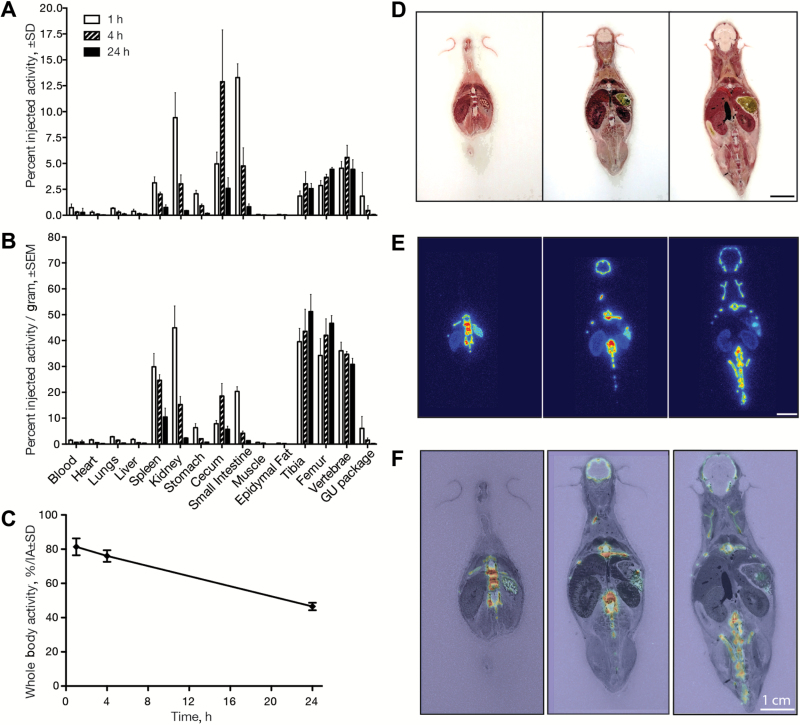
Results: (223)Ra uptake in the bones (>30% injected activity per gram) at 24 hours was also accompanied by non-negligible remnant activity in the kidney (2.33% ± 0.36%), intestines (5.73% ± 2.04%), and spleen (10.5% ± 5.9%) Skeletal accumulation across strains did not correspond with bone volume or surface area but instead to local blood vessel density (P = .04). Microdistribution analysis by autoradiography and α camera revealed targeting of the ossifying surfaces adjacent to the epiphyseal growth plate. In models of PCa metastasis, radioactivity does not localize directly within tumors but instead at the apposite bone surface. Osteoblastic and lytic lesions display similar intensity, which is comparable with uptake at sites of normal bone remodeling.

Conclusions: Profiling the macro- and microdistribution of (223)Ra in healthy and diseased models has important implications to guide precision application of this emerging α-therapy approach for bmCRPC and other bone metastastic diseases.


Figures

Figure 1.
Figure 1.
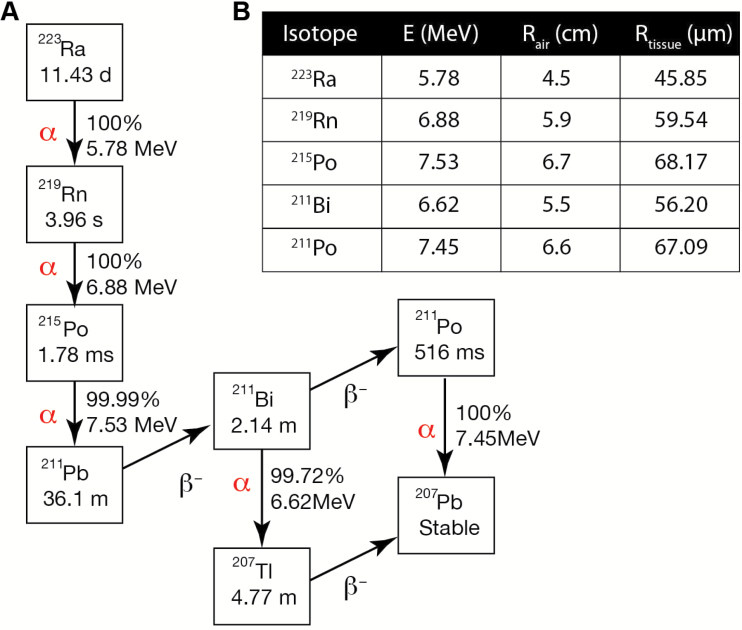
Decay chain and properties of Radium-223. A) The predominant alpha (α) and beta (β-) particle emissions of Radium-223 and its daughters results in production of four high-energy α emissions per disintigration. For each disintegration, abundance and energy released are presented. The rapid decay of the daughters ensures that dose is deposited at or near the longer-lived, bone-seeking Radium-223 parent. B) Alpha particle ranges in air were determined using energies and decay ratios as provided in (30) and computed as per (9). Tissue travel range values were computed using the Bragg-Kleeman rule (10).
Figure 2.
Figure 2.
Dynamic organ-level distribution of Radium-223 evaluated in skeletally mature male CD-1 mice. Mice (n = 4–5 per group) were killed at one, four, and 24 hours postinjection, and organs evaluated for activity by γ counting. A) The distribution is expressed in percent injected activity (%IA ± SD) representing the amount in each organ relative to the administered dose and (B) normalized to the weight of each organ (%IA/g ± standard error of the mean). C) 223Ra clearance profile was defined measuring whole-body radioactive content over 24 hours. D-F) To confirm ex vivo γ count results, whole-body undecalcified cryosections (14 µm) were obtained at 24 hours after administration. Autoradiography revealed skeletal uptake in the calvaria and vertebrae, while soft tissue accumulation is recapitulated in the spleen and kidney. Scale bars = 1cm.
Figure 3.
Figure 3.
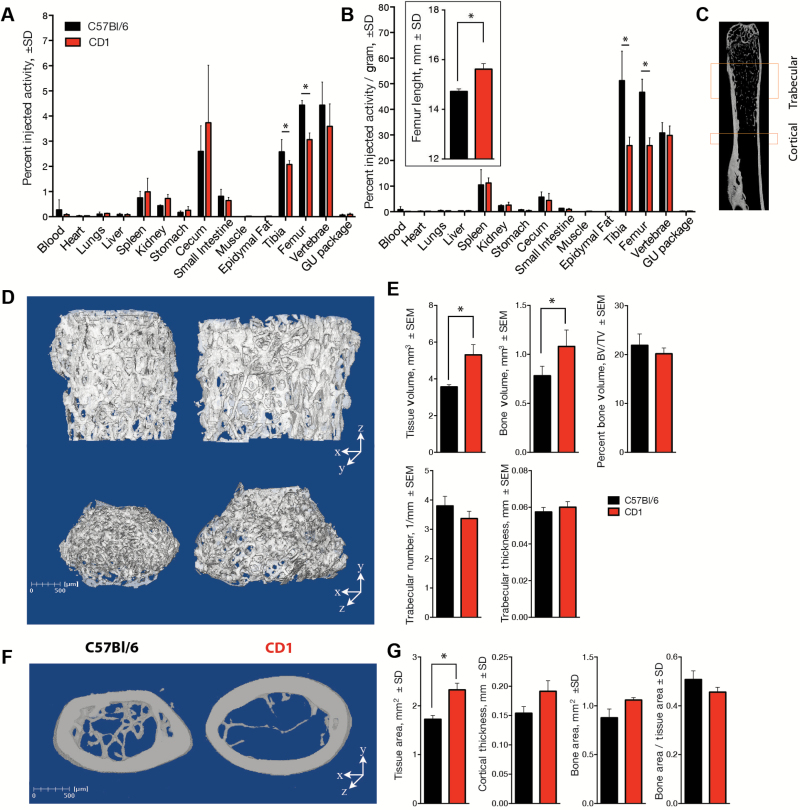
Strain-dependent differences in Radium-223 uptake and bone microarchitecture. A) The distribution of the radionuclide was compared in age- and sex-matched C57Bl/6 and CD-1 (n = 5) as percent injected activity %IA ± SD. B) The greater overall uptake in the smaller long bones of the C57Bl/6 strain (insert) is enhanced when normalized to tissue mass (%IA/g ± SD). C) Regions of cortical and trabecular compartments for analysis by µCT. Three-dimensional bone volume from representative samples of (D) the trabecular (at two perspectives) and (F) cortical regions of the femur (scale bars = 500 µm). E) Quantitative µCT analysis of the distal femur reveals the larger tissue and bone volume of the CD-1 mice. The bone density bone volume fraction (BV/TV ± standard error of the mean) and other morphologic parameters of the trabeculae do not meet statistical significance; therefore, there is incontrovertibly greater bone area in the CD-1 mice. G) Likewise, analysis of the cortical bone establishes the greater size of the CD-1 (tissue and bone area ± SD) to that of C57Bl/6, despite the two strains having similar cortical area fraction values (bone/tissue area ± SD). Statistical significance was determined using an unpaired two-tailed Student’s t test; *P < .05.
Figure 4.
Figure 4.
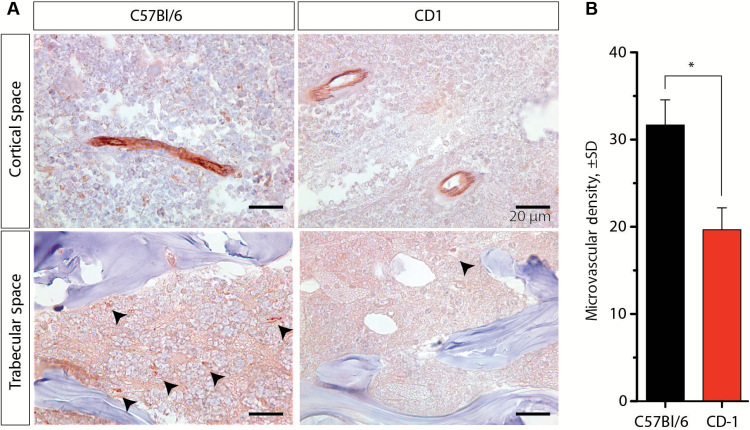
Endothelial cell (CD-31) immunohistochemistry of paraffin-embedded bone sections. A) Vessels identified in the C57Bl/6 and CD-1 strains of mice (n = 3 per strain) in the trabecular and cortical compartments, indicated by arrowhead (scale bar = 20 µm). B) Quantification of microvessel density as number of vessels per mm2. Error bars represent SD, and statistical significance was determined using an unpaired two-tailed Student’s t test; *P < .05.
Figure 5.
Figure 5.
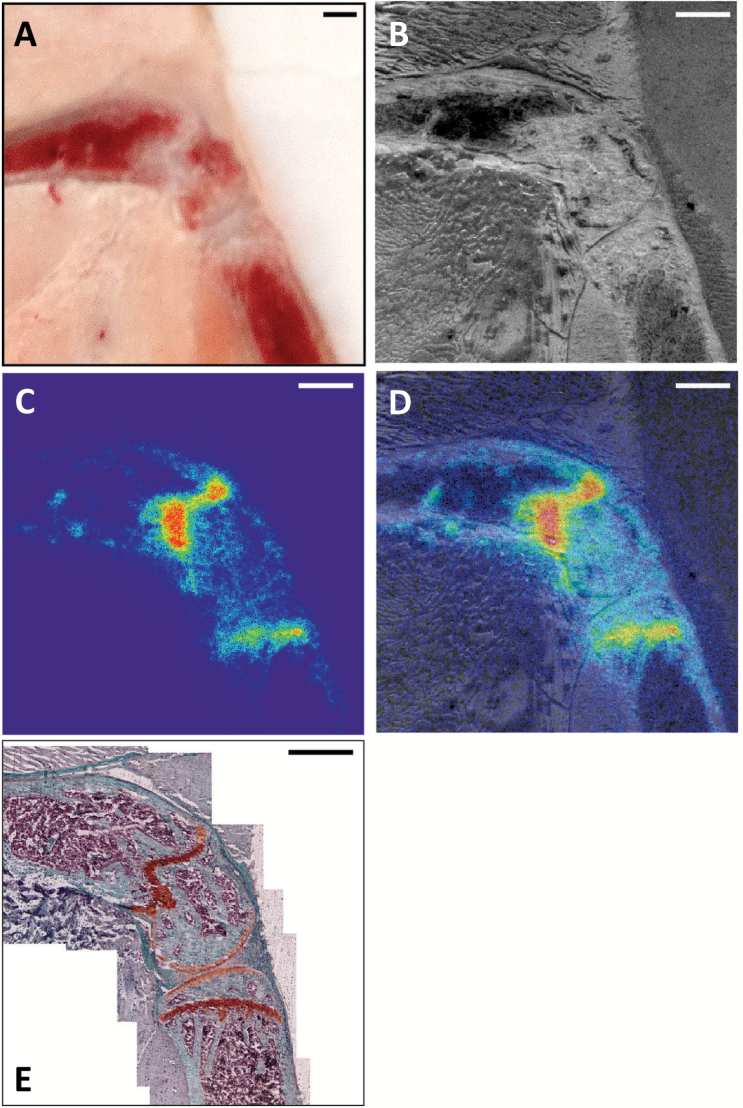
Undecalcified whole-mount cryosection and alpha camera autoradiography of distal femur and proximal tibia. A) En bloc color macrophotograph of embedded sample at the cutting surface. B) White-light reflectance image of alpha-scintillant mounted section (14 µm) in α camera. C) α camera acquisition of Radium-223 (and α-emitting daughters) distribution in sample. D) α emission image overlaid with reflectance image. E) Composite microscope image of Safranin-O histology revealing mature bone (green) and uncalcified proteoglycans (orange) at the growth plate, adjacent to the ossification front. Representative result of n = 6; scale bars = 500 µm.
Figure 6.
Figure 6.
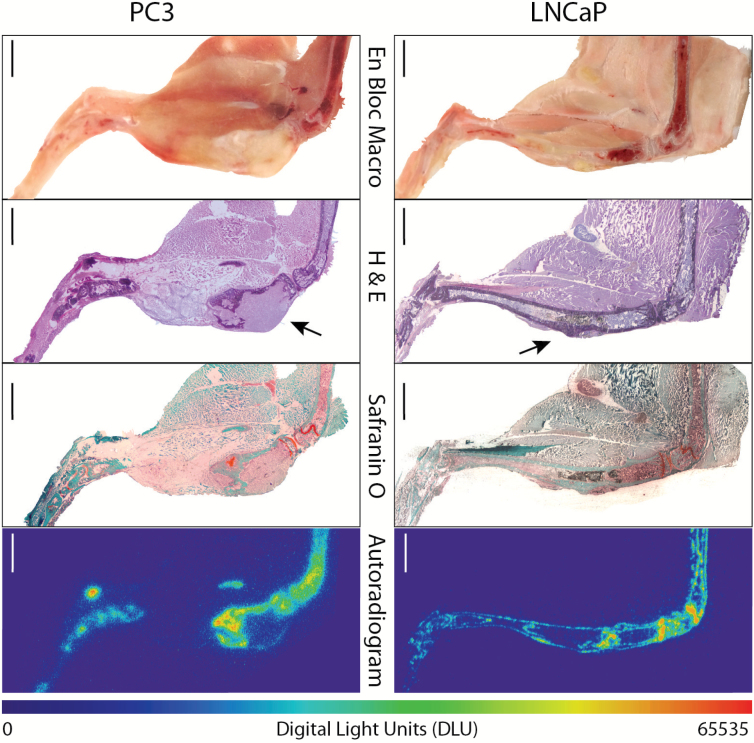
Undecalcified whole-mount cryosection and autoradiography of osteoblastic (LNCaP) and osteolytic (PC3) intratibial prostate cancer xenograft models (n = 3–4 mice per group). En bloc color macrophotograph of embedded sample at the cutting surface. Haematoxylin and eosin (H&E) stain of the whole-mount adhesive bound section, tumor indicated by arrow. Safranin-O staining for calcified (green) and uncalcified (orange-brown) regions. Autoradiography of Radium-223 and daughter emission. Areas of intense uptake colocalize with active bone modeling/remodeling sites (at the interface of the calcified and uncalcified compartments) in the distal femur, proximal tibia, and the bone surfaces adjacent to the bone metastasis. Scale bars = 1mm.

References

    1. Siegel R, Ma J, Zou Z, et al. Cancer statistics, 2014. CA Cancer J Clin. 2014;64(1): 9–29. - PubMed
    1. Lange PH, Vessella RL. Mechanisms, hypotheses and questions regarding prostate cancer micrometastases to bone. Cancer Metastasis Rev. 1998;17(4):331–336. - PubMed
    1. Sathiakumar N, Delzell E, Morrisey MA, et al. Mortality following bone metastasis and skeletal-related events among men with prostate cancer: a population-based analysis of US Medicare beneficiaries, 1999–2006. Prostate Cancer Prostatic Dis. 2011;14(2):177–183. - PubMed
    1. Saad F, Gleason DM, Murray R, et al. A randomized, placebo-controlled trial of zoledronic acid in patients with hormone-refractory metastatic prostate carcinoma. J Natl Cancer Inst. 2002;94(19):1458–1468. - PubMed
    1. Smith MR, Saad F, Coleman R, et al. Denosumab and bone-metastasis-free survival in men with castration-resistant prostate cancer: results of a phase 3, randomised, placebo-controlled trial. Lancet. 2012;379(9810):39–46. - PMC - PubMed

Publication types

MeSH terms