


doi: 10.1089/ast.2015.1113.
A Strategy for Origins of Life Research
Affiliations
- PMID: 26684503
- PMCID: PMC4683543
- DOI: 10.1089/ast.2015.1113
Item in Clipboard
A Strategy for Origins of Life Research
Astrobiology.
2015 Dec.
Abstract
Contents 1. Introduction 1.1. A workshop and this document 1.2. Framing origins of life science 1.2.1. What do we mean by the origins of life (OoL)? 1.2.2. Defining life 1.2.3. How should we characterize approaches to OoL science? 1.2.4. One path to life or many? 2. A Strategy for Origins of Life Research 2.1. Outcomes-key questions and investigations 2.1.1. Domain 1: Theory 2.1.2. Domain 2: Practice 2.1.3. Domain 3: Process 2.1.4. Domain 4: Future studies 2.2. EON Roadmap 2.3. Relationship to NASA Astrobiology Roadmap and Strategy documents and the European AstRoMap Appendix I Appendix II Supplementary Materials References.
Figures
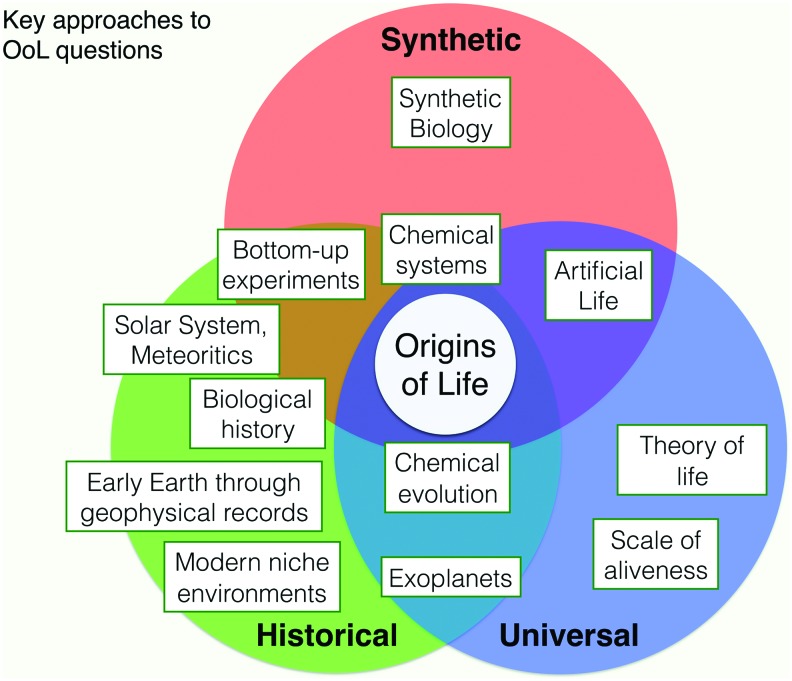
A concept map of the approaches to OoL science (Historical, Synthetic, and Universal) and where selected current areas of study sit in relation to each other and these three approaches. For example, the study of chemical systems overlaps with all three approaches, whereas the study of early Earth is primarily concerned with the single, Historical, nature of terrestrial OoL.
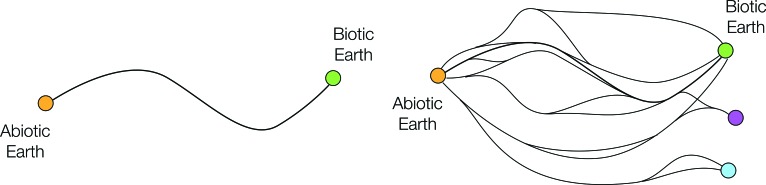
Left: A single historical path from an abiotic to a biotic planet. Right: Many possible paths leading to multiple end points, representing states that differ in some significant way from the biosphere we know on Earth.
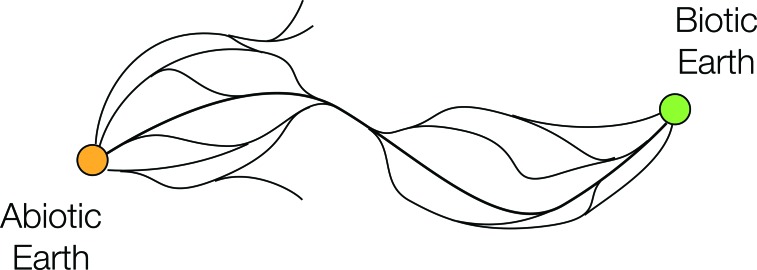
A bottleneck in the space of paths to life; some parts of the story are much more tightly constrained than others. In contrast to the case illustrated in Fig. 2 (right panel) where numerous “histories” lead to an OoL event, here only a specific “history” leads to an OoL event.
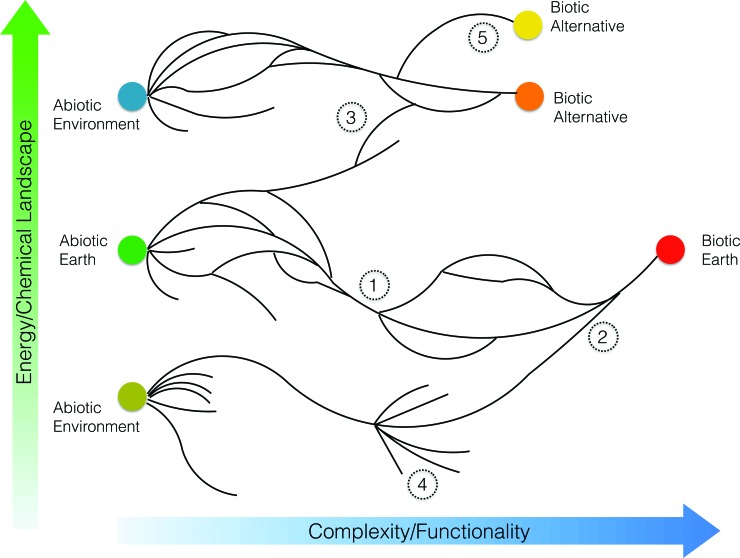
A conceptual representation of hypothetical pathways from abiotic to living states. An unspecified measure of complexity and/or functionality increases from left to right, and an unspecified measure of the energy or chemical landscape increases bottom to top. Labeled points illustrate various hypothetical situations: (1) A bottleneck—all histories must pass through here for terrestrial OoL—this therefore represents a critical focus for geological study or exploration (e.g., Mars), cf.
Fig. 2. (2) An alternate (nonterrestrial/actual) abiotic environment nonetheless leads to an exact match to terrestrial OoL. (3) A terrestrial abiotic landscape eventually leads to a nonterrestrial (alternate) biotic system of lower complexity. (4) A pathway exhibits rapid diversification of preliving systems (e.g., molecular structures) although only one leads to an OoL event. (5) A nonterrestrial pathway splits at advanced complexity and leads to a separate OoL event within the same abiotic environment.
References
-
- Bedau M.A. and Cleland C.E. (2010) The Nature of Life, Cambridge University Press, Cambridge, UK
-
- Benner S.A. (2014) Paradoxes in the origin of life. Orig Life Evol Biosph 44:339–343 - PubMed
-
- Cleland C.E. and Chyba C.F. (2002) Defining “life.” Orig Life Evol Biosph 32:387–393 - PubMed
-
- Des Marais D.J., Allamandola L.J., Benner S.A., Boss A.P., Deamer D., Falkowski P.G., Farmer J.D., Hedges S.B., Jakosky B.M., Knoll A.H., Liskowsky D.R., Meadows V.S., Meyer M.A., Pilcher C.B., Nealson K.H., Spormann A.M., Trent J.D., Turner W.W., Woolf N.J., and Yorke H.W. (2003) The NASA Astrobiology Roadmap. Astrobiology 3:219–235 - PubMed
Publication types
MeSH terms
Substances
LinkOut - more resources
Full Text Sources
Other Literature Sources
