. 2016 Feb 15;25(4):693-705.
doi: 10.1093/hmg/ddv507. Epub 2015 Dec 18.

Reduced cholesterol levels impair Smoothened activation in Smith-Lemli-Opitz syndrome

Affiliations

Reduced cholesterol levels impair Smoothened activation in Smith-Lemli-Opitz syndrome

Robert Blassberg et al. Hum Mol Genet. .

Abstract

Smith-Lemli-Opitz syndrome (SLOS) is a common autosomal-recessive disorder that results from mutations in the gene encoding the cholesterol biosynthetic enzyme 7-dehydrocholesterol reductase (DHCR7). Impaired DHCR7 function is associated with a spectrum of congenital malformations, intellectual impairment, epileptiform activity and autism spectrum disorder. Biochemically, there is a deficit in cholesterol and an accumulation of its metabolic precursor 7-dehydrocholesterol (7DHC) in developing tissues. Morphological abnormalities in SLOS resemble those seen in congenital Sonic Hedgehog (SHH)-deficient conditions, leading to the proposal that the pathogenesis of SLOS is mediated by aberrant SHH signalling. SHH signalling is transduced through the transmembrane protein Smoothened (SMO), which localizes to the primary cilium of a cell on activation and is both positively and negatively regulated by sterol molecules derived from cholesterol biosynthesis. One proposed mechanism of SLOS involves SMO dysregulation by altered sterol levels, but the salient sterol species has not been identified. Here, we clarify the relationship between disrupted cholesterol metabolism and reduced SHH signalling in SLOS by modelling the disorder in vitro. Our results indicate that a deficit in cholesterol, as opposed to an accumulation of 7DHC, impairs SMO activation and its localization to the primary cilium.


Figures

Figure 1.
Figure 1.
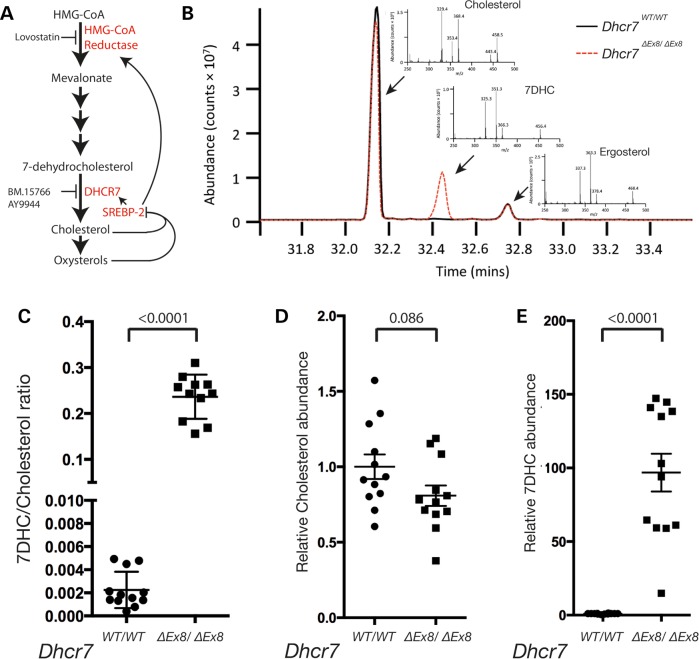
GC-MS analysis of sterol levels. (A) Mevalonate is synthesized by HMG-CoA reductase. A series of subsequent metabolic reactions produce the cholesterol precursor and DHCR7 substrate, 7DHC. Cholesterol is a substrate for oxysterols, and both lipids negatively regulate the transcription of metabolic enzymes via SREBP-2. The enzymatic activities of HMG-CoA reductase and DHCR7 are inhibited by the pharmacological compounds Lovastatin, and AY9944 and BM15.766, respectively. (B) Example total ion chromatogram illustrates peaks for cholesterol, 7DHC and the internal standard ergosterol. Diagnostic fragment ions of cholesterol, 7DHC and ergosterol used for identification/quantification of each sterol are shown (inset). (C) 7DHC/cholesterol ratios for each sample of WT and Dhcr7ΔEx8/ΔEx8 MEFs analysed. (D) Relative abundance of cholesterol between samples of WT and Dhcr7ΔEx8/ΔEx8 MEFs. (E) Relative abundance of 7DHC between samples of WT and Dhcr7ΔEx8/ΔEx8 MEFs. Bars represent mean ± SEM. P-values from unpaired t-test.
Figure 2.
Figure 2.
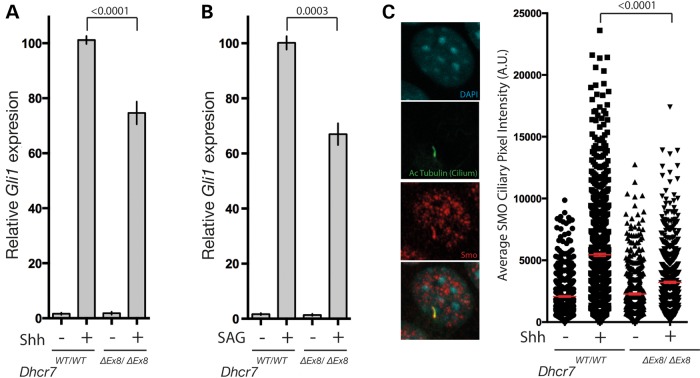
SMO activation is impaired in Dhcr7ΔEx8/ΔEx8 MEFs. (A) Gli1 transcriptional response of WT and Dhcr7ΔEx8/ΔEx8 MEFs stimulated with SHH (n = 24) or (B) SAG (n = 8), measured by qPCR. Mean ± SEM. P-values from paired t-test. (C) Immunofluorescence staining of SMO accumulation in primary cilia of SHH-treated WT and Dhcr7ΔEx8/ΔEx8 MEFs. The mean pixel value of individual SMO immunostained cilia was plotted. Bars represent mean ± SEM of mean pixel values. P-values from the Kolmogorov–Smirnov test.
Figure 3.
Figure 3.
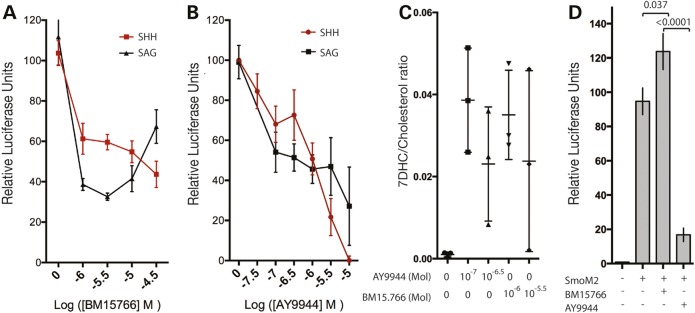
The DHCR7 inhibitor BM15.766 recapitulates the c.964-1G>C mutation. (A) The DHCR7 inhibitor BM15.766 partially inhibits activation of a Gli luciferase reporter in Shh-Light2 cells by SHH or direct activation of SMO by SAG across a broad range of concentrations. Mean ± SD (n = 3). (B) At high concentrations the DHCR7 inhibitor AY9944 completely inhibits activation of a GLI-luciferase reporter by SHH. Mean ± SD (n = 6). (C) 7DHC/cholesterol ratios derived from GC-MS analysis illustrate that 10−7 M AY9944 and 10−6 M BM15.766 maximally inhibit DHCR7 enzymatic activity. Mean ± SD. (D) Activation of the GLI-luciferase reporter by constitutively active SmoM2 in transfected NIH3T3 fibroblasts is insensitive to 10−5 M BM15.766 and inhibited by 10−5 M AY9944. Mean ± SEM (n = 12). P-values from unpaired t-test.
Figure 4.
Figure 4.
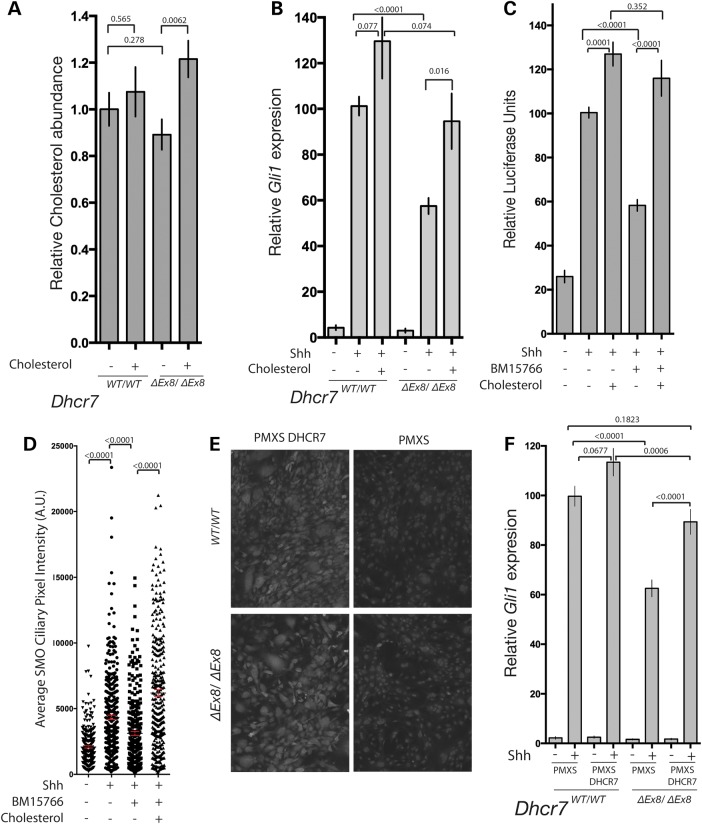
DHCR7 cholesterol biosynthetic activity is required for normal SHH signalling. (A) Addition of exogenous cholesterol raised cellular cholesterol levels of Dhcr7ΔEx8/ΔEx8 MEFs as determined by GC-MS. (B) Gli1 transcriptional response of SHH stimulated WT and Dhcr7ΔEx8/ΔEx8 MEFs cultured with or without additional cholesterol. Mean ± SEM. P-values from paired t-tests (n = 10). (C) Inhibition of GLI-reporter activation by BM15.766 in Shh-LIGHT2 cells cultured with or without additional cholesterol. Mean ± SEM. P-values from the Mann–Whitney test (n = 20). (D) The mean pixel value of individual SMO immunostained cilia was reduced in SHH-stimulated NIH3T3 fibroblasts cultured with BM15.766. The effect was reversed by cholesterol. Mean ± SEM. P-values from the Kolmogorov–Smirnov test. (E) Immunofluorescence staining of human DHCR7 overexpressed in MEFs by retroviral transduction compared with untransfected control MEFs. (F) DHCR7 overexpression rescued the reduced Gli1 transcriptional response of SHH stimulated Dhcr7ΔEx8/ΔEx8 MEFs. Mean ± SEM (n = 16). P-values from paired t-tests.
Figure 5.
Figure 5.
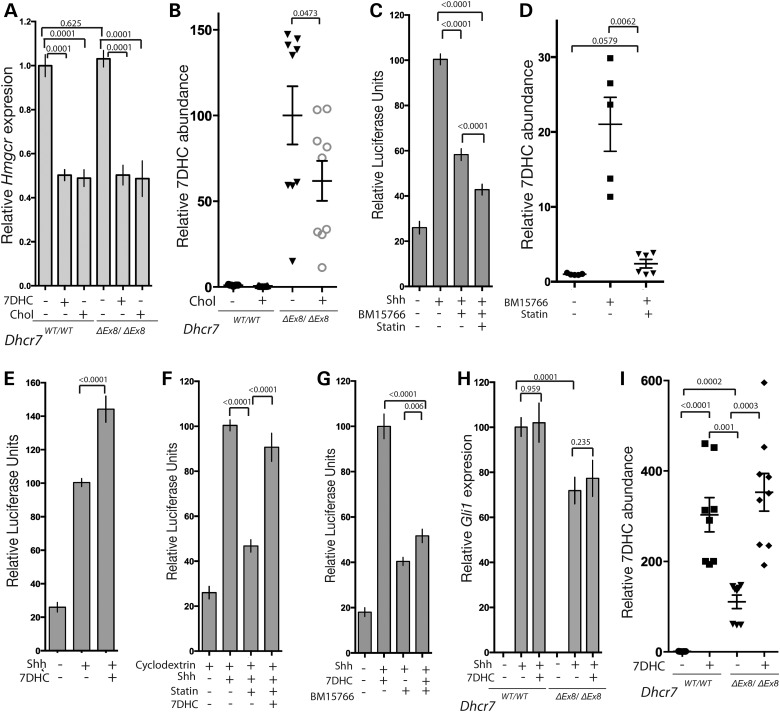
7DHC accumulation does not inhibit SHH signalling. (A) Hmgcr expression measured by qPCR is equivalent in WT and Dhcr7ΔEx8/ΔEx8 MEFs, and reduced by 7DHC or cholesterol (n = 5). (B) Exogenous cholesterol reduces the elevated 7DHC levels in Dhcr7ΔEx8/ΔEx8 MEFs. Abundances determined by GC-MS. P-values are from paired t-tests. (C) Inhibition of SHH-induced GLI-reporter activation by BM15.766 in Shh-LIGHT2 cells is not reversed by Lovastatin (n = 20). (D) Lovastatin blocks 7DHC accumulation in 3T3 cells treated with BM15.766. (E) 7DHC did not inhibit SHH-induced GLI-reporter activation (n = 20). (F) 7DHC rescued reduced GLI-reporter activation by SHH in the presence of 5 uM Lovastatin and 0.1% 2-hydroxypropyl-β-cyclodextrin (n = 16). (G) 7DHC did not potentiate the inhibitory effect of BM15.766 on SHH-induced GLI-reporter activation (n = 20). (H) 7DHC had no effect on the Gli1 transcriptional response of SHH stimulated Dhcr7ΔEx8/ΔEx8 or WT MEFs. Paired t-test (n = 9). (I) Exogenous 7DHC accumulates in WT and Dhcr7ΔEx8/ΔEx8 MEFs. P-values are from paired t-tests. All panels illustrate mean ± SEM. P-values are from Mann–Whitney tests unless stated otherwise.
Figure 6.
Figure 6.
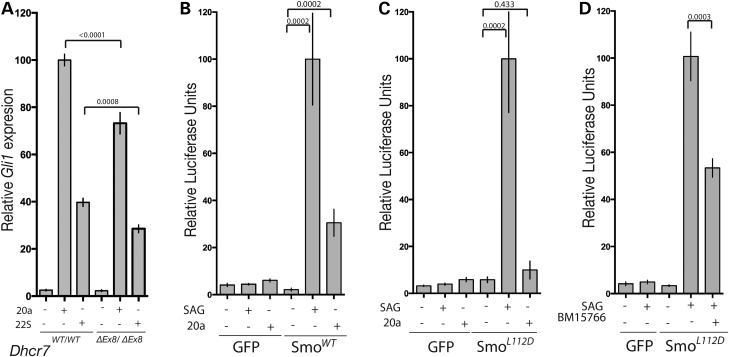
DHCR7 cholesterol biosynthetic activity is required for normal SMO activation by oxysterols. (A) Gli1 transcriptional response to two activating oxysterols was reduced in Dhcr7ΔEx8/ΔEx8 MEFs. Paired t-test (n = 9). (B) The GLI response of NIH3T3 fibroblasts to SAG and 20α-hydroxycholesterol depends upon transfection with WT SMO when endogenous SMO is disrupted by CRISPR (n = 8). (C) Transfection with SmoL112D rescues the GLI response of SMO-CRISPR fibroblasts to SAG, but not 20α-hydroxycholesterol (n = 8). (D) BM15.766 inhibits the GLI-response of SmoL112D transfected SMO-CRISPR fibroblasts (n = 15). All panels illustrate mean ± SEM. P-values are from Mann–Whitney tests unless stated otherwise.

References

    1. Porter F.D., Herman G.E. (2011) Malformation syndromes caused by disorders of cholesterol synthesis. J. Lipid Res., 52, 6–34. - PMC - PubMed
    1. Kelley R.I., Hennekam R.C. (2000) The Smith-Lemli-Opitz syndrome. J. Med. Genet., 37, 321–335. - PMC - PubMed
    1. Nowaczyk M.J., Zeesman S., Waye J.S., Douketis J.D. (2004) Incidence of Smith-Lemli-Opitz syndrome in Canada: results of three-year population surveillance. J. Pediatr., 145, 530–535. - PubMed
    1. Tint G.S., Irons M., Elias E.R., Batta A.K., Frieden R., Chen T.S., Salen G. (1994) Defective cholesterol biosynthesis associated with the Smith-Lemli-Opitz syndrome. N. Engl. J. Med., 330, 107–113. - PubMed
    1. Nowaczyk M.J., McCaughey D., Whelan D.T., Porter F.D. (2001) Incidence of Smith-Lemli-Opitz syndrome in Ontario, Canada. Am. J. Med. Genet., 102, 18–20. - PubMed

Publication types