. 2015 Dec 22;13(11):2336-2344.
doi: 10.1016/j.celrep.2015.11.041. Epub 2015 Dec 10.

Condensin Relocalization from Centromeres to Chromosome Arms Promotes Top2 Recruitment during Anaphase

Affiliations

Condensin Relocalization from Centromeres to Chromosome Arms Promotes Top2 Recruitment during Anaphase

Joanne Leonard et al. Cell Rep. .

Abstract

Condensin is a conserved chromosomal complex necessary to promote mitotic chromosome condensation and sister chromatid resolution during anaphase. Here, we report that yeast condensin binds to replicated centromere regions. We show that centromeric condensin relocalizes to chromosome arms as cells undergo anaphase segregation. We find that condensin relocalization is initiated immediately after the bipolar attachment of sister kinetochores to spindles and requires Polo kinase activity. Moreover, condensin localization during anaphase involves a higher binding rate on DNA and temporally overlaps with condensin's DNA overwinding activity. Finally, we demonstrate that topoisomerase 2 (Top2) is also recruited to chromosome arms during anaphase in a condensin-dependent manner. Our results uncover a functional relation between condensin and Top2 during anaphase to mediate chromosome segregation.


Figures

None
Graphical abstract
Figure 1
Figure 1
Chromosome Biorientation Promotes Reduced Condensin Binding at Centromeres (A) Association of condensin subunit Smc2 by ChIP-seq analysis to chromosomes in metaphase arrested cells in the presence and absence of mitotic spindles. cdc20-td SMC2-3HA cells were arrested in metaphase with nocodazole under Cdc20 depleting conditions (CDC20 metaphase arrest-plus nocodazole). After the arrest, nocodazole was removed and samples collected at 120 min (CDC20 metaphase arrest-minus nocodazole). Finally, nocodazole was added back and samples collected after 120 min (CDC20 metaphase arrest- nocodazole addback). Note that Smc2 centromere localization is inversely correlated to the presence of spindles. (B) Cells as in (A) were synchronized in G1 and released into the cell cycle in the presence of nocodazole. Samples were taken for analysis at the G1 block and 120 min after release when cells reached metaphase arrest. Note that Smc2 centromeric localization is absent in cells arrested in G1. See also Data S1, S2, S3, and S4.
Figure 2
Figure 2
Condensin Localizes to the Chromosome upon Chromosome Biorientation (A) SMC2-6HA cells were synchronized in G1 and released into the cell cycle. Samples were taken at the indicated time points and processed for ChIP-qPCR analysis. Graphs show the mean ± SD. (B) Met-CDC20 SMC2-9MYC cells were arrested in metaphase with nocodazole under Cdc20 depleting conditions. Cells were transferred to new media lacking nocodazole at 37°C and samples collected for ChIP-qPCR analysis at the indicated times. Graphs show the mean ± SD. (C) Cells were treated as in (B). Chromosomal association at selected positions was determined by ChIP-qPCR. Graphs show the mean ± SD.
Figure 3
Figure 3
Condensin-Mediated DNA Supercoiling and Localization to Chromosome Arms Temporally Overlap during Anaphase and Require Polo Kinase (A) Cdc20-td top2-td, cdc20-td top2-td cdc5-1, cdc20-td top2-td ipl1-321, cdc20-td top2-td brn1-60, and cdc20-td top2-td dyn1Δ kip1Δ cyn8-3 strains bearing a circular centromeric minichromosome (pRS316) were synchronized in G1, split in two, and released into the cell cycle under conditions of Cdc20 and Top2 depletion at 37°C. Nocodazole was added to one of the samples. DNA was resolved in agarose gels and probed for the circular minichromosome. Electrophoretic mobility of monomers (OCm, relaxed monomer; Lm, linear monomer; CCCm, supercoiled monomer) is indicated. Dimeric forms CatC type catenanes (negatively supercoiled) and CatC type catenanes—(positively supercoiled) are indicated. (B) A top2-td cdc15-2 strain carrying a minichromosome (pRS316) was synchronously arrested in mitosis using nocodazole to prevent formation of mitotic spindles. Top2 protein was then degraded before washing off the nocodazole to allow mitotic spindles to form and cells were allowed to proceed to a telophase arrest at 37°C mediated by cdc15-2. DNA was analyzed in 2D chloroquine gels to reveal the supercoiling distribution of the monomer plasmids. To assign the mobility of topoisomers (as positive or negative) we treated minichromosomes with eukaryotic topoisomerase I and run the fully relaxed plasmids under the same gel conditions. A cartoon representation of how the plasmid distribution relates to supercoiling status is shown (right). OC, open circles; SM, supercoiled monomer; CatC, type C catenane negatively supercoiled; CatC, type C catenane positively supercoiled. (C) SMC2-6HA and cdc5-1 SMC2-6HA cells were synchronized in G1 and released into the cell cycle in the presence of nocodazole. Following metaphase arrest, cells were transferred to new media lacking nocodazole at 37°C and samples were collected at the indicated time points. Association to chromosome 12 was determined by ChIP-qPCR. Graphs show the mean ± SD.
Figure 4
Figure 4
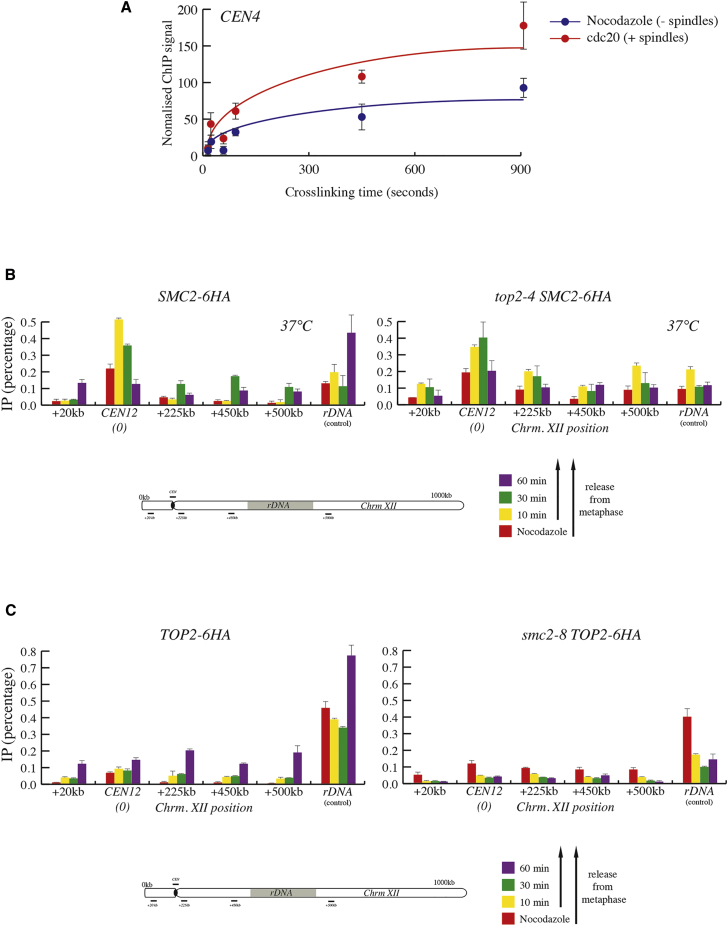
Condensin Localization in Anaphase Involves a Higher Binding Rate on DNA and Promotes Top2 Binding to Chromosome Arms (A) CLK analysis for SMC2-3HA binding to CEN4 in cells arrested in nocodazole (−spindles; blue) or released to a cdc20 block (+spindles; red). Conditions were as in Figure 2B. Smc2 binding to CEN4 was determined by ChIP-qPCR for each crosslinking time. Data and fits are shown. Graphs show the mean ± SD. (B) SMC2-6HA and top2-4 SMC2-6HA cells were synchronized in G1 and released into the cell cycle in the presence of nocodazole. Following metaphase arrest, cells were transferred to new media lacking nocodazole at 37°C and samples were collected at the indicated time points. Chromosomal association at selected positions was determined by ChIP-qPCR. Graphs show the mean ± SD. (C) TOP2-6HA and smc2-8 TOP2-6HA cells were treated and analyzed as in (B). Graphs show the mean ± SD.

References

    1. Baxter J., Aragón L. A model for chromosome condensation based on the interplay between condensin and topoisomerase II. Trends Genet. 2012;28:110–117. - PubMed
    1. Baxter J., Sen N., Martínez V.L., De Carandini M.E., Schvartzman J.B., Diffley J.F., Aragón L. Positive supercoiling of mitotic DNA drives decatenation by topoisomerase II in eukaryotes. Science. 2011;331:1328–1332. - PubMed
    1. Bazett-Jones D.P., Kimura K., Hirano T. Efficient supercoiling of DNA by a single condensin complex as revealed by electron spectroscopic imaging. Mol. Cell. 2002;9:1183–1190. - PubMed
    1. Charbin A., Bouchoux C., Uhlmann F. Condensin aids sister chromatid decatenation by topoisomerase II. Nucleic Acids Res. 2014;42:340–348. - PMC - PubMed
    1. Cuylen S., Metz J., Hruby A., Haering C.H. Entrapment of chromosomes by condensin rings prevents their breakage during cytokinesis. Dev. Cell. 2013;27:469–478. - PubMed

Publication types

MeSH terms