


The Social ABCs caregiver-mediated intervention for toddlers with autism spectrum disorder: Feasibility, acceptability, and evidence of promise from a multisite study
- PMID: 26688077
- PMCID: PMC5064621
- DOI: 10.1002/aur.1582
The Social ABCs caregiver-mediated intervention for toddlers with autism spectrum disorder: Feasibility, acceptability, and evidence of promise from a multisite study
Abstract
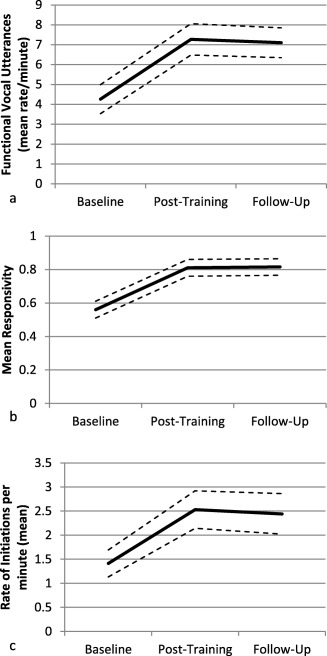
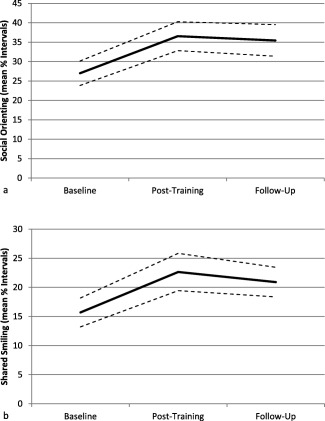
The Social ABCs is a parent-mediated intervention for toddlers with suspected or confirmed autism spectrum disorder (ASD). We undertook a multi-site pilot study to evaluate feasibility and acceptability, and to identify trends in child and parent behavior to inform future research using a larger sample and a rigorous research design. The program involved 12 weeks of parent coaching, followed by 12 weeks' implementation, and 3-month follow-up assessment for 20 parent-toddler dyads (age range: 12-32 months). Parents successfully learned the techniques and rated the intervention as highly acceptable. Paired samples t-tests revealed significant gains in children's functional communication (responsivity, initiations), and language gains (age-equivalents on standardized measures) commensurate with typical developmental rates. Significant increases in shared smiling and social orienting also emerged, but were attenuated at follow-up. Parents' fidelity was positively associated with child responsivity. Training parents as mediators is a feasible and highly acceptable approach that provides a potentially cost-effective opportunity for intensive intervention at a very young age at the first signs of ASD risk. Child and parent gains in several key variables demonstrate the promise of this intervention. Autism Res 2016, 9: 899-912. © 2015 The Authors Autism Research published by Wiley Periodicals, Inc. on behalf of International Society for Autism Research.
Keywords: autism spectrum disorder; caregiver-mediated; communication; early intervention; high-risk; parent-mediated; pivotal response treatment; smiling; toddlers.
© 2015 The Authors Autism Research published by Wiley Periodicals, Inc. on behalf of International Society for Autism Research.
Figures
References
-
- American Psychiatric Association . (2013). Diagnostic and statistical manual of mental disorders (5th ed). Washington, DC: American Psychiatric Association.
-
- Baranek, G. , Watson, L.R. , Turner‐Brown, L. , Field, S.H. , Crais, E.R. , Wakeford, L. , … Reznick, S.J. (2015). Preliminary efficacy of Adapted Responsive Teaching for infants at risk of autism spectrum disorder in a community sample. Autism Research and Treatment. Article ID 386951, doi: dx.doi.org/. - DOI - PMC - PubMed
-
- Beaudoin, A.J. , Sebire, G. , & Couture, M. (2014). Parent training interventions for toddlers with autism spectrum disorder (Review Article). Autism Research and Treatment, Article ID 839890, http://dx.doi.org/. - DOI - PMC - PubMed
-
- Brian, J.A. , Bryson, S.E. , & Zwaigenbaum, L. (2015). ASD in infancy: Developmental considerations in treatment targets. Current Opinion in Neurology, 28(2), 117–123. - PubMed
-
- Brian, J.A. , Roncadin, C. , Duku, E. , Bryson, S.E. , Smith, I.M. , Roberts, W. , … Zwaigenbaum, L. (2014). Emerging cognitive profiles in high‐risk infants with and without autism spectrum disorder. Research in Autism Spectrum Disorders, 8(11), 1557–1566.
Publication types
MeSH terms
LinkOut - more resources
Full Text Sources
Other Literature Sources
Medical
