


Anxiety and its disorders as risk factors for suicidal thoughts and behaviors: A meta-analytic review
- PMID: 26688478
- PMCID: PMC4771521
- DOI: 10.1016/j.cpr.2015.11.008
Anxiety and its disorders as risk factors for suicidal thoughts and behaviors: A meta-analytic review
Abstract
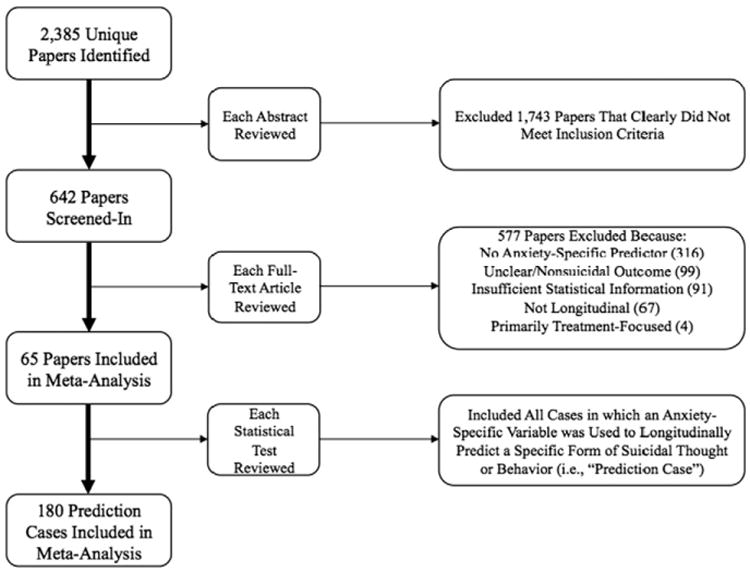
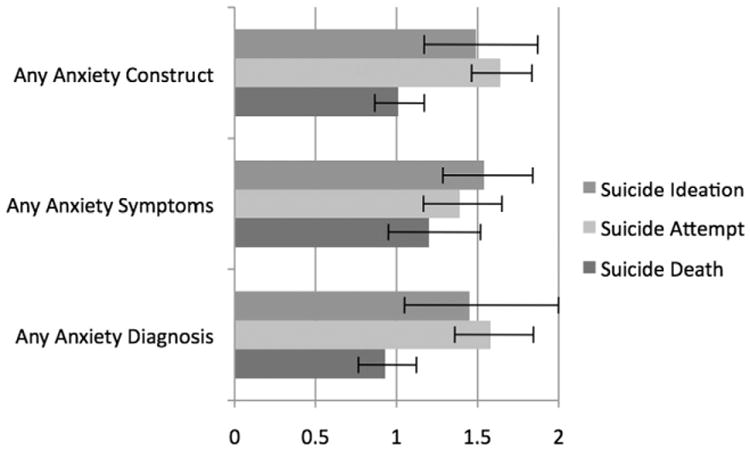
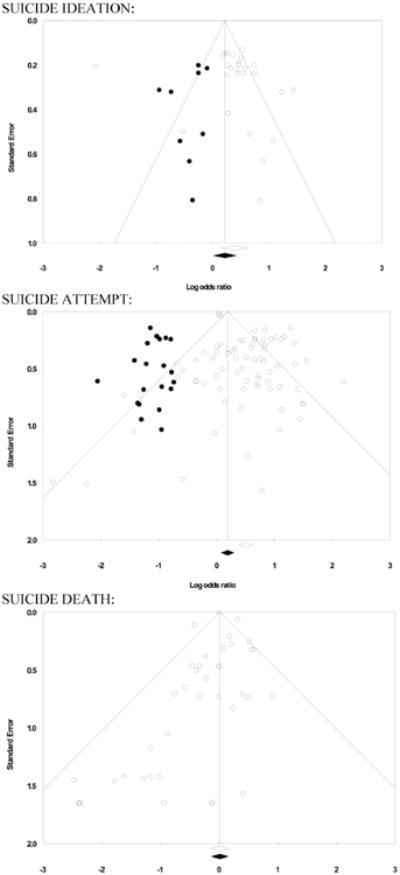
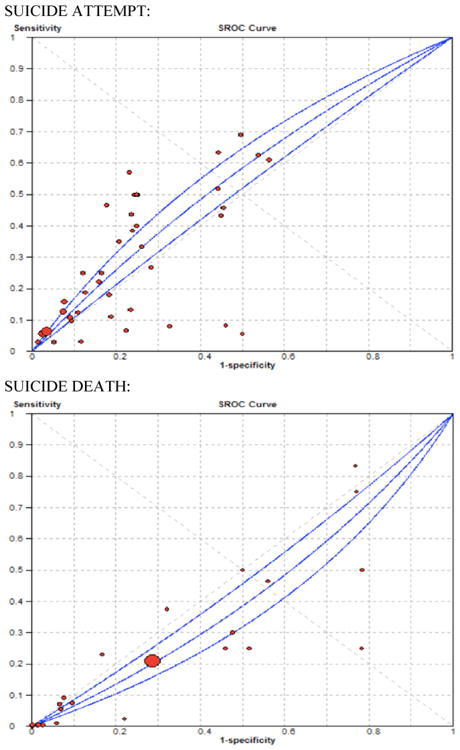
Suicidal thoughts and behaviors are highly prevalent public health problems with devastating consequences. There is an urgent need to improve our understanding of risk factors for suicide to identify effective intervention targets. The aim of this meta-analysis was to examine the magnitude and clinical utility of anxiety and its disorders as risk factors for suicide ideation, attempts, and deaths. We conducted a literature search through December 2014; of the 65 articles meeting our inclusion criteria, we extracted 180 cases in which an anxiety-specific variable was used to longitudinally predict a suicide-related outcome. Results indicated that anxiety is a statistically significant, yet weak, predictor of suicide ideation (OR=1.49, 95% CI: 1.18, 1.88) and attempts (OR=1.64, 95% CI: 1.47, 1.83), but not deaths (OR=1.01, 95% CI: 0.87, 1.18). The strongest associations were observed for PTSD. Estimates were reduced after accounting for publication bias, and diagnostic accuracy analyses indicated acceptable specificity but poor sensitivity. Overall, the extant literature suggests that anxiety and its disorders, at least when these constructs are measured in isolation and as trait-like constructs, are relatively weak predictors of suicidal thoughts and behaviors over long follow-up periods. Implications for future research priorities are discussed.
Keywords: Anxiety; Meta-analysis; Risk factor; Suicide.
Copyright © 2015 Elsevier Ltd. All rights reserved.
Figures
References
Appendix A. References for articles included in meta-analyses
-
- Allgulander C, Allebeck P, Przybeck T, Rice JP. Risk of suicide by psychiatric diagnosis in Stockholm County. Euorpean Archives of Psychiatry and Clinical Neuroscience. 1992;241:323–326. - PubMed
-
- Alonso P, Segalàs C, Real E, Pertusa A, Labad J, Jiménez-Murcia S, et al. Menchón JM. Suicide in patients treated for obsessive–compulsive disorder: A prospective follow-up study. Journal of Affective Disorders. 2010;124:300–308. http://dx.doi.org/10.1016/j.jad.2009.12.001. - DOI - PubMed
-
- Angst J, Clayton PJ. Personality, smoking, and suicide: A prospective study. Journal of Affective Disorders. 1998;51:55–62. - PubMed
-
- Bakken K, Vaglum P. Predictors of suicide attempters in substance-dependent patients: A six-year prospective follow-up. Clinical Practice and Epidemiology in Mental Health. 2007;3(20) http://dx.doi.org/10.1186/1745-0179-3-20 http://dx.doi.org/10.1186/1745-0179-3-20. - DOI - DOI - PMC - PubMed
-
- Beautrais AL. Further suicidal behavior among medically serious suicide attempters. Suicide and Life-Threatening Behavior. 2004;34(1):1–11. - PubMed
References
-
- American Association of Suicidology. Warning Signs & Risk Factors [online] [Accessed October 16, 2015];2015 http://www.suicidology.org/ncpys/warning-signs-risk-factors.
-
- American Foundation for Suicide Prevention. Suicide Risk factors [online] [Accessed October 16, 2015];2015 https://www.afsp.org/understanding-suicide/suicide-risk-factors.
-
- Amir M, Kaplan Z, Efroni R, Kotler M. Suicide risk and coping styles in posttraumatic stress disorder patients. Psychotherapy and Psychosomatics. 1999;68(2):76–81. - PubMed
-
- Barlow DH, Sauer-Zavala S, Carl JR, Bullis JR, Ellard KK. The nature, diagnosis, and treatment of neuroticism: Back to the future. Clinical Psychological Science. 2014;2(3):344–365.
-
- Baumeister R. Suicide as escape from self. Psychological Review. 1990;97:90–113. http://dx.doi.org/10.1037/0033-295X.97.1.90. - DOI - PubMed
Publication types
MeSH terms
Grants and funding
LinkOut - more resources
Full Text Sources
Other Literature Sources
Medical
