. 2016 Jan:52:188-96.
doi: 10.1016/j.ejca.2015.10.003. Epub 2015 Dec 12.

Nicotine induces self-renewal of pancreatic cancer stem cells via neurotransmitter-driven activation of sonic hedgehog signalling

Affiliations

Nicotine induces self-renewal of pancreatic cancer stem cells via neurotransmitter-driven activation of sonic hedgehog signalling

Mohammed H Al-Wadei et al. Eur J Cancer. 2016 Jan.

Abstract

A small subpopulation of pancreatic cancer cells with characteristics of stem cells drive tumour initiation, progression and metastasis. A better understanding of the regulation of cancer stem cells may lead to more effective cancer prevention and therapy. We have shown that the proliferation and migration of pancreatic cancer cell lines is activated by the nicotinic receptor-mediated release of stress neurotransmitters, responses reversed by γ-aminobutyric acid (GABA). However, the observed cancer inhibiting effects of GABA will only succeed clinically if GABA inhibits pancreatic cancer stem cells (PCSCs) in addition to the more differentiated cancer cells that comprise the majority of cancer tissues and cell lines. Using PCSCs isolated from two pancreatic cancer patients by cell sorting and by spheroid formation assay from pancreatic cancer cell line Panc-1, we tested the hypothesis that nicotine induces the self-renewal of PCSCs. Nicotinic acetylcholine receptors (nAChRs) α3, α4, α5 and α7 were expressed and chronic exposure to nicotine increased the protein expression of these receptors. Immunoassays showed that PCSCs produced the stress neurotransmitters epinephrine and norepinephrine and the inhibitory neurotransmitter GABA. Chronic nicotine significantly increased the production of stress neurotransmitters and sonic hedgehog (SHH) while inducing Gli1 protein and decreasing GABA. GABA treatment inhibited the induction of SHH and Gli1. Spheroid formation and 3-[4,5-dimethylthiazol-2-yl]-2,5-diphenyltetrazoliumbromide assays showed significant nicotine-induced increases in self renewal and cell proliferation, responses blocked by GABA. Our data suggest that nicotine increases the SHH-mediated malignant potential of PCSCs and that GABA prevents these effects.

Keywords: Cancer stem cells; GABA; Nicotinic receptors; Pancreatic cancer; Sonic hedgehog; Stress neurotransmitters.


Conflict of interest statement

Conflict of interest statement

The authors declare no conflicts of interest

Figures
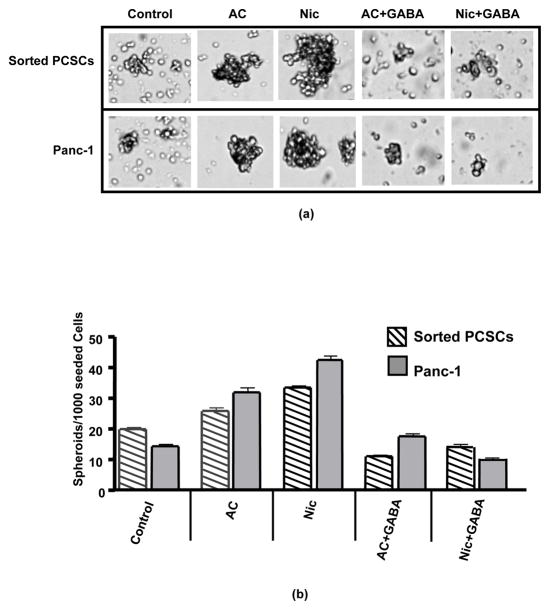
Figure 1
Figure 1
(a) Assessment of cancer stem cell self-renewal by spheroid formation assays of 15 days duration with Panc-1 cells and sorted PCSCs showed that daily treatment with acetylcholine (10 μM/L) or nicotine (1 μM/L) during the entire assay period significantly (p < 0.0001) increased the number of spheroids and these responses were completely blocked by simultaneous treatment with GABA (30 μM/L). (b) Columns in the graph represent mean values and standard deviations of spheroids per 1000 seeded cells from 5 samples per treatment group.
Figure 2
Figure 2
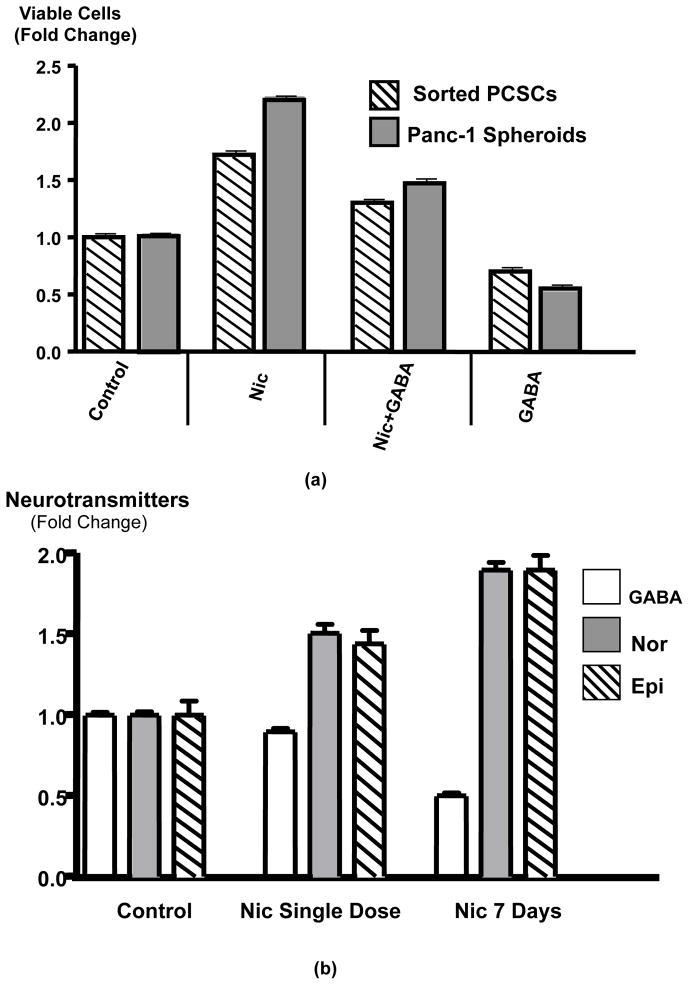
(a) The number of viable cells in spheroids as an indicator of PCSCs proliferation was determined by MTT assay. In accord with the larger spheroid sizes after nicotine treatment (Figure 1), exposure of spheroids for 7 days to nicotine (1 μM/L) significantly (p < 0.001) increased the number of viable cells, a response significantly (p < 0.001) inhibited by treatment with GABA (30 μM/L). GABA treatment alone significantly (p < 0.001) reduced the number of viable cells below control levels. Data are mean values and standard deviations of 5 samples per treatment group. (b) Results of ELISA assays for the assessment of total (intracellular plus secreted) norepinephrine (Nor), epinephrine (Epi) and GABA in PCSC spheroids. Daily treatment of spheroids for 7 days with nicotine (1 μM/L) significantly (p < 0.01) increased the levels of both stress neurotransmitters while reducing GABA. Exposure to a single dose of nicotine for 30 minutes was less effective. Data are mean values and standard deviations of 5 samples per treatment group.
Figure 3
Figure 3
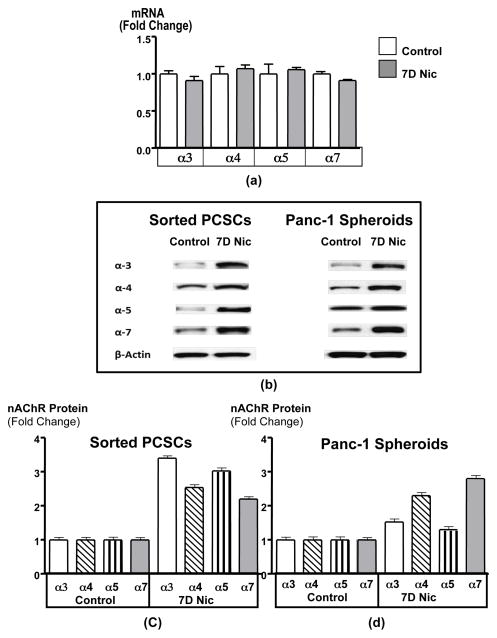
(a) Real-time PCR showed that the mRNA levels of nAChR receptor subunits α3, α4, α5 and α7 were expressed in spheroids but did not significantly change in response to treatment for 7 days with nicotine (1 μM/L), suggesting that the upregulations in receptor protein determined by Western blots (b) in these spheroids were caused by post-translational mechanisms. Densitometry values of western blots (c and d) revealed that protein upregulation of nAChR subunits a3, 4 and 7 were significant (p < 0.0001). Columns in graphs c and d represent the mean values and standard deviations of 3 densitometric readings per band from three independent Western blots.
Figure 4
Figure 4
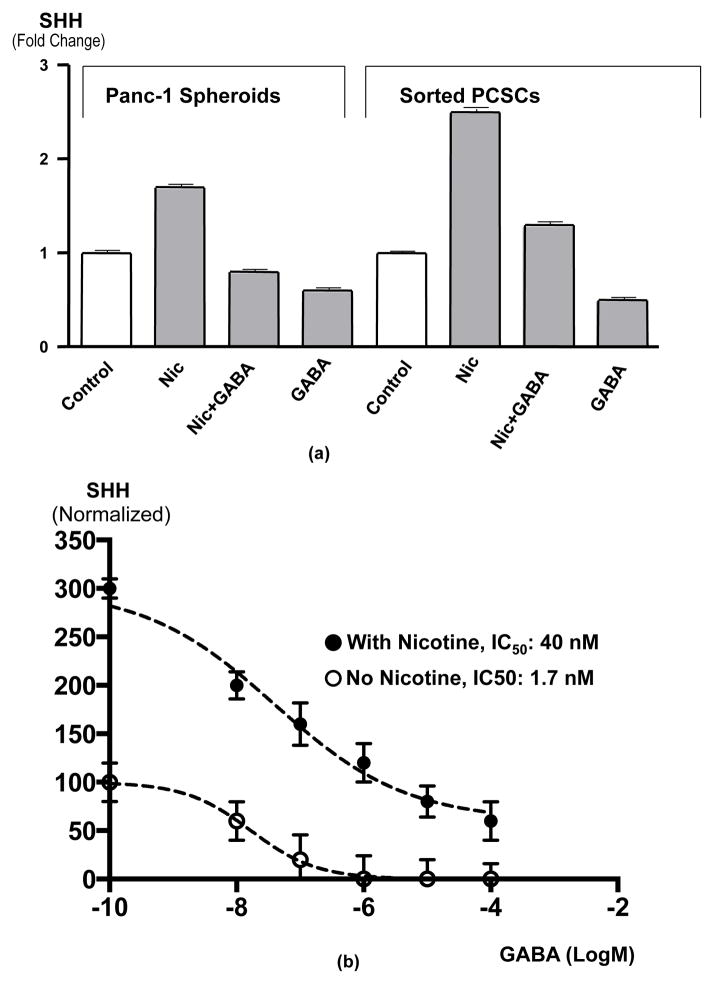
(a) Results of ELISA assays for the detection of total (intracellular plus secreted) sonic hedgehog (SHH) in spheroids from Panc-1 and sorted PCSCs. Exposure of spheroids for 7 days to nicotine (1 μM/L) significantly (p < 0.003) increased SHH levels. This response was completely blocked by simultaneous treatment for 7 days with GABA (30 μM/L) while GABA alone significantly (p < 0.003) reduced SHH below control levels. Data are mean values and standard deviations of 5 samples per treatment group. (b) Dose-response curves for GABA-induced SHH inhibition in Panc-1 spheroids in the presence and absence of 7-day nicotine (1 μM). The IC50 in the presence of nicotine was 23.5 times higher than in the absence of nicotine, emphasizing the antagonistic effects of nicotine and GABA on SHH production. Data points are mean values and standard deviations of triplicate samples normalized to controls with untreated controls set as 100% and maximum inhibition of non-nicotine exposed samples set as 0%. The curves and IC50 values were determined by nonlinear regression analysis.
Figure 5
Figure 5
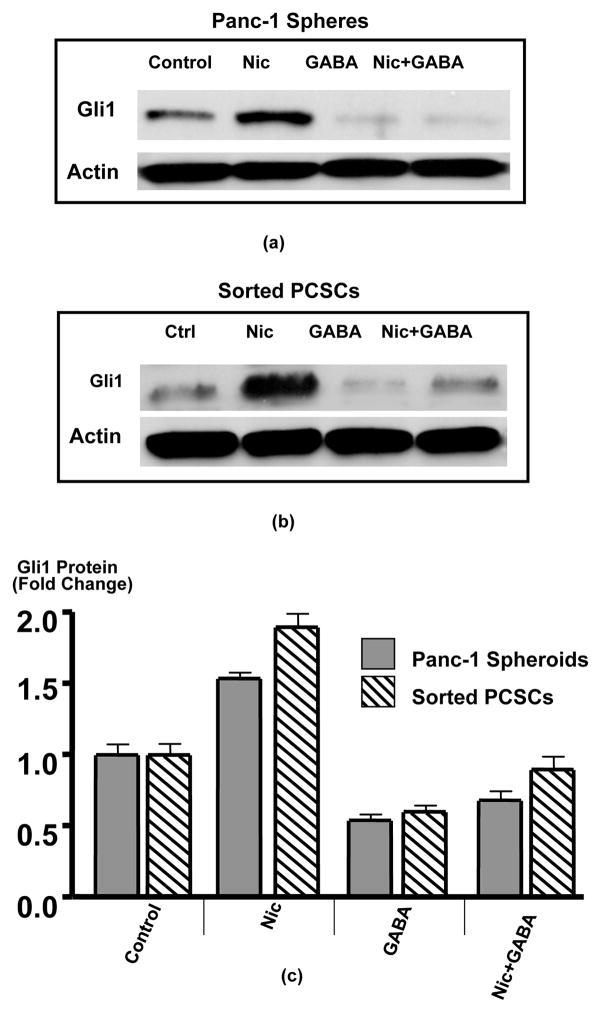
Western blots showing protein expression of Gli1 in spheroids from Panc-1 (a) and sorted PCSCs (b). Nicotine (1μM/L) for 7 days significantly (p < 0.001) induced Gli1 protein, a response completely blocked by simultaneous treatment with GABA (30 μM/L) GABA alone significantly (p < 0.001) reduced Gli1 protein below control levels. Columns in the graph (c) are mean values and standard deviations of 3 densitometric readings per band from 3 independent Western blots.
Figure 6
Figure 6
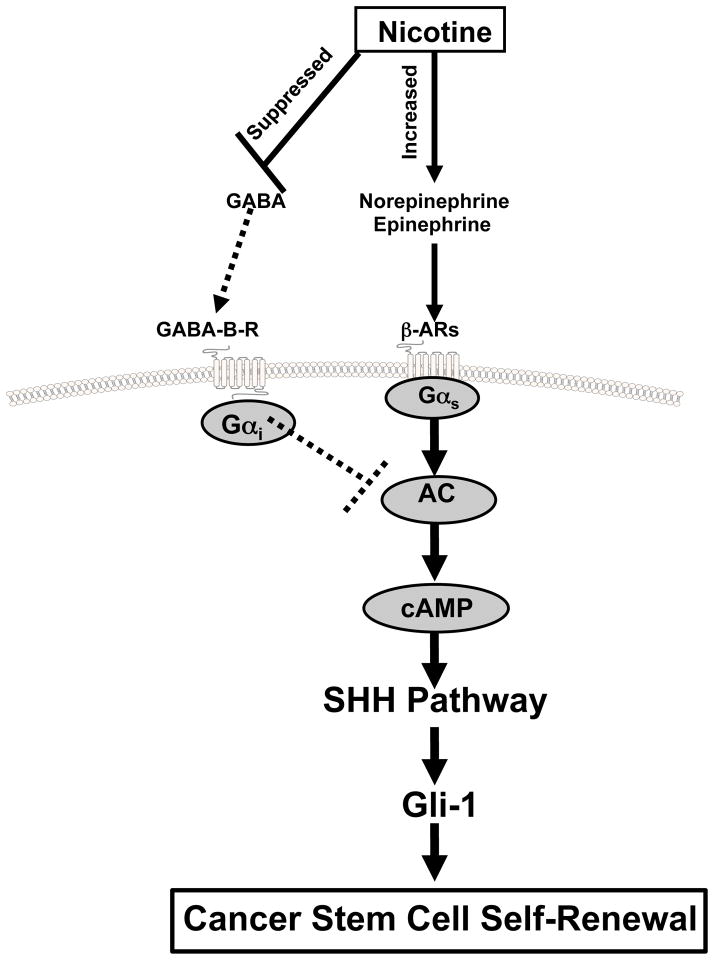
Working model illustrating the putative regulatory pathway in pancreatic cancer stem cells that is stimulated by nicotine and inhibited by GABA. Nicotine simultaneously suppresses GABA while increasing stress neurotransmitter production, resulting in the cAMP-driven hyperactivity of the SHH pathway. Exogenous supplementation with GABA reverses these effects of nicotine.

References

    1. Al-Wadei HA, Plummer HK, 3rd, Schuller HM. Nicotine stimulates pancreatic cancer xenografts by systemic increase in stress neurotransmitters and suppression of the inhibitory neurotransmitter gamma-aminobutyric acid. Carcinogenesis. 2009;30:506–11. - PMC - PubMed
    1. Al-Wadei MH, Al-Wadei HA, Schuller HM. Effects of chronic nicotine on the autocrine regulation of pancreatic cancer cells and pancreatic duct epithelial cells by stimulatory and inhibitory neurotransmitters. Carcinogenesis. 2012;33:1745–53. - PMC - PubMed
    1. Al-Wadei MH, Al-Wadei HA, Schuller HM. Pancreatic Cancer Cells and Normal Pancreatic Duct Epithelial Cells Express an Autocrine Catecholamine Loop that Is Activated by Nicotinic Acetylcholine Receptors alpha3, alpha5, and alpha7. Mol Cancer Res. 2012;10:239–49. - PMC - PubMed
    1. Almhanna K, Philip PA. Defining new paradigms for the treatment of pancreatic cancer. Curr Treat Options Oncol. 2011;12:111–25. - PubMed
    1. Balic A, Dorado J, Alonso-Gomez M, Heeschen C. Stem cells as the root of pancreatic ductal adenocarcinoma. Exp Cell Res. 2012;318:691–704. - PubMed

Publication types

MeSH terms