


Global Status Report on Violence Prevention 2014
- PMID: 26689979
- PMCID: PMC5868961
- DOI: 10.1016/j.amepre.2015.10.007
Global Status Report on Violence Prevention 2014
Abstract
Introduction: Interpersonal violence affects millions of people worldwide, often has lifelong consequences, and is gaining recognition as an important global public health problem. There has been no assessment of measures countries are taking to address it. This report aims to assess such measures and provide a baseline against which to track future progress.
Methods: In each country, with help from a government-appointed National Data Coordinator, representatives from six to ten sectors completed a questionnaire before convening in a consensus meeting to decide on final country data; 133 of 194 (69%) WHO Member States participated. The questionnaire covered data, plans, prevention measures, and victim services. Data were collected between November 2012 and June 2014, and analyzed between June and October 2014. Global and country-level homicides for 2000-2012 were also calculated for all 194 Members.
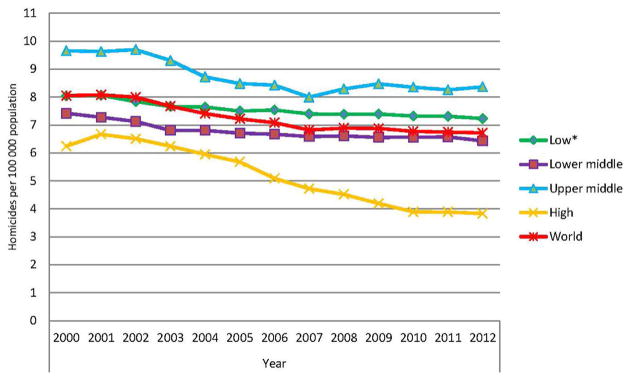
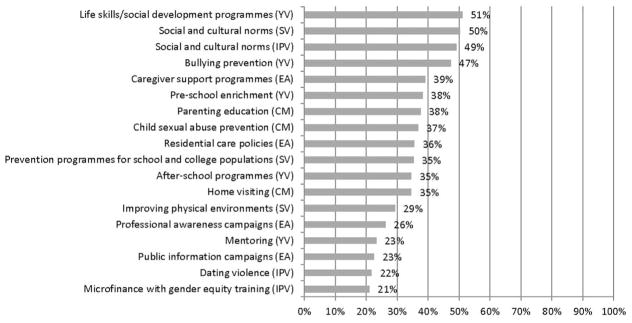
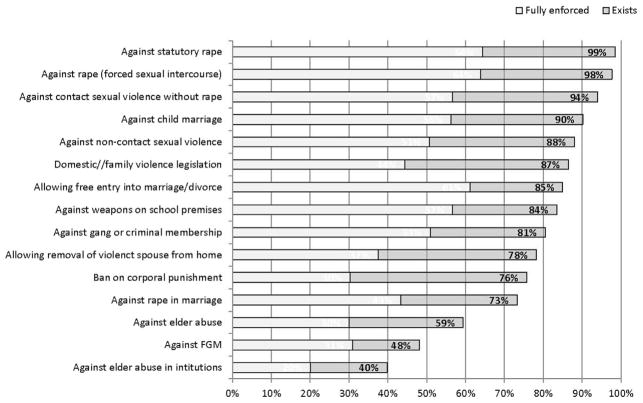
Results: Worldwide, 475,000 people were homicide victims in 2012 and homicide rates declined by 16% from 2000 to 2012. Data on fatal and, in particular, non-fatal forms of violence are lacking in many countries. Each of the 18 types of surveyed prevention programs was reported to be implemented in a third of the 133 participating countries; each law was reported to exist in 80% of countries, but fully enforced in just 57%; and each victim service was reported to be in place in just more than half of the countries.
Conclusions: Although many countries have begun to tackle violence, serious gaps remain, and public health researchers have a critical role to play in addressing them.
Copyright © 2016. Published by Elsevier Inc.
Figures
Comment in
-
Global Violence Prevention: The Time Is Now.Am J Prev Med. 2016 May;50(5):660-662. doi: 10.1016/j.amepre.2015.12.014. Am J Prev Med. 2016. PMID: 27102640 No abstract available.
References
-
- Krug EG, Dahlberg LL, Mercy JA, Zwi AB, Lozano R. The World Report on Violence and Health. Geneva: WHO; 2002. www.who.int/violence_injury_prevention/violence/world_report/en/ - PubMed
-
- WHO. Global Status Report on Violence Prevention 2014. Geneva: WHO; 2014.
-
- GBD 2013 Mortality and Causes of Death Collaborators. Global, regional, and national age-sex specific all-cause and cause-specific mortality for 240 causes of death, 1990–2013: a systematic analysis for the Global Burden of Disease Study 2013. Lancet. 2015;385(9963):117–171. http://dx.doi.org/10.1016/S0140-6736(14)61682-2. - DOI - PMC - PubMed
-
- Institute of Health Metrics and Evaluation. [Accessed August 15, 2015];GBD cause patterns—intentional injuries. http://vizhub.healthdata.org/gbd-cause-patterns/. Published 2015.
-
- Lozano R, Naghavi M, Foreman K, et al. Global and regional mortality from 235 causes of death for 20 age groups in 1990 and 2010: a systematic analysis for the Global Burden of Disease Study 2010. Lancet. 2012;380(9859):2095–2128. http://dx.doi.org/10.1016/S0140-6736(12)61728-0. - DOI - PMC - PubMed
Publication types
MeSH terms
Grants and funding
LinkOut - more resources
Full Text Sources
Other Literature Sources
Medical
