


Anti-Tumor Immunity in Head and Neck Cancer: Understanding the Evidence, How Tumors Escape and Immunotherapeutic Approaches
- PMID: 26690220
- PMCID: PMC4695900
- DOI: 10.3390/cancers7040900
Anti-Tumor Immunity in Head and Neck Cancer: Understanding the Evidence, How Tumors Escape and Immunotherapeutic Approaches
Abstract
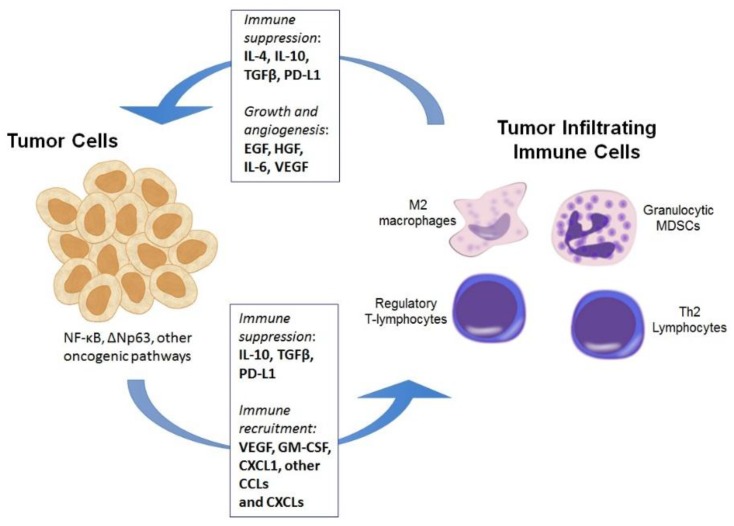
Many carcinogen- and human papilloma virus (HPV)-associated head and neck cancers (HNSCC) display a hematopoietic cell infiltrate indicative of a T-cell inflamed phenotype and an underlying anti-tumor immune response. However, by definition, these tumors have escaped immune elimination and formed a clinically significant malignancy. A number of both genetic and environmental mechanisms may allow such immune escape, including selection of poorly antigenic cancer cell subsets, tumor produced proinflammatory and immunosuppressive cytokines, recruitment of immunosuppressive immune cell subsets into the tumor and expression of checkpoint pathway components that limit T-cell responses. Here, we explore concepts of antigenicity and immunogenicity in solid tumors, summarize the scientific and clinical data that supports the use of immunotherapeutic approaches in patients with head and neck cancer, and discuss immune-based treatment approaches currently in clinical trials.
Keywords: adaptive immunity; antigenicity; checkpoint inhibitors; immunogenicity; immunosuppression; immunotherapy; innate immunity; syngeneic mouse models; tumor antigen; vaccines.
Figures
References
-
- Chen Z., Rosten S.I., Lord E.M., Gaspari A.A. Murine Pam 212 cutaneous squamous cell carcinoma is nonimmunogenic in normal syngeneic hosts and resistant to immune effector mechanisms. Reg. Immunol. 1993;5:285–292. - PubMed
-
- Yeh K.Y., Chen Z., Nasir A., Ohsuga Y., Takashima A., Lord E.M., Gaspari A.A. Expression of B7-1 by Pam 212 squamous cell carcinoma enhances tumor cell interactions with dendritic epidermal cells but does not affect in vivo tumor growth. J. Investig. Dermatol. 1997;109:728–733. doi: 10.1111/1523-1747.ep12340723. - DOI - PubMed
-
- Chen Z., Smith C.W., Kiel D., van Waes C. Metastatic variants derived following in vivo tumor progression of an in vitro transformed squamous cell carcinoma line acquire a differential growth advantage requiring tumor-host interaction. Clin. Exp. Metastasis. 1997;15:527–537. doi: 10.1023/A:1018474910432. - DOI - PubMed
-
- Dong G., Chen Z., Kato T., van Waes C. The host environment promotes the constitutive activation of nuclear factor-kappaB and proinflammatory cytokine expression during metastatic tumor progression of murine squamous cell carcinoma. Cancer Res. 1999;59:3495–3504. - PubMed
-
- Smith C.W., Chen Z., Dong G., Loukinova E., Pegram M.Y., Nicholas-Figueroa L., van Waes C. The host environment promotes the development of primary and metastatic squamous cell carcinomas that constitutively express proinflammatory cytokines IL-1α, IL-6, GM-CSF, and KC. Clin. Exp. Metastasis. 1998;16:655–664. doi: 10.1023/A:1006559811429. - DOI - PubMed
Publication types
Grants and funding
LinkOut - more resources
Full Text Sources
Other Literature Sources
Medical
