


Influence of grand-mother diet on offspring performances through the male line in Muscovy duck
- PMID: 26690963
- PMCID: PMC4687110
- DOI: 10.1186/s12863-015-0303-z
Influence of grand-mother diet on offspring performances through the male line in Muscovy duck
Abstract
Background: In mammals, multigenerational environmental effects have been documented by either epidemiological studies in human or animal experiments in rodents. Whether such phenomena also occur in birds for more than one generation is still an open question. The objective of this study was to investigate if a methionine deficiency experienced by a mother (G0) could affect her grand-offspring phenotypes (G2 hybrid mule ducks and G2 purebred Muscovy ducks), through their Muscovy sons (G1). Muscovy drakes are used for the production of mule ducks, which are sterile offspring of female common duck (Anas platyrhynchos) and Muscovy drakes (Cairina moschata). In France, mule ducks are bred mainly for the production of "foie gras", which stems from hepatic steatosis under two weeks of force-feeding (FF). Two groups of female Muscovy ducks received either a methionine deficient diet or a control diet. Their sons were mated to Muscovy or to common duck females to produce Muscovy or Mule ducks, respectively. Several traits were measured in the G2 progenies, concerning growth, feed efficiency during FF, body composition after FF, and quality of foie gras and magret.
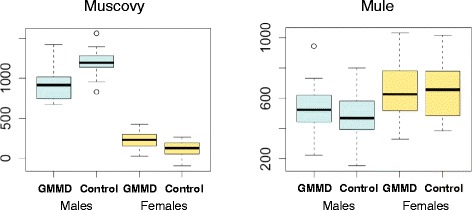
Results: In the G2 mule duck progeny, grand-maternal methionine deficiency (GMMD) decreased 4, 8, and 12 week body weights but increased weight gain and feed efficiency during FF, and abdominal fat weight. The plasmatic glucose and triglyceride contents at the end of FF were higher in the methionine deficient group. In the G2 purebred Muscovy progeny, GMMD tended to decrease 4 week body weight in both sexes, and decreased weight gain between the ages of 4 and 12 weeks, 12 week body weight, and body weight at the end of FF in male offspring only. GMMD tended to increase liver weight and increased the carcass proportion of liver in both sexes.
Conclusion: Altogether, these results show that the mother's diet is able to affect traits linked to growth and to lipid metabolism in the offspring of her sons, in Muscovy ducks. Whether this transmission through the father of information induced in the grand-mother by the environment is epigenetic remains to be demonstrated.
Figures


References
-
- Dickerson GE. Experimental approaches in utilizing breed resources. Anim Breed Abstr. 1969;37:191–202.
-
- Willham RL. The role of maternal effects in animal breeding. 3. Biometrical aspects of maternal effects in animals. J Anim Sci. 1972;35(6):1288–93. - PubMed
-
- Jablonka E, Lamb MJ. Epigenetic inheritance and evolution: The Lamarckian Dimension. Oxford, UK: Oxford University Press; 1995
Publication types
MeSH terms
Substances
LinkOut - more resources
Full Text Sources
Other Literature Sources
