


Association between maternal obesity and offspring Apgar score or cord pH: a systematic review and meta-analysis
- PMID: 26692415
- PMCID: PMC4686911
- DOI: 10.1038/srep18386
Association between maternal obesity and offspring Apgar score or cord pH: a systematic review and meta-analysis
Abstract
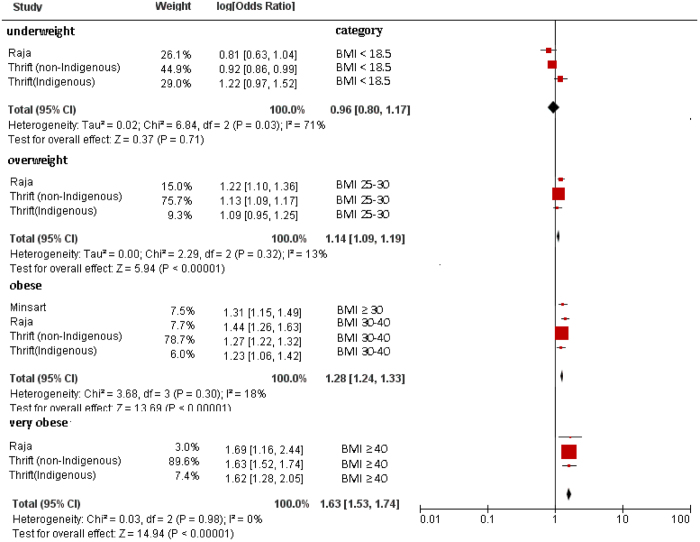
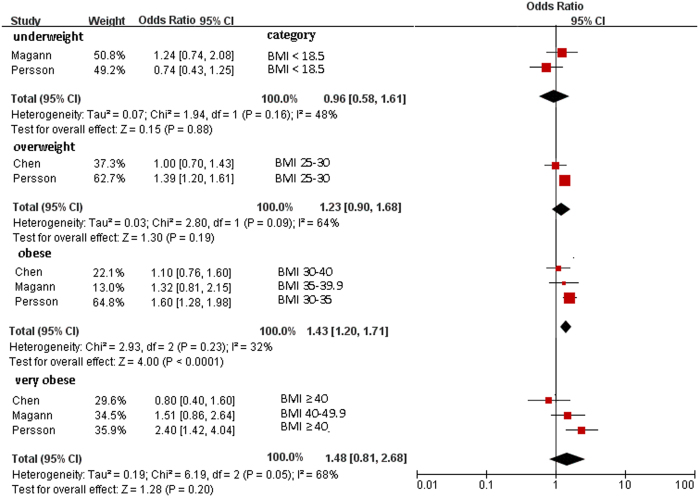
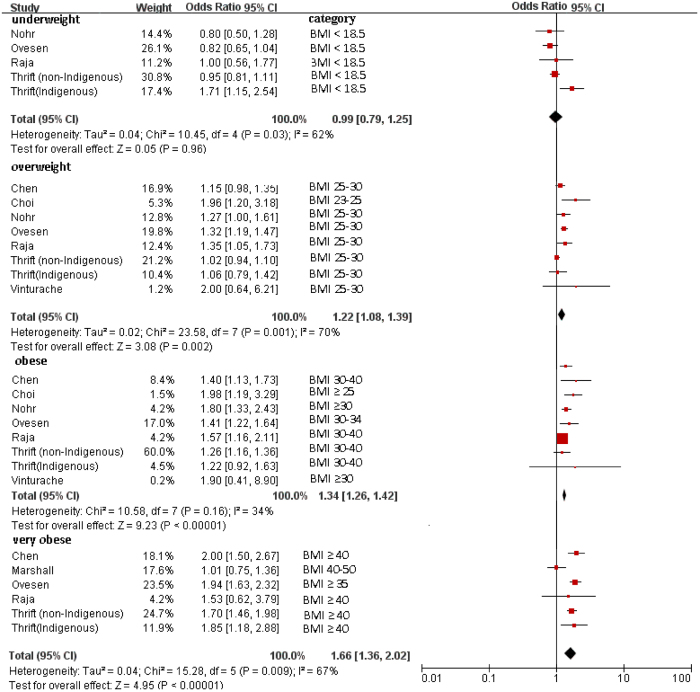
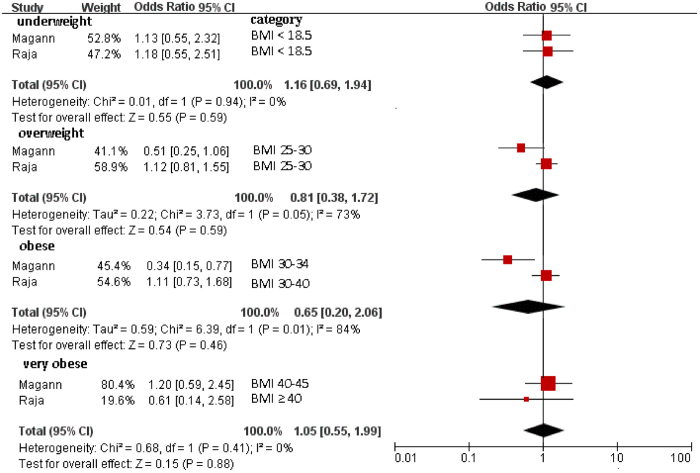
Previous results are inconsistent regarding the association between maternal obesity and Apgar score or cord pH in humans. The aim of this study was to investigate the association between maternal pre-pregnancy and pregnancy body mass index (BMI) and infant Apgar score or cord pH. We conducted a systematic review of studies published in English before 20 August 2015 using PubMed, EMBASE, and Cochrane Library. Eleven cohort studies with a total of 2,586,265 participants finally met our inclusion criteria. Pooled results revealed the following factors associated with Apgar score <7 at 5 minutes: overweight (odds ratio [OR] 1.13; 95% confidence interval [CI], 1.08-1.20), obese (OR 1.40; 95% CI, 1.27-1.54), and very obese (OR 1.71; 95% CI, 1.55-1.89). The pooled analysis also revealed that maternal overweight or obesity increased the risk for Apgar score <7 at 1 minute. There was no association between maternal BMI and neonatal cord pH. Thus, this study suggests that maternal overweight and obesity affect baby's condition immediately after birth in general. More studies are needed to confirm these results and detect the influence of variables across studies.
Figures
Similar articles
-
Metformin for women who are overweight or obese during pregnancy for improving maternal and infant outcomes.Cochrane Database Syst Rev. 2018 Jul 24;7(7):CD010564. doi: 10.1002/14651858.CD010564.pub2. Cochrane Database Syst Rev. 2018. PMID: 30039871 Free PMC article.
-
Pushing/bearing down methods for the second stage of labour.Cochrane Database Syst Rev. 2017 Mar 26;3(3):CD009124. doi: 10.1002/14651858.CD009124.pub3. Cochrane Database Syst Rev. 2017. PMID: 28349526 Free PMC article.
-
Safety of topical corticosteroids in pregnancy.Cochrane Database Syst Rev. 2015 Oct 26;2015(10):CD007346. doi: 10.1002/14651858.CD007346.pub3. Cochrane Database Syst Rev. 2015. PMID: 26497573 Free PMC article.
-
Pushing/bearing down methods for the second stage of labour.Cochrane Database Syst Rev. 2015 Oct 9;(10):CD009124. doi: 10.1002/14651858.CD009124.pub2. Cochrane Database Syst Rev. 2015. Update in: Cochrane Database Syst Rev. 2017 Mar 26;3:CD009124. doi: 10.1002/14651858.CD009124.pub3. PMID: 26451755 Updated.
-
Intermittent auscultation (IA) of fetal heart rate in labour for fetal well-being.Cochrane Database Syst Rev. 2017 Feb 13;2(2):CD008680. doi: 10.1002/14651858.CD008680.pub2. Cochrane Database Syst Rev. 2017. PMID: 28191626 Free PMC article.
Cited by
-
Plant viral proteins and fibrillarin: the link to complete the infective cycle.Mol Biol Rep. 2021 May;48(5):4677-4686. doi: 10.1007/s11033-021-06401-1. Epub 2021 May 25. Mol Biol Rep. 2021. PMID: 34036480 Review.
-
Maternal Pre-pregnancy Body Mass Index Categories and Infant Birth Outcomes: A Population-Based Study of 9 Million Mother-Infant Pairs.Front Nutr. 2022 Feb 17;9:789833. doi: 10.3389/fnut.2022.789833. eCollection 2022. Front Nutr. 2022. PMID: 35252291 Free PMC article.
-
Maternal prepregnancy overweight/obesity increase the risk of low Apgar scores in twins: a population-based cohort study in China.Front Pediatr. 2025 Jan 17;12:1412975. doi: 10.3389/fped.2024.1412975. eCollection 2024. Front Pediatr. 2025. PMID: 39895986 Free PMC article.
-
Cumulative evidence for association of rhinitis and depression.Allergy Asthma Clin Immunol. 2021 Oct 24;17(1):111. doi: 10.1186/s13223-021-00615-5. Allergy Asthma Clin Immunol. 2021. PMID: 34689833 Free PMC article. Review.
-
Obesity and gynaecological and obstetric conditions: umbrella review of the literature.BMJ. 2017 Oct 26;359:j4511. doi: 10.1136/bmj.j4511. BMJ. 2017. PMID: 29074629 Free PMC article.
References
-
- World Health Organization (WHO). Obesity and overweight: WHO. Fact sheet no. 311 (2013). Available at: www.who.int/mediacentre/ factsheets/fs311/en/ (Accessed April 17, 2014).
-
- Sekhavat L. & Fallah R. Could maternal pre-pregnancy body mass index affect Apgar score? Arch Gynecol Obstet. 287, 15–18 (2013). - PubMed
Publication types
MeSH terms
LinkOut - more resources
Full Text Sources
Other Literature Sources
Medical
Miscellaneous
