


BMI changes in adolescents treated with bupropion SR for smoking cessation
- PMID: 26692579
- PMCID: PMC4688900
- DOI: 10.1002/oby.21360
BMI changes in adolescents treated with bupropion SR for smoking cessation
Abstract
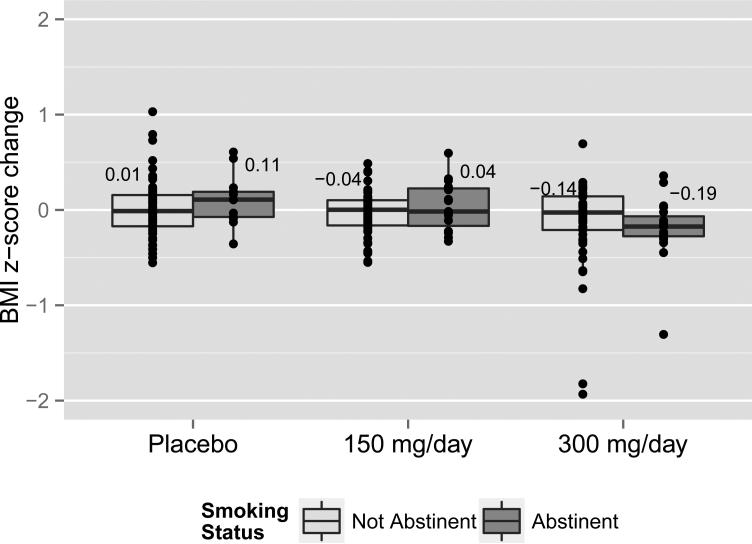
Objective: Adolescent overweight and obesity and smoking continue to be very important health challenges because of their lasting effects on overall health. Weight gain after smoking cessation is a barrier to quitting as well as a negative consequence to health. This study reports changes in the body mass index (BMI) z-scores of adolescent smokers participating in a dose-ranging clinical trial of bupropion SR (150 mg/day and 300 mg/day) for smoking cessation.
Methods: A total of N = 296 adolescent smokers (placebo n = 100, 150 mg/day n = 101, 300 mg/day n = 95) with a BMI z-score of 0.5 (sd: 1.4), 0.5 (sd: 1.3), and 0.5 (sd: 1.2) in the placebo, 150 mg/day, and 300 mg/day groups, respectively, were followed for 6 months.
Results: Adolescents in the 300 mg/day group had a significant reduction in BMI z-score 6 weeks after quitting (β = -0.16, CI = (-0.29, -0.04), P-value = 0.01). This result was not sustained at the 6-month follow-up.
Conclusions: A reduction in BMI z-score during smoking cessation with bupropion has important implications for the future of adolescent smoking cessation. These results are particularly relevant for adolescents who have either overweight or obesity or who have reservations about quitting for fear of gaining weight or BMI.
© 2015 The Obesity Society.
Figures
References
-
- Kann L, Kinchen S, Shanklin SL, Flint KH, Kawkins J, Harris WA, et al. Youth risk behavior surveillance--United States, 2013. Morbidity and mortality weekly report Surveillance summaries (Washington, DC : 2002) 2014;63(Suppl 4):1–168. Epub 2014/06/12. PubMed PMID: 24918634. - PubMed
-
- Freedman DS, Mei Z, Srinivasan SR, Berenson GS, Dietz WH. Cardiovascular risk factors and excess adiposity among overweight children and adolescents: the Bogalusa Heart Study. The Journal of pediatrics. 2007;150(1):12–7. e2. Epub 2006/12/26. doi: 10.1016/j.jpeds.2006.08.042. PubMed PMID: 17188605. - PubMed
-
- Pronk NP, Anderson LH, Crain AL, Martinson BC, O'Connor PJ, Sherwood NE, et al. Meeting recommendations for multiple healthy lifestyle factors. Prevalence, clustering, and predictors among adolescent, adult, and senior health plan members. American journal of preventive medicine. 2004;27(2 Suppl):25–33. Epub 2004/07/28. doi: 10.1016/j.amepre.2004.04.022. PubMed PMID: 15275671. - PubMed
Publication types
MeSH terms
Substances
Grants and funding
LinkOut - more resources
Full Text Sources
Other Literature Sources
Medical
Research Materials
