Review
. 2015 Oct;10(10):1540-4.
doi: 10.4103/1673-5374.167747.

Delayed peripheral nerve repair: methods, including surgical 'cross-bridging' to promote nerve regeneration

Affiliations
Review

Delayed peripheral nerve repair: methods, including surgical 'cross-bridging' to promote nerve regeneration

Tessa Gordon et al. Neural Regen Res. 2015 Oct.

Erratum in

Abstract

Despite the capacity of Schwann cells to support peripheral nerve regeneration, functional recovery after nerve injuries is frequently poor, especially for proximal injuries that require regenerating axons to grow over long distances to reinnervate distal targets. Nerve transfers, where small fascicles from an adjacent intact nerve are coapted to the nerve stump of a nearby denervated muscle, allow for functional return but at the expense of reduced numbers of innervating nerves. A 1-hour period of 20 Hz electrical nerve stimulation via electrodes proximal to an injury site accelerates axon outgrowth to hasten target reinnervation in rats and humans, even after delayed surgery. A novel strategy of enticing donor axons from an otherwise intact nerve to grow through small nerve grafts (cross-bridges) into a denervated nerve stump, promotes improved axon regeneration after delayed nerve repair. The efficacy of this technique has been demonstrated in a rat model and is now in clinical use in patients undergoing cross-face nerve grafting for facial paralysis. In conclusion, brief electrical stimulation, combined with the surgical technique of promoting the regeneration of some donor axons to 'protect' chronically denervated Schwann cells, improves nerve regeneration and, in turn, functional outcomes in the management of peripheral nerve injuries.

Keywords: Schwann cells; axon regeneration; electrical nerve stimulation; nerve regeneration; nerve repair; peripheral nerve injury.


Figures
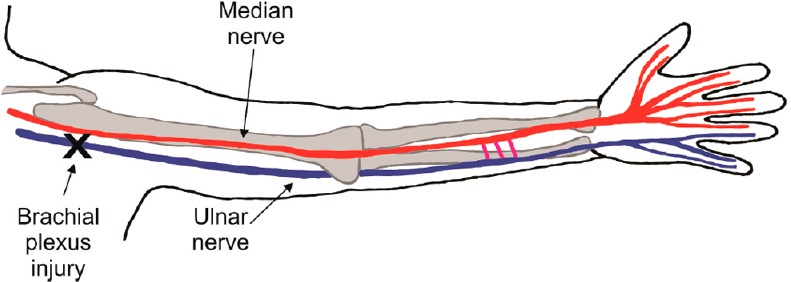
Figure 1
Figure 1
Brachial plexus injuries in adults. Injured nerves must regenerate over long distances to reinnervate targets such as denervated muscle and sensory targets in the hand. At a regeneration rate of 1mm/day in humans, as much as an 800 day delay may be incurred for axons to regenerate over a distance of a metre from the injury site to the denervated targets in the hand. Reinnervation of the hand almost never occurs even after surgical nerve repair in these situations.
Figure 2
Figure 2
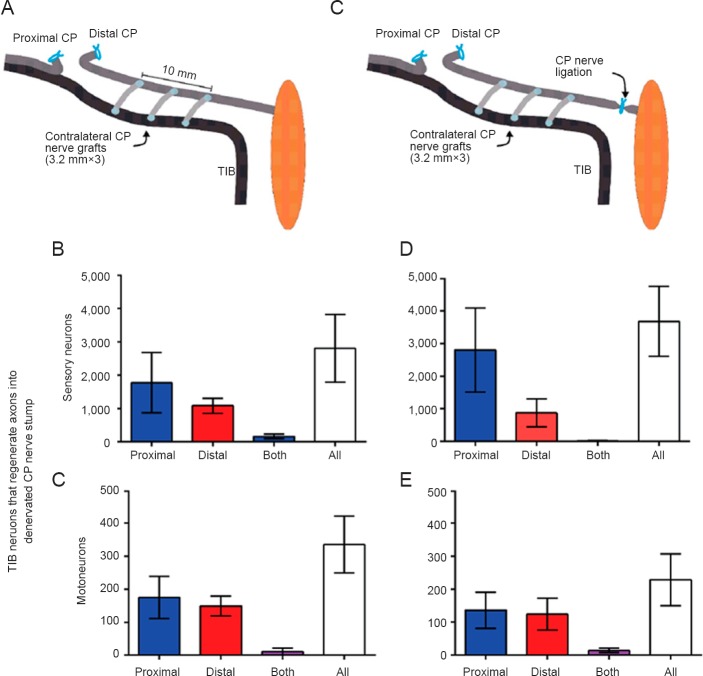
Experimental rat model of securing 3 side-to-side 3.2 mm long autologous common peroneal nerve cross-bridges (dissected from the contralateral hindlimb) between 500 μm perineurial windows cut into a donor intact tibial (TIB) nerve and a recipient denervated common peroneal (CP) distal nerve stump. The sterile surgery was performed under halothane anesthesia. Either the CP nerve stump remained in continuity with denervated flexor musculature in 12 rats (A) or the continuity was interrupted in 6 rats by cutting and ligating the nerve to eliminate possible retrograde neurotrophic influences from the denervated targets (C). Three months later, retrograde dyes, rubyred and fluorogold, were each applied to the CP nerve stump 5 mm either side of the cross-bridges for one hour, again under halothane anesthesia and using sterile technique. A week later, the dorsal root ganglia and spinal cord were removed to enumerate the backlabelled neurons that had regenerated their axons in transverse sections of the spinal cord and dorsal root ganglia. Irrespective of whether the distal nerve stump (A) remained in continuity with the denervated muscles and sensory targets or (C) the continuity was interrupted by cutting and ligating the nerve to eliminate possible retrograde neurotrophic influence(s) from the denervated targets, equal numbers of TIB (B, D) sensory and (C, E) motor neurons regenerated axons across the bridges and grew into the recipient denervated CP nerve stump either side of the cross-bridges. Very few grew in both directions, the axons growing either proximal or distal to the bridges within the recipient CP nerve stump. The data are expressed as the mean ± SE.
Figure 3
Figure 3
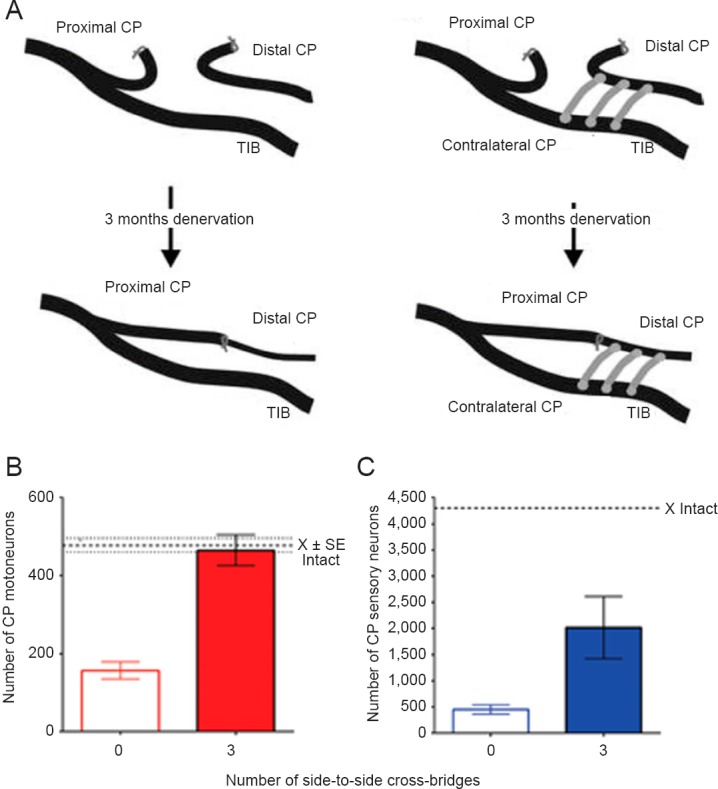
Regeneration of the axons of common peroneal (CP) motoneurons and sensory neurons was compared after delayed surgical coaptation of the proximal and distal nerve stumps (nerve repair) under halothane anesthesia and using aseptic technique when no (0) and 3 autologous CP cross-bridges were placed between the donor tibial (TIB) nerve and the recipient denervated CP nerve stump 3 months prior to the surgical repair. (A) The number of CP motoneurons (B) and sensory neurons (C) that regenerated their axons through chronically CP denervated nerve stumps was increased by a factor of 3 by ‘protection’ of the nerve stumps with TIB axons that regenerated through the cross-bridges into the recipient denervated CP nerve stump. The heavy dotted lines in B and C represent the mean number of CP neurons that project axons into the intact CP nerve. The light dotted lines in B show the SE of the mean number of motoneurons that normally send axons into the intact CP nerve. The data are expressed as the mean ± SE, the stars representing a significant increase with 3 bridges as compared to 0 bridges (P < 0.01) (n = 6 for each of the bars in the histograms plotted in B and C).
Figure 4
Figure 4
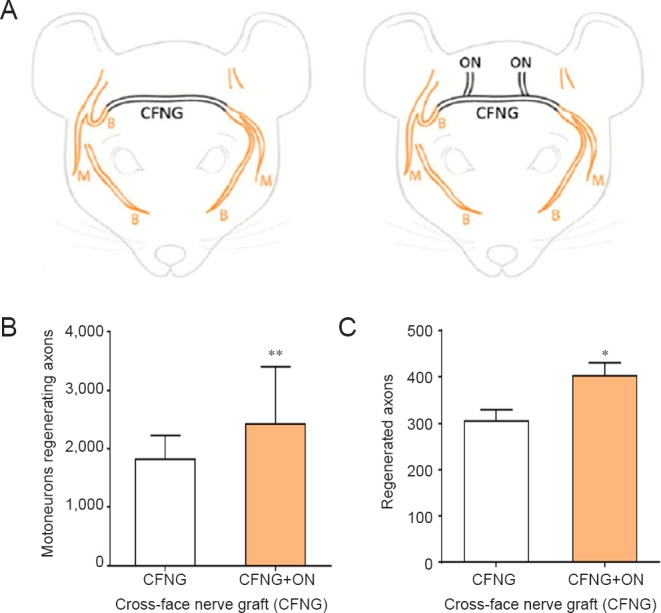
Insertion of 2 sensory neurons in an end-to-side fashion into a denervated nerve stump improves the regeneration of axons through the nerve stump. (A) Under halothane anesthesia and using aseptic technique, sensory occipital nerves were coapted end-to-side to the 30 mm long cross-face common peroneal nerve graft (CFNG) that connected the proximal stump of the transected right buccal branch of the facial nerve and the distal stumps of the transected left buccal and marginal mandibular branches. The motoneurons that regenerated their axons into the two left branches were backlabelled by exposing the two branches 10 mm distal to the CFNG to fluorogold and rubyred retrograde dyes for one hour, 16 weeks after the first surgery. (B) The number of motoneurons regenerating their axons across the CFNG was significantly increased after ‘protection’ of the chronically denervated distal facial nerve stump by the ingrowth of sensory neurons from the two sensory occipital nerves (ON) that were sutured to the side of the CFNG. (C) Regenerated axons enumerated from cross-sections of the buccal and marginal mandibular branches (taken ~11 mm distal to the CFNG), were also significantly increased in number when compared to the number of axons that regenerated through the unprotected distal stump of the facial nerve. The data are expressed as the mean ± SE, the stars representing a significant increase when sensory occipital nerves were coapted end-to-side (n = 12 for each of the CFNG and CFNG + ON groups; *P < 0.05; **P < 0.01).

References

    1. Al-Majed AA, Neumann CM, Brushart TM, Gordon T. Brief electrical stimulation promotes the speed and accuracy of motor axonal regeneration. J Neurosci. 2000;20:2602–2608. - PMC - PubMed
    1. Brushart TM, Hoffman PN, Royall RM, Murinson BB, Witzel C, Gordon T. Electrical stimulation promotes motoneuron regeneration without increasing its speed or conditioning the neuron. J Neurosci. 2002;22:6631–6638. - PMC - PubMed
    1. Elzinga K, Tyreman N, Ladak A, Savaryn B, Olson J, Gordon T. Brief electrical stimulation improves nerve regeneration after delayed repair in Sprague Dawley rats. Exp Neurol. 2015;269:142–153. - PubMed
    1. Fu SY, Gordon T. Contributing factors to poor functional recovery after delayed nerve repair: prolonged axotomy. J Neurosci. 1995a;15:3876–3885. - PMC - PubMed
    1. Fu SY, Gordon T. Contributing factors to poor functional recovery after delayed nerve repair: prolonged denervation. J Neurosci. 1995b;15:3886–3895. - PMC - PubMed

LinkOut - more resources