. 2016 Mar;37(3):301-7.
doi: 10.1002/humu.22946. Epub 2016 Jan 12.

Weaver Syndrome-Associated EZH2 Protein Variants Show Impaired Histone Methyltransferase Function In Vitro

Affiliations

Weaver Syndrome-Associated EZH2 Protein Variants Show Impaired Histone Methyltransferase Function In Vitro

Ana S A Cohen et al. Hum Mutat. 2016 Mar.

Abstract

Weaver syndrome (WS) is a rare congenital disorder characterized by generalized overgrowth, macrocephaly, specific facial features, accelerated bone age, intellectual disability, and susceptibility to cancers. De novo mutations in the enhancer of zeste homolog 2 (EZH2) have been shown to cause WS. EZH2 is a histone methyltransferase that acts as the catalytic agent of the polycomb-repressive complex 2 (PRC2) to maintain gene repression via methylation of lysine 27 on histone H3 (H3K27). Functional studies investigating histone methyltransferase activity of mutant EZH2 from various cancers have been reported, whereas WS-associated mutations remain poorly characterized. To investigate the role of EZH2 in WS, we performed functional studies using artificially assembled PRC2 complexes containing mutagenized human EZH2 that reflected the codon changes predicted from patients with WS. We found that WS-associated amino acid alterations reduce the histone methyltransferase function of EZH2 in this in vitro assay. Our results support the hypothesis that WS is caused by constitutional mutations in EZH2 that alter the histone methyltransferase function of PRC2. However, histone methyltransferase activities of different EZH2 variants do not appear to correlate directly with the phenotypic variability between WS patients and individuals with a common c.553G>C (p.Asp185His) polymorphism in EZH2.

Keywords: EZH2; H3K27; Weaver syndrome; childhood cancer; histone methyltransferase.


Figures

Figure 1
Figure 1
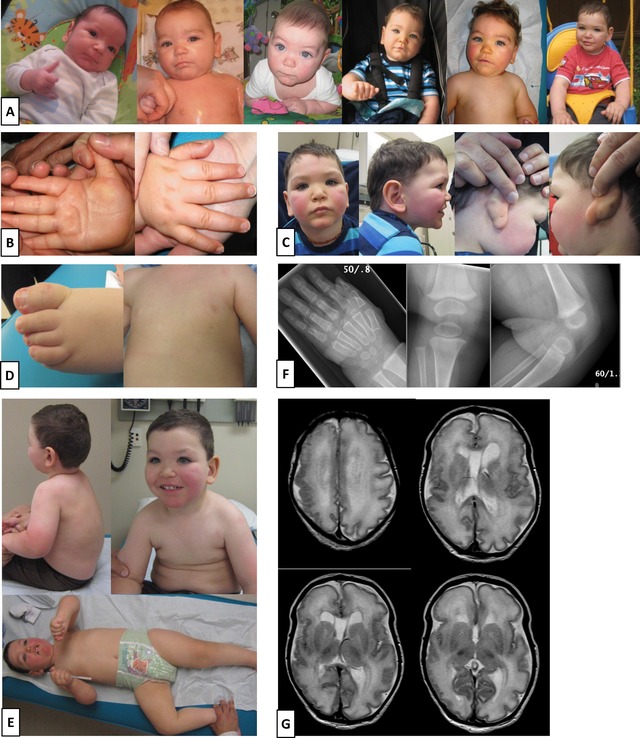
Weaver syndrome proband with polymicrogyria described in this study. A: Proband 5 is shown at 2, 4, 6, 8, 12, and 19 months. B: Both sides of the hand are shown at 12 months to illustrate the prominent palmar crease. C: At 27 months, face with prominent rosy cheeks, profile and ears are shown to confirm the dimple is only present behind the right ear. D: At 31 months, mild camptodactyly is seen on the toes and a third nipple is apparent. E: Full torso and full body are also shown at 31 months. F: X‐rays of the hand at 11½ months and the knee at 10½ months are indicative of advanced bone age. G: MRI done at 5 days of age illustrates asymmetric perisylvian polymicrogyria.
Figure 2
Figure 2
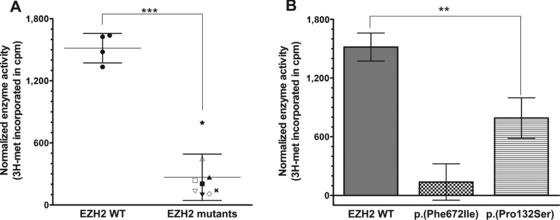
Weaver syndrome mutants are impaired in their histone methyltransferase activity in vitro. Histone methyltransferase reactions were performed using 2 μg purified core histones and 0.67 μM 3H‐S‐adenosyl‐methionine (3H‐SAM). Each reaction was incubated with 250 ng of either wild‐type (WT) or a mutant HMTase complex (or no enzyme controls). Histone methyltransferase activity was measured based on the incorporation of 3H‐labeled methyl groups, represented in scintillation counts per minute. Counts were normalized by subtracting background counts (i.e., no enzyme) from the total counts. A: Incorporation of tritiated methyl groups from 3H‐SAM onto core histones is shown for each complex: EZH2 WT , p.(Phe672Ile) ×, p.(Pro132Ser) , p.(Tyr153del) △, p.(His694Tyr) ▽, p.(Glu745Lys) ▴, p.(Ala682Thr) ▾, p.(Arg684Cys) ▪, p.(Tyr133Cys) □, and p.(Asp185His) ◇. Error bars represent standard deviation (SD) within the groups “EZH2 WT” and “EZH2 mutants.” Unpaired t‐test showed statistically significant difference between the two groups (P value < 0.0001). B: Incorporation of tritiated methyl groups from 3H‐SAM onto core histones is shown for the positive control EZH2 WT, the negative control EZH2 (p.Phe672Ile), and the mutant complex with activity closest to WT, namely, EZH2 (p.Pro132Ser). Error bars represent SD of four independent replicates for the controls, and three independent replicates for the mutant EZH2 (p.Pro132Ser). One‐way ANOVA showed statistically significant difference between all groups (overall P value < 0.0001; P values between WT and p.(Phe672Ile), between p.(Phe672Ile) and p.(Pro132Ser), and between WT and p.(Pro132Ser) were all <0.05).

References

    1. Al‐Salem A, Alshammari MJ, Hassan H, Alazami AM, Alkuraya FS. 2013. Weaver syndrome and defective cortical development: a rare association. Am J Med Genet A 161A:225–227. - PubMed
    1. Bodian DL, McCutcheon JN, Kothiyal P, Huddleston KC, Iyer RK, Vockley JG, Niederhuber JE. 2014. Germline variation in cancer‐susceptibility genes in a healthy, ancestrally diverse cohort: implications for individual genome sequencing. PLoS One 9:e94554. - PMC - PubMed
    1. Cha TL, Zhou BP, Xia W, Wu Y, Yang CC, Chen CT, Ping B, Otte AP, Hung MC. 2005. Akt‐mediated phosphorylation of EZH2 suppresses methylation of lysine 27 in histone H3. Science 310:306–310. - PubMed
    1. Coulter‐Mackie MB, Gagnier L. 2003. Spectrum of mutations in the arylsulfatase A gene in a Canadian DNA collection including two novel frameshift mutations, a new missense mutation (C488R) and an MLD mutation (R84Q) in cis with a pseudodeficiency allele. Mol Genet Metab 79:91–98. - PubMed
    1. Di Meglio T, Kratochwil CF, Vilain N, Loche A, Vitobello A, Yonehara K, Hrycaj SM, Roska B, Peters AHFM, Eichmann A, Wellik D, Ducret S, et al. 2013. Ezh2 orchestrates topographic migration and connectivity of mouse precerebellar neurons. Science 339:204–207. - PMC - PubMed

Publication types

MeSH terms

Substances

Supplementary concepts