


Mechanisms of Hepatitis C Viral Resistance to Direct Acting Antivirals
- PMID: 26694454
- PMCID: PMC4690891
- DOI: 10.3390/v7122968
Mechanisms of Hepatitis C Viral Resistance to Direct Acting Antivirals
Abstract
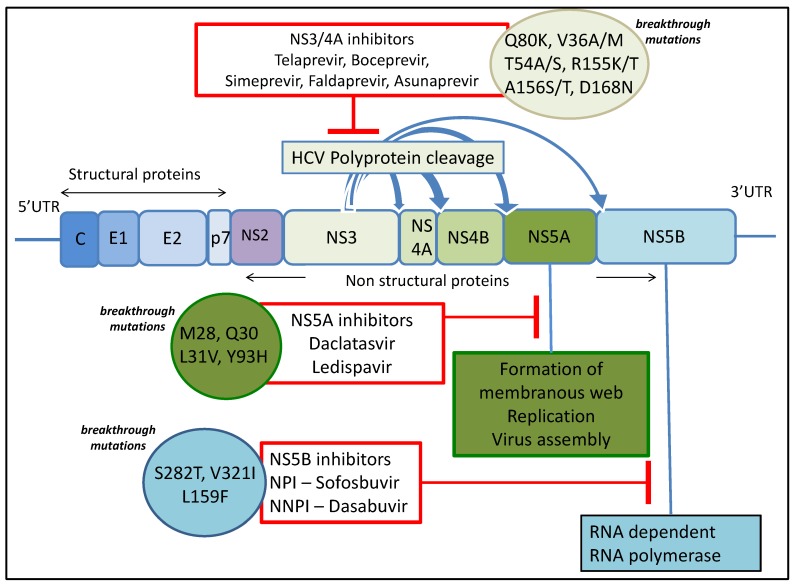
There has been a remarkable transformation in the treatment of chronic hepatitis C in recent years with the development of direct acting antiviral agents targeting virus encoded proteins important for viral replication including NS3/4A, NS5A and NS5B. These agents have shown high sustained viral response (SVR) rates of more than 90% in phase 2 and phase 3 clinical trials; however, this is slightly lower in real-life cohorts. Hepatitis C virus resistant variants are seen in most patients who do not achieve SVR due to selection and outgrowth of resistant hepatitis C virus variants within a given host. These resistance associated mutations depend on the class of direct-acting antiviral drugs used and also vary between hepatitis C virus genotypes and subtypes. The understanding of these mutations has a clear clinical implication in terms of choice and combination of drugs used. In this review, we describe mechanism of action of currently available drugs and summarize clinically relevant resistance data.
Keywords: breakthrough variants; direct acting antivirals; hepatitis C; resistance.
Figures
References
-
- World Health Organisation Hepatitis C. [(accessed on 29 September 2015)]. Available online: http://www.who.int/mediacentre/factsheets/fs164/en/
Publication types
MeSH terms
Substances
LinkOut - more resources
Full Text Sources
Other Literature Sources
