Review
. 2015 Dec 15:6:1376.
doi: 10.3389/fmicb.2015.01376. eCollection 2015.

In Metabolic Engineering of Eukaryotic Microalgae: Potential and Challenges Come with Great Diversity

Affiliations
Review

In Metabolic Engineering of Eukaryotic Microalgae: Potential and Challenges Come with Great Diversity

Javier A Gimpel et al. Front Microbiol. .

Abstract

The great phylogenetic diversity of microalgae is corresponded by a wide arrange of interesting and useful metabolites. Nonetheless metabolic engineering in microalgae has been limited, since specific transformation tools must be developed for each species for either the nuclear or chloroplast genomes. Microalgae as production platforms for metabolites offer several advantages over plants and other microorganisms, like the ability of GMO containment and reduced costs in culture media, respectively. Currently, microalgae have proved particularly well suited for the commercial production of omega-3 fatty acids and carotenoids. Therefore most metabolic engineering strategies have been developed for these metabolites. Microalgal biofuels have also drawn great attention recently, resulting in efforts for improving the production of hydrogen and photosynthates, particularly triacylglycerides. Metabolic pathways of microalgae have also been manipulated in order to improve photosynthetic growth under specific conditions and for achieving trophic conversion. Although these pathways are not strictly related to secondary metabolites, the synthetic biology approaches could potentially be translated to this field and will also be discussed.

Keywords: PUFA; biodiesel; biohydrogen; carotenoids; metabolic engineering; microalgae; photosynthesis; transformation.


Figures
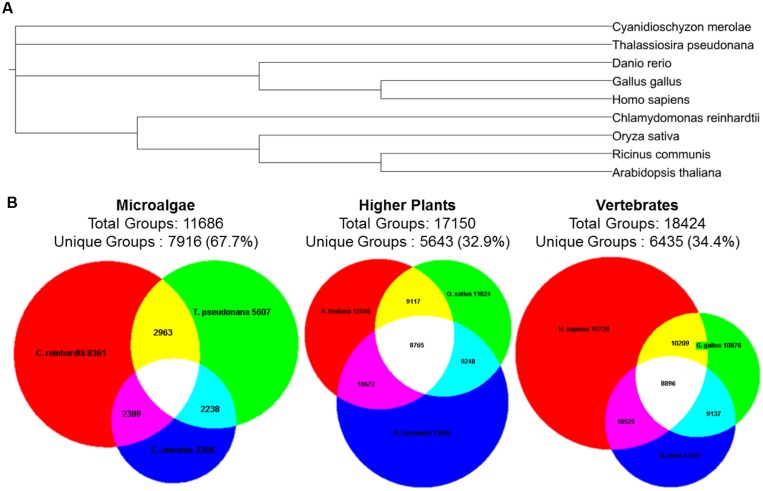
FIGURE 1
FIGURE 1
Diversity of protein ortholog groups in microalgae, higher plants, and vertebrates. (A) Phylogenetic tree of the selected species according to NCBI taxonomy. The tree was constructed using PhyloT and iTOL (Letunic and Bork, 2011). (B) Unique and shared groups of protein orthologs according to OrthoMCL database (Chen et al., 2006). The Venn diagrams were constructed using Euler3Applet (Chow and Rodgers, 2005). Common names for the species: Chlamydomonas reinhardtii (green alga, red circle); Thalassiosira pseudonana (diatom, green circle) Cyanidioschyzon merolae (red alga, blue circle); Arabidopsis thaliana (thale cress, red circle); Oryza sativa (rice, green circle); Ricinus communis (castor oil plant, blue circle); Homo sapiens (human, red circle); Gallus gallus (chicken, green circle); Danio rerio (zebrafish, blue circle).
FIGURE 2
FIGURE 2
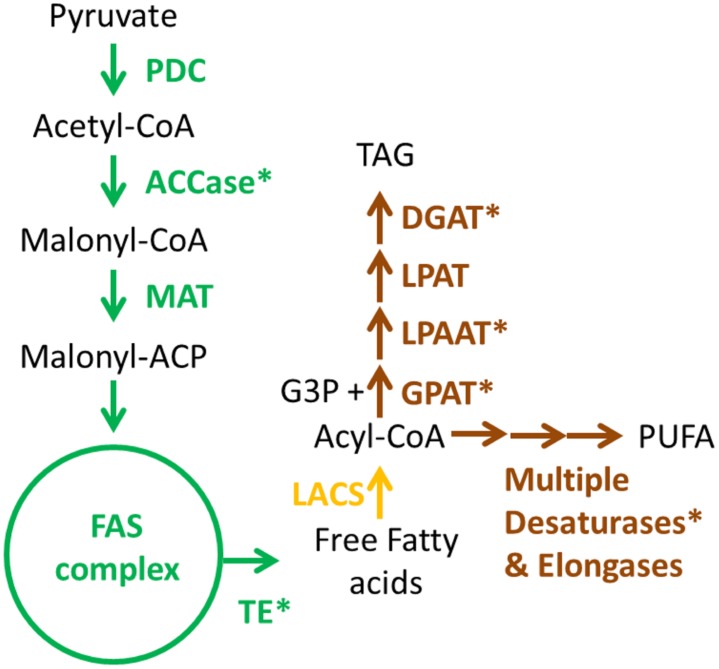
Simplified biosynthetic pathways for fatty acids (FAs), triacylglycerols (TAGs) and polyunsaturated FAs in green microalgae. Enzyme names are colored according to their localization. Green: plastid; Yellow: cytoplasm; Brown: endoplasmic reticulum. Asterisks denote enzymes which have been targeted for metabolic engineering, as shown in Table 1. PDC, pyruvate dehydrogenase complex; ACCase, acetyl-CoA carboxylase; MAT, malonyl-CoA/ACP transacylase; ACP, acyl-carrier protein; LACS, long-chain acyl-CoA synthetase; FAS, FA synthase; TE, fatty acyl-ACP thioesterase; GPAT, glycerol-3-phosphate acyltransferase; LPAAT, lyso-phosphatidic acid acyltransferase; LPAT, lyso-phosphatidylcholine acyltransferase; DGAT, diacylglycerol acyltransferase; CoA, coenzyme A; G3P, glycerate-3-phosphate; TAG, triacylglycerol; PUFA, polyunsaturated FA.
FIGURE 3
FIGURE 3
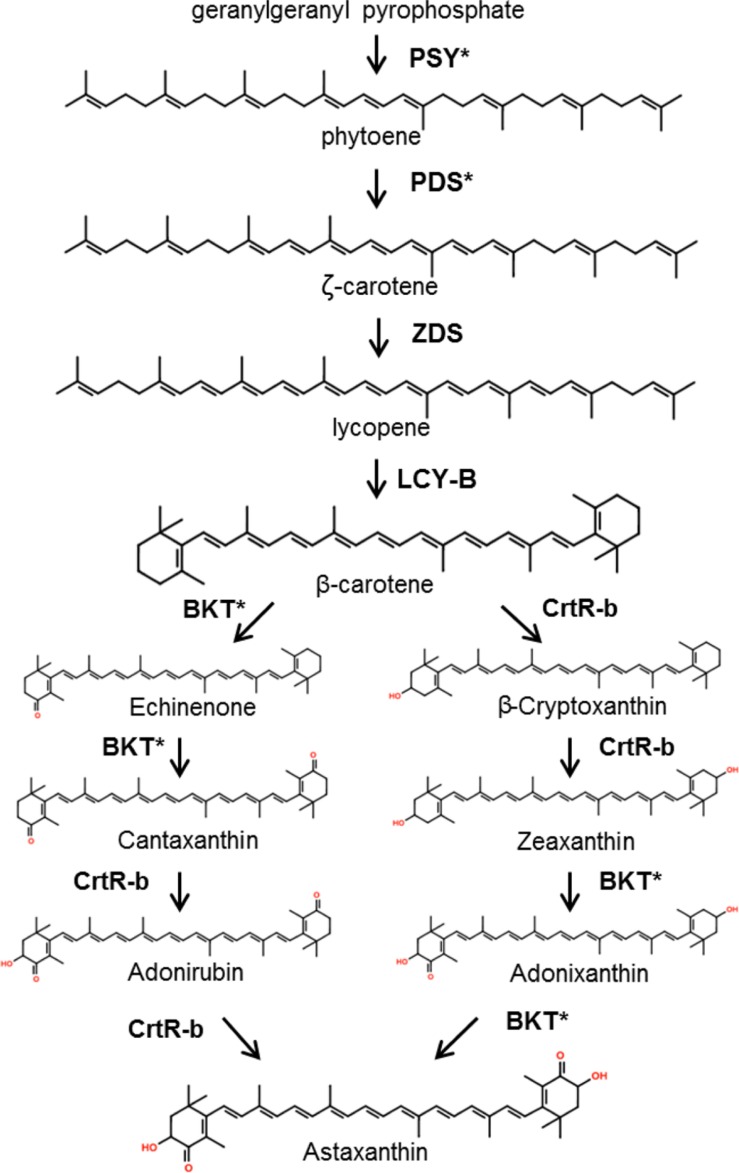
Proposed pathway for astaxanthin synthesis in green microalgae. Asterisks denote enzymes which have been targeted for metabolic engineering, as shown in Table 2. PSY, phytoene synthase; PDS, phytoene desaturase; ZDS, ζ-carotene desaturase; LYC-B, lycopene β-cyclase; BKT, β -carotene ketolase; CrtR-b, β-carotene hydroxylase. Modified from (Grünewald et al., 2001; Ye et al., 2008). Synthesis of β -carotene occurs in the chloroplast, while there is evidence that the subsequent steps could also take place in the cytoplasm (Grünewald et al., 2001; Guedes et al., 2011).
FIGURE 4
FIGURE 4
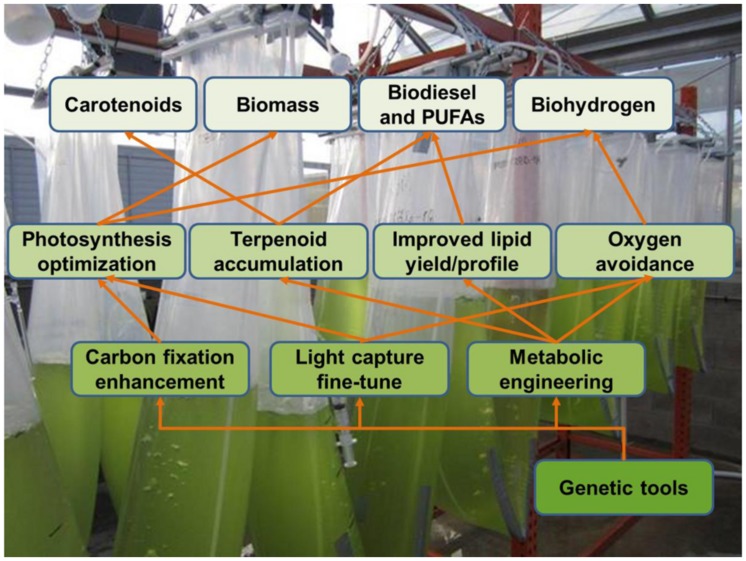
Contribution of microalgal genetic tools to enhance the production of secondary metabolites and biomass.

References

    1. Apt K. E., Allnutt F. T., Kyle D. J., Lippmeier J. C. (2011). Trophic Conversion of Obligate Phototrophic Algae Through Metabolic Engineering. Google Patents US Patent number 7939710 Washington, DC: U.S. Patent and Trademark Office.
    1. Baroukh C., Muñoz-Tamayo R., Steyer J.-P., Bernard O. (2015). A state of the art of metabolic networks of unicellular microalgae and cyanobacteria for biofuel production. Metab. Eng. 30 49–60. 10.1016/j.ymben.2015.03.019 - DOI - PubMed
    1. Beckmann J., Lehr F., Finazzi G., Hankamer B., Posten C., Wobbe L., et al. (2009). Improvement of light to biomass conversion by de-regulation of light-harvesting protein translation in Chlamydomonas reinhardtii. J. Biotechnol. 142 70–77. 10.1016/j.jbiotec.2009.02.015 - DOI - PubMed
    1. Beer L. L., Boyd E. S., Peters J. W., Posewitz M. C. (2009). Engineering algae for biohydrogen and biofuel production. Curr. Opin. Biotechnol. 20 264–271. 10.1016/j.copbio.2009.06.002 - DOI - PubMed
    1. Bellou S., Baeshen M. N., Elazzazy A. M., Aggeli D., Sayegh F., Aggelis G. (2014). Microalgal lipids biochemistry and biotechnological perspectives. Biotechnol. Adv. 32 1476–1493. 10.1016/j.biotechadv.2014.10.003 - DOI - PubMed