Review
. 2015 Dec 15:6:1394.
doi: 10.3389/fmicb.2015.01394. eCollection 2015.

Immune Evasion Mechanisms of Entamoeba histolytica: Progression to Disease

Affiliations
Review

Immune Evasion Mechanisms of Entamoeba histolytica: Progression to Disease

Sharmin Begum et al. Front Microbiol. .

Abstract

Entamoeba histolytica (Eh) is a protozoan parasite that infects 10% of the world's population and results in 100,000 deaths/year from amebic dysentery and/or liver abscess. In most cases, this extracellular parasite colonizes the colon by high affinity binding to MUC2 mucin without disease symptoms, whereas in some cases, Eh triggers an aggressive inflammatory response upon invasion of the colonic mucosa. The specific host-parasite factors critical for disease pathogenesis are still not well characterized. From the parasite, the signature events that lead to disease progression are cysteine protease cleavage of the C-terminus of MUC2 that dissolves the mucus layer followed by Eh binding and cytotoxicity of the mucosal epithelium. The host mounts an ineffective excessive host pro-inflammatory response following contact with host cells that causes tissue damage and participates in disease pathogenesis as Eh escapes host immune clearance by mechanisms that are not completely understood. Ameba can modulate or destroy effector immune cells by inducing neutrophil apoptosis and suppressing respiratory burst or nitric oxide (NO) production from macrophages. Eh adherence to the host cells also induce multiple cytotoxic effects that can promote cell death through phagocytosis, apoptosis or by trogocytosis (ingestion of living cells) that might play critical roles in immune evasion. This review focuses on the immune evasion mechanisms that Eh uses to survive and induce disease manifestation in the host.

Keywords: Entamoeba histolytica; apoptosis; immune evasion; phagocytosis; trogocytosis.


Figures
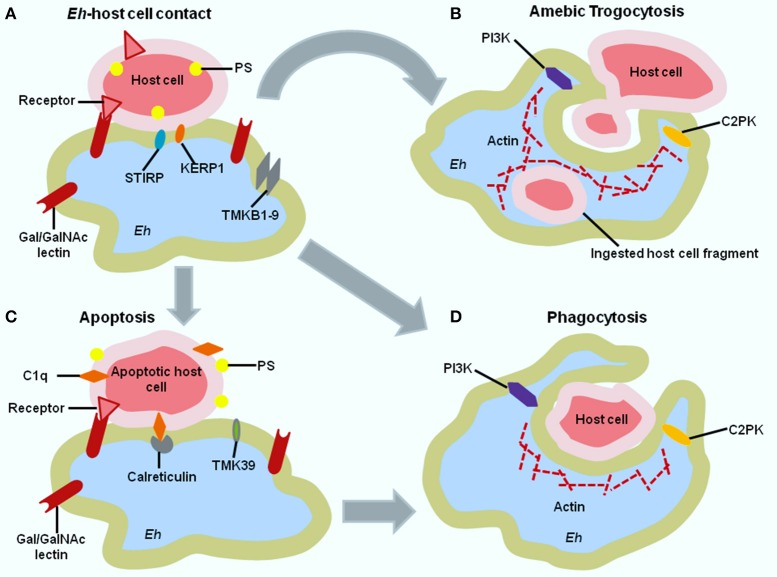
Figure 1
Figure 1
Immune evasion of E. histolytica (Eh) by host cell killing. (A) Contact between Eh and host cell is mediated by the Gal-lectin and host cell surface Gal and GalNAc receptors. Other amebic proteins involved in host cell attachment include the trans-membrane serine, threonine, and isoleucine proteins (STIRP) and transmembrane kinase family member TMKb1-9. After Eh-host contact, three events can take place-(B) amebic trogocytosis (C) apoptotic cell death (D) phagocytosis. In (B) larger cells undergo amebic trogocytosis. Amebic trogocytosis require PI3K and C2PK signal transduction for actin polymerization. (C) Host cells that have been induced to undergo apoptosis express phosphatidylserine (PS) and C1q complement protein that induce opsonization by ameba involving amebic calreticulin receptor. Finally, in (D) both apoptotically death cell and smaller cell undergo phagocytosis. Signal transduction for phagocytosis is also mediated by PI3K and EhC2PK and influences actin polymerization. PI3K-phosphoinositide 3 kinase, C2PK-C2 domain containing protein kinase, TMK39-Transmembrane kinase family member.

References

    1. Andrä J., Herbst R., Leippe M. (2003). Amoebapores, archaic effector peptides of protozoan origin, are discharged into phagosomes and kill bacteria by permeabilizing their membranes. Dev. Comp. Immunol. 27, 291–304. 10.1016/S0145-305X(02)00106-4 - DOI - PubMed
    1. Ankri S., Padilla-Vaca F., Stolarsky T., Koole L., Katz U., Mirelman D. (1999). Antisense inhibition of expression of the light subunit (35 kDa) of the Gal/GalNac lectin complex inhibits Entamoeba histolytica virulence. Mol. Microbiol. 33, 327–337. 10.1046/j.1365-2958.1999.01476.x - DOI - PubMed
    1. Becker S. M., Cho K.-N., Guo X., Fendig K., Oosman M. N., Whitehead R., et al. (2010). Epithelial cell apoptosis facilitates Entamoeba histolytica infection in the gut. Am. J. Pathol. 176, 1316–1322. 10.2353/ajpath.2010.090740 - DOI - PMC - PubMed
    1. Braga L. L., Ninomiya H., McCoy J. J., Eacker S., Wiedmer T., Pham C., et al. (1992). Inhibition of the complement membrane attack complex by the galactose-specific adhesion of Entamoeba histolytica. J. Clin. Invest. 90, 1131. 10.1172/JCI115931 - DOI - PMC - PubMed
    1. Bruchhaus I., Richter S., Tannich E. (1998). Recombinant expression and biochemical characterization of an NADPH: flavin oxidoreductase from Entamoeba histolytica. Biochem. J. 330, 1217–1221. 10.1042/bj3301217 - DOI - PMC - PubMed
