Review
. 2016:2016:1716341.
doi: 10.1155/2016/1716341. Epub 2015 Nov 30.

Bypassing Mechanisms of Mitochondria-Mediated Cancer Stem Cells Resistance to Chemo- and Radiotherapy

Affiliations
Review

Bypassing Mechanisms of Mitochondria-Mediated Cancer Stem Cells Resistance to Chemo- and Radiotherapy

Alex Lyakhovich et al. Oxid Med Cell Longev. 2016.

Abstract

Cancer stem cells (CSCs) are highly resistant to conventional chemo- and radiotherapeutic regimes. Therefore, the multiple drug resistance (MDR) of cancer is most likely due to the resistance of CSCs. Such resistance can be attributed to some bypassing pathways including detoxification mechanisms of reactive oxygen and nitrogen species (RO/NS) formation or enhanced autophagy. Unlike in normal cells, where RO/NS concentration is maintained at certain threshold required for signal transduction or immune response mechanisms, CSCs may develop alternative pathways to diminish RO/NS levels leading to cancer survival. In this minireview, we will focus on elaborated mechanisms developed by CSCs to attenuate high RO/NS levels. Gaining a better insight into the mechanisms of stem cell resistance to chemo- or radiotherapy may lead to new therapeutic targets thus serving for better anticancer strategies.


Figures
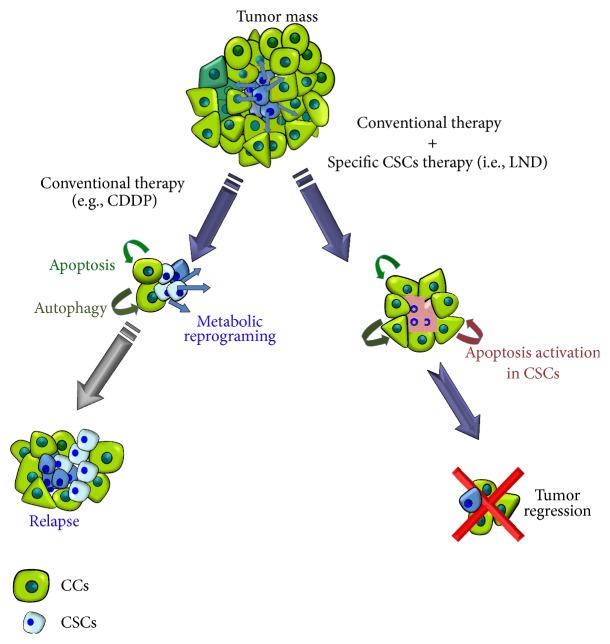
Figure 1
Figure 1
CSCs survival after chemo-/radiotherapy. The percentage of CSCs in a tumor varies depending on tumor type and tumor stage but generally comprises 0.5–5%. Most CCs in a tumor are killed after radiation or conventional chemotherapy (i.e., CDDP). The most important consequence of this is that although the tumor disappears in some cases (i.e., by image such us nuclear magnetic resonance), the percentage of CSCs has not diminished; quite the contrary it increased in proportion to the whole number of microscopically tumoral cells (reaching till 50% or more). CSCs left behind unaffected, due to their chemo- and radioresistance, eventually will experience metabolic reprograming to give rise to new CCs and CSCs, nesting the gap left by the tumor often with more aggressive phenotype. The cotreatment of conventional therapy with a more specific drug against CSCs (i.e., LND) in parallel will solve this problem.

References

    1. Plaks V., Kong N., Werb Z. The cancer stem cell niche: how essential is the niche in regulating stemness of tumor cells? Cell Stem Cell. 2015;16(3):225–238. doi: 10.1016/j.stem.2015.02.015. - DOI - PMC - PubMed
    1. Leal J. A., Feliciano A., Lleonart M. E. Stem cell MicroRNAs in senescence and immortalization: novel players in cancer therapy. Medicinal Research Reviews. 2013;33(1):112–138. doi: 10.1002/med.20246. - DOI - PubMed
    1. Mitra A., Mishra L., Li S. EMT, CTCs and CSCs in tumor relapse and drug-resistance. Oncotarget. 2015;6(13):10697–10711. - PMC - PubMed
    1. Hassan H. T. c-Kit expression in human normal and malignant stem cells prognostic and therapeutic implications. Leukemia Research. 2009;33(1):5–10. doi: 10.1016/j.leukres.2008.06.011. - DOI - PubMed
    1. Studer L., Vera E., Cornacchia D. Programming and reprogramming cellular age in the era of induced pluripotency. Cell Stem Cell. 2015;16(6):591–600. doi: 10.1016/j.stem.2015.05.004. - DOI - PMC - PubMed

Publication types

LinkOut - more resources
